

More news on this day
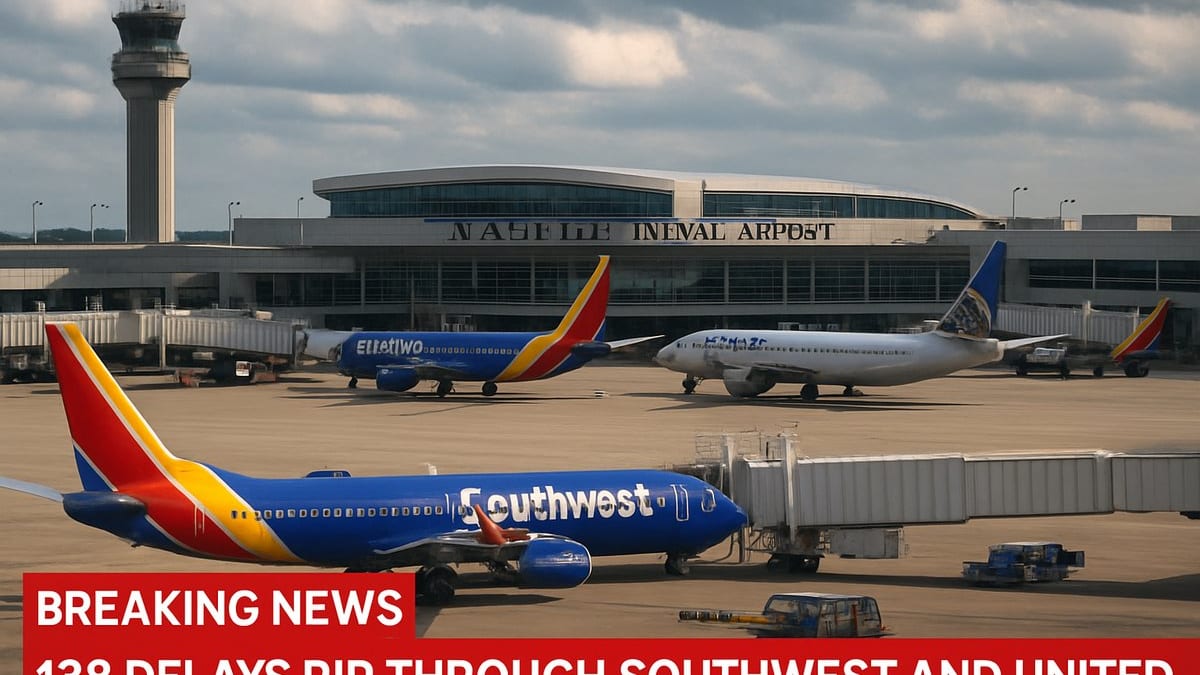
Travelers moving through Nashville International Airport on April 4 faced a bruising day of disruption, with around 138 delayed flights rippling across Southwest and United schedules and straining one of the country’s fastest-growing mid‑sized hubs.
Get the latest news straight to your inbox!
Heavy Delays Hit a Key Southern Hub
Publicly available flight tracking data for April 4 indicates that Nashville International Airport saw a sharp spike in late departures and arrivals, centered on services operated by Southwest Airlines and United Airlines. While BNA regularly handles periods of congestion, the number of affected flights on Friday stood well above normal patterns for this time of year.
Operational data for recent weeks shows Southwest running a dense schedule out of Nashville, with up to nearly 200 daily departures systemwide and a broad mix of regional and cross‑country flights touching the Tennessee capital. United, which uses Nashville as a feeder point into its hub network, contributes fewer departures but connects large numbers of passengers through its bases in Chicago, Denver and Houston. When disruption starts at BNA, those connections can quickly unravel across multiple time zones.
By late afternoon, the delays had cascaded through the day’s operations, leaving some flights running significantly behind schedule while others held close to on time. Passengers reported longer than expected waits at gates, tight or missed connections at onward hubs and difficulty rebooking during peak afternoon and evening travel windows.
The timing of the disruption, at the tail end of the workweek, increased the impact. Friday is one of the busiest days for Nashville’s airport, serving both business travelers heading home and leisure travelers starting weekend trips or early spring journeys to beach and mountain destinations.
Weather, Congestion and Network Knock‑On Effects
Weather has been an intermittent challenge for Tennessee and surrounding states through late winter and early spring, with a series of strong systems recently sweeping through the region. While conditions at Nashville on April 4 were not as severe as the major storms that hit parts of the United States earlier in the season, even moderate rain, low visibility or nearby convective activity can tighten air traffic control spacing and slow ground operations.
Published historical studies of Nashville International Airport show that both summer thunderstorms and winter weather contribute to delay spikes for carriers such as Southwest, with April standing out as a month where delays can climb as traffic grows faster than capacity. When the airport is already running close to its limits, relatively minor slowdowns in departure flows or ramp movements can quickly lead to a queue of aircraft waiting for takeoff or a shortage of open gates for arriving flights.
The disruption at BNA also fed into wider network effects. Southwest relies on tight turns and high aircraft utilization, so a delay departing Nashville can cause the same aircraft to arrive late into another city, push back behind schedule on its next leg, and continue propagating lateness across several flights. United faces similar pressures when delays at Nashville cause travelers to miss onward connections at its major hubs, forcing rebookings onto later flights that may already be near capacity.
As the day progressed, this combination of weather‑related constraints, ground congestion and knock‑on network impacts appears to have been a primary driver of the elevated delay totals seen on both carriers.
What Travelers Experienced at BNA
Reports from recent travelers and publicly shared accounts indicate that the passenger experience at Nashville during busy periods can shift quickly from smooth to strained when operations falter. Crowding at security checkpoints, longer walks in expanded concourses and tight time windows for connections can all compound the stress of a delay notice on a departure screen.
Several travelers transiting BNA in recent weeks have highlighted that when Southwest or United flights run late, gate areas can fill rapidly and seat availability on alternative departures becomes scarce. Given Southwest’s point‑to‑point model and United’s banked hub operations, a missed connection out of Nashville can mean hours of additional wait time, or in some cases an unplanned overnight stay if subsequent flights are fully booked.
On days like April 4, when dozens of services are running behind schedule, airport concessions and seating areas often become de facto waiting rooms as passengers attempt to charge devices, monitor flight status updates and adjust ground transportation or hotel bookings. Families traveling with small children or those connecting from international services into domestic flights can be particularly affected by uncertainty around departure times.
Despite those challenges, some travelers have noted in recent public discussions that security processing at Nashville has generally remained manageable during the current federal funding and staffing debates that have raised concerns at other U.S. airports. The primary pain points on disruptive days tend to be at the gate and in the airfield environment rather than at the initial checkpoint.
Why Nashville’s Growth Magnifies Disruptions
Nashville International Airport has spent the past several years in rapid expansion, with new concourses, additional gates and an upgraded international arrivals facility reflecting the city’s surge in tourism and corporate growth. Financial and planning documents from the airport authority show steadily rising passenger volumes and a strong presence from low‑cost and legacy carriers alike, with Southwest maintaining a significant share of overall traffic alongside Delta, American and United.
That success, however, also means that on heavy travel days BNA operates near the upper limits of its current capacity. Taxiways, ramp space and runway configurations must juggle a wide mix of regional jets, narrow‑body aircraft and occasional wide‑body services, leaving little slack when unscheduled disruptions appear. In this environment, a burst of delays affecting 138 flights on two major airlines is enough to be felt across the entire terminal complex.
Analysts who track airline performance data note that high‑growth mid‑continent airports like Nashville can be particularly vulnerable to cascading disruption because they function as both origin‑and‑destination markets and connection points. When local passengers, inbound visitors and connecting travelers all share the same constrained gate and runway capacity, small operational issues can become large headaches for multiple carriers simultaneously.
Recent on‑time performance statistics for Southwest flights touching Nashville illustrate the delicate balance. Many routes post solid records over multi‑month periods, but average delay times in the range of 15 to 25 minutes remain common on busier services. On a day when weather or staffing tightens margins, those averages can quickly spike.
What Passengers Can Do on High‑Delay Days
For travelers with upcoming trips through Nashville on Southwest or United, aviation and consumer advocates generally recommend treating days of elevated disruption as a prompt to build extra resilience into itineraries. That can include choosing longer connection times when possible, booking earlier departures to preserve recovery options later in the day, and monitoring flight status closely starting 24 hours before departure.
Publicly available airline policies outline that both Southwest and United allow same‑day changes or rebooking options in certain disruption scenarios, particularly when delays are substantial or when official travel waivers are issued during storms or major operational events. Passengers who can adjust travel plans proactively, such as moving to a morning departure ahead of forecasted afternoon storms, may avoid the worst of the congestion.
At the airport level, allowing additional time to navigate parking, check‑in and security at BNA can create a margin that helps absorb moderate delays without triggering missed flights or connections. Travelers who rely on ride‑share or highway routes that are prone to rush‑hour slowdowns often factor in both road and airport variability when planning their departure from home or office.
While the April 4 disruption at Nashville is notable for the number of flights affected across two major airlines, it also reflects broader trends in a U.S. aviation system that is operating close to capacity in many markets. As Nashville continues to grow as both a destination and connecting point, days like this underscore the importance for carriers, airports and travelers to anticipate and manage the ripple effects of even modest operational shocks.