

More news on this day
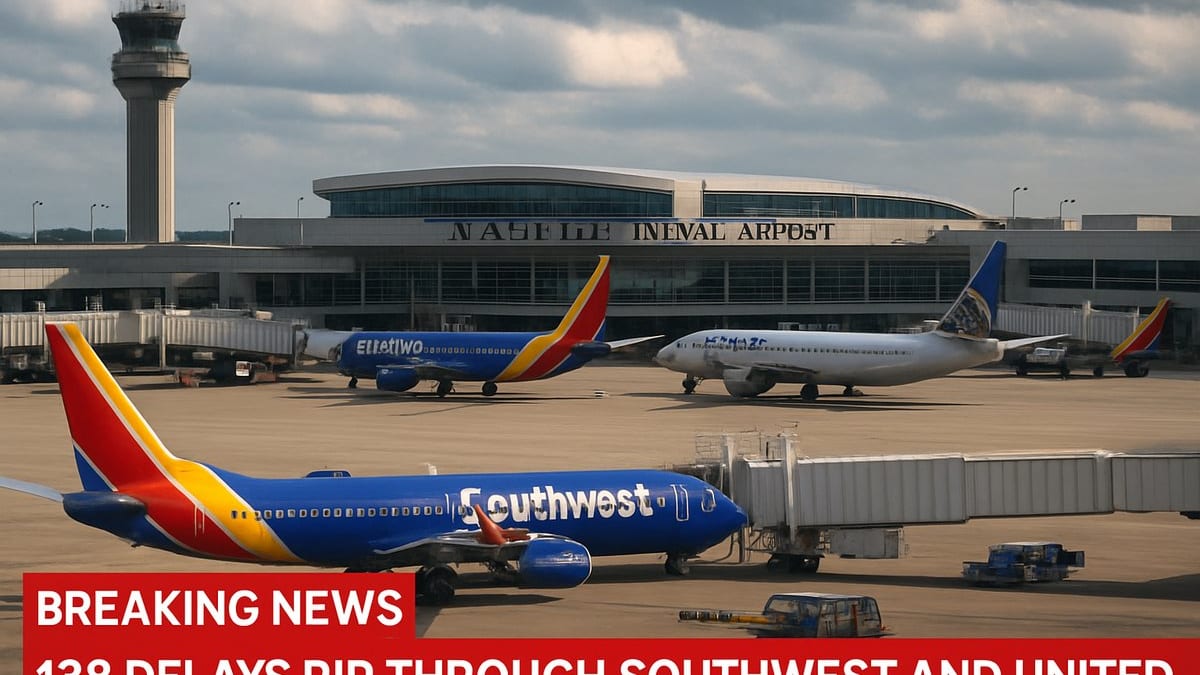
Spring travelers moving through Nashville International Airport faced an unusually rough day as a fresh wave of operational disruption translated into 138 flight delays tied to Southwest Airlines and United Airlines, rippling through schedules and leaving many passengers racing to rebook or reroute plans across the country.
Get the latest news straight to your inbox!
A Spike in Delays Hits a Growing Hub
Publicly available tracking data on April 4 indicated that Nashville International Airport recorded well over one hundred flight delays, with Southwest and United among the most affected carriers. A combined 138 late departures and arrivals were linked to those two airlines, according to real time delay dashboards that aggregate airline and airport performance. The disruptions were concentrated over peak travel periods, tightening bottlenecks at check-in counters, gate areas and security checkpoints.
The timing is particularly sensitive for Nashville. The airport has been growing aggressively in recent years, adding gates and reshaping its concourses to accommodate higher passenger volumes. Financial and traffic filings from the Metropolitan Nashville Airport Authority show that Southwest has emerged as BNA’s dominant carrier, while United maintains a smaller but strategically important presence focused on connections to its hubs. That mix means operational issues at even a handful of gates can quickly spill across the terminal.
Reports from passenger forums and local travel communities described crowded concourses and extended waits as rebookings stacked up. Many travelers attempting to connect through Nashville reported missed onward flights when delays stretched beyond an hour, forcing overnight stays or reroutes through other hubs.
Operational Pressures on Southwest and United
Industry coverage this week has highlighted broad system strain across major U.S. airlines, with Southwest and United both showing elevated delay counts across multiple airports. National roundups of April disruptions point to Southwest experiencing several hundred late flights in a single day across its network, while United has recorded a comparable volume of delays and dozens of cancellations routed through its biggest hubs.
At Nashville, those national patterns converged with local constraints. Southwest’s point to point model relies on aircraft turning quickly between cities, and any schedule slippage earlier in the day can accumulate by the time planes cycle through Tennessee. Flight performance statistics for several Southwest routes touching BNA show average arrival delays in the range of 10 to 20 minutes over recent weeks. On days of heavier disruption, those modest averages mask extreme outliers, when weather challenges or congestion at other airports push individual flights back by more than an hour.
United, which feeds passengers through Nashville onto connecting banks at airports such as Chicago and Denver, is sensitive to delays propagating through its hub and spoke system. When inbound aircraft from those hubs arrive behind schedule, subsequent BNA departures can be forced into longer ground holds. On a day when the wider United network is already experiencing several hundred delays, even a relatively small station like Nashville can quickly feel the knock-on effects.
National Disruption Wave Magnifies Local Impact
The Nashville disruption did not occur in isolation. National travel coverage over the first days of April has documented a broad spike in flight delays at major U.S. airports, from Chicago to New York and Los Angeles. These reports attribute the turbulence to a mix of factors, including convective spring weather, ongoing air traffic control staffing challenges at particular facilities, and runway or airspace constraints that reduce arrival and departure rates.
On peak disruption days, carrier specific tallies have reached into the high hundreds of delayed flights for Southwest and United alone. When combined with other large airlines, that has meant thousands of late operations across the national system in a single 24 hour period. For passengers beginning or ending their journeys in Nashville, the result can be a cascade of revised departure times and aircraft swaps that are determined far from Tennessee but felt acutely at BNA’s gates.
Federal transportation statistics and previous winter weather events also illustrate how quickly Nashville can move from relatively smooth operations to top tier disruption. During an earlier severe weather episode covered by trade publications, BNA briefly ranked among the U.S. airports with the highest proportion of cancellations and delays. While the current disruption wave is more diffuse and less tied to a single storm system, the cumulative effect on passengers can be similar when multiple carriers are under strain.
What Travelers Experienced on the Ground
Firsthand accounts circulating on social platforms and travel forums on April 4 painted a picture familiar to frequent flyers on bad weather days, even though local skies in Nashville were not the only driver. Travelers reported boarding delays as crews awaited inbound aircraft, rolling departure times that shifted in 15 to 30 minute increments, and gate changes that forced last minute dashes across the expanded concourses.
Some passengers attempting to connect through Nashville on Southwest noted that slight schedule slippage earlier in the day erased comfortable layover buffers, leaving them with sprint level connections or missed flights. Others on United itineraries described how an initial delay departing a hub airport led to a domino effect, with missed regional links out of BNA and limited same day alternatives as seats filled up quickly.
Airport crowding also emerged as a recurring theme in traveler reports. Bottlenecks formed at customer service counters as passengers queued to request meal vouchers, hotel assistance or rebooking options, while security wait times fluctuated as heavier evening departure banks concentrated demand. Although some travelers reported relatively swift passage through screening, those arriving closer to departure found that even a moderate queue could become critical once their flights slipped behind schedule.
How Nashville Fliers Can Navigate Ongoing Volatility
With national data and recent coverage pointing to continued operational volatility across the major U.S. airlines, travelers using Nashville International Airport in the coming days and weeks may face similar, if smaller scale, disruptions. Consumer advocates and travel analysts consistently recommend building extra buffer time into itineraries during such periods, including longer layovers where possible and earlier arrivals at the airport to absorb unexpected lines or schedule changes.
Digital tools that track real time flight status and the location of inbound aircraft can be particularly helpful at an airport like BNA, where a large share of flights belong to a single carrier. By watching how a specific plane progresses on its earlier legs, passengers can gain an early sense of whether a departure will hold close to schedule or is likely to slip by an hour or more.
For Southwest and United customers affected by delays, published airline policies and recent regulatory actions underscore the importance of understanding what forms of compensation or accommodation may be available. Federal transportation dashboards comparing carriers on customer service commitments now highlight whether airlines provide meal vouchers or hotel support during significant controllable delays. While the particulars vary by situation, passengers who document their disruption and proactively engage with airline channels often report better outcomes.
As Nashville’s air traffic continues to grow, the events surrounding the 138 delays linked to Southwest and United at BNA serve as another reminder that localized disruptions are increasingly intertwined with the health of the broader U.S. flight network. For many travelers, planning with that bigger picture in mind may be the best defense against a future day of cascading delays.