

More news on this day
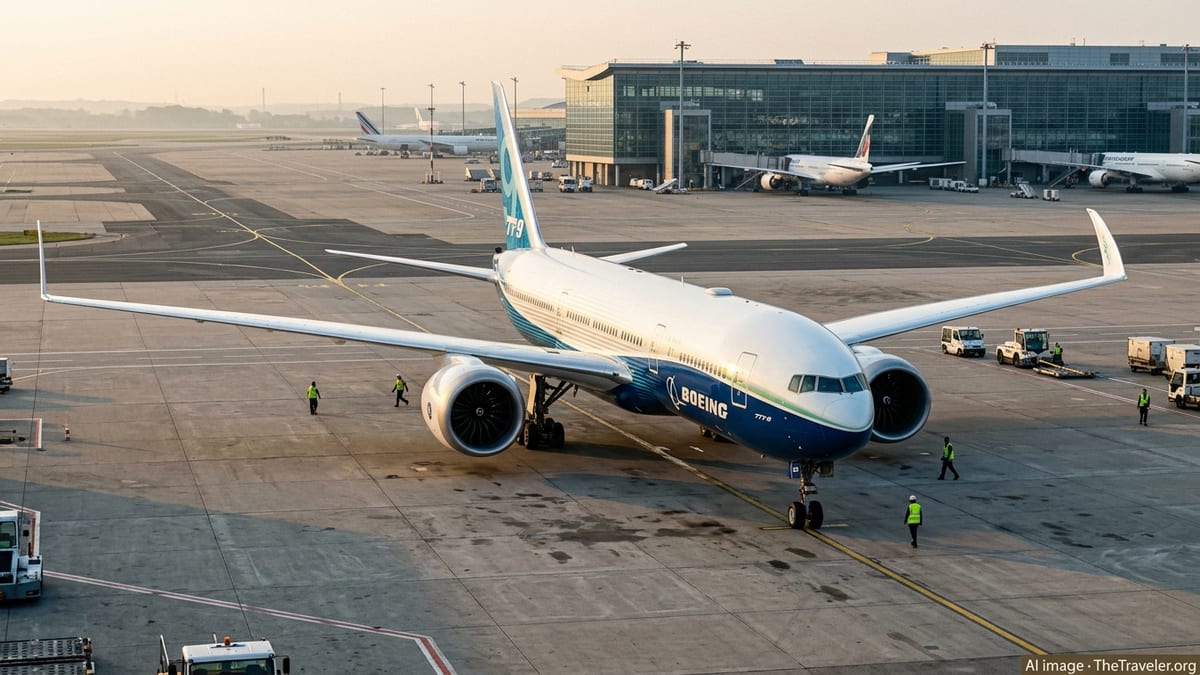
The Boeing 777-9, centerpiece of the long-delayed 777X program, has cleared the first segment of Phase 4 in its U.S. certification campaign, marking a fresh milestone on the path toward a projected 2027 entry into service that could redefine how travelers experience long-haul flights.
Get the latest news straight to your inbox!
Fresh Momentum in a Long, Complicated Certification Journey
Publicly available industry coverage indicates that the Federal Aviation Administration has now authorized Boeing to proceed with Phase 4A of the Type Inspection Authorization (TIA) flight-test campaign for the 777-9. Enthusiast and trade reporting describes this Phase 4A clearance as the first part of a broader Phase 4 systems and performance demonstration effort, building on earlier phases that focused on structural, envelope-expansion, and systems validation work.
The approval comes after several years of program turbulence, including design changes, a failed static test in 2019, and a series of schedule resets that pushed the 777-9 far beyond its originally targeted mid-2020s debut. U.S. regulatory scrutiny has also intensified across new-aircraft certifications, increasing the level of documentation, analysis, and test evidence required compared with earlier Boeing widebody programs.
Despite these setbacks, recent FAA documentation and Boeing program updates suggest a more orderly progression through the remaining phases of certification flight testing. Phase 4A clearance is being interpreted across the aviation community as a sign that major design issues are now understood and that remaining work is shifting toward detailed demonstrations and compliance verification rather than fundamental redesign.
With Phase 4A underway, focus turns to completing subsequent sub-phases of Phase 4 and the smaller, clean-up oriented Phase 5. Industry expectations now largely center on a first delivery and entry into service in 2027, following a type certificate that is anticipated to arrive in the mid-2026 timeframe if flight testing proceeds without major new obstacles.
What Phase 4A Means for Travelers, Not Just Engineers
While certification jargon can feel remote from everyday travelers, the work carried out in Phase 4A connects directly to the in-flight experience passengers will eventually see on the 777-9. This stage of testing concentrates on systems demonstrations under realistic operating conditions, including handling qualities, flight controls, high-lift systems, environmental controls, and the integration of advanced avionics. It is, in effect, the regulatory dress rehearsal for how the aircraft behaves on a typical airline mission.
For passengers, this translates into confidence that the aircraft’s new technologies are mature, predictable, and reliable over long-haul sectors. The 777-9’s composite folding wingtips, highly efficient GE9X engines, and revised flight-deck systems are all subject to close scrutiny across a wide range of altitudes, weights, and weather scenarios. These tests help ensure the aircraft can deliver both the range and payload that airlines have ordered while maintaining stringent safety margins.
The Phase 4A milestone also signals to airline customers and the wider market that the 777-9 program is entering its final, more predictable stretch. Airlines planning future route networks, cabin refits, and long-term fleet strategies can now align their schedules more closely with a narrowed certification and delivery window. For travelers, this increases the likelihood that new cabins and routes built around the 777-9 will materialize closer to their revised timetables.
Because certification phases are sequenced and interdependent, successful progression through 4A tends to reinforce confidence that subsequent sub-phases will move forward, provided no significant new technical or compliance findings emerge. That dynamic is helping reset the narrative around the 777-9 from uncertainty about “if” it will enter service, back toward questions of “when” and “where” travelers will first encounter it.
A 2027 Service Debut and the New Widebody Landscape
According to updated program timelines referenced in recent airline fleet planning documents and public reporting, the 777-9 is now expected to reach entry into service in early 2027. Lufthansa remains widely identified as the launch customer, while Emirates, Qatar Airways, and several other long-haul carriers retain significant orders. For these airlines, the aircraft’s timing has important implications for competitive positioning on key intercontinental routes.
The 777-9 is designed to seat more passengers than today’s 777-300ER while offering improved fuel burn per seat, extended range, and lower emissions relative to the aircraft it replaces. In a market shaped by the retirement of the Airbus A380 and older 747 variants, it is positioned as one of the largest new-generation passenger jets, occupying a niche for high-capacity, long-range operations between major global hubs.
By 2027, many airlines expect long-haul demand to be reshaped by renewed tourism flows, more flexible business travel, and growing connecting traffic through Middle Eastern and European hubs. The arrival of the 777-9 into that environment could influence how airlines structure their long-haul fleets, balancing smaller, point-to-point twinjets like the 787 and A350 against higher-capacity flagship aircraft for dense city pairs.
If the 2027 target holds, the 777-9 will also enter service in a more sustainability-conscious era, one in which airlines are measured not only on network breadth and onboard product, but also on emissions intensity and noise footprints near major airports. The aircraft’s advanced engines, aerodynamics, and greater seat density are intended to help airlines improve performance on these metrics while still offering expansive premium cabins.
Cabins, Passenger Comfort, and the Battle for the Long-Haul Crown
For travelers, the most visible impact of the 777-9 will be its cabins. One of the four 777-9 flight-test aircraft is configured with a full passenger interior and has already been used for environmental, systems, and acoustic trials. These tests help airlines and regulators understand how the aircraft’s size, fuselage structure, and systems translate into cabin noise levels, air quality, lighting performance, and thermal comfort over many hours aloft.
Airlines have signaled that the 777-9 will anchor next-generation long-haul products, with high-density premium cabins, more enclosed suites in business class, and increasingly sophisticated premium economy offerings. The aircraft’s wider cabin cross-section and long fuselage give airlines flexibility to combine large premium zones with efficient economy seating layouts, a factor that will shape how travelers perceive the aircraft compared with today’s 777-300ER and rival A350 variants.
As carriers gradually firm up interior plans ahead of delivery, the 777-9 is emerging as a contender for the informal title of “new king” of long-haul travel. Its success will hinge on whether airlines can translate the aircraft’s raw capacity and range into cabin experiences that feel more spacious and personalized than the high-density layouts that characterized some earlier widebodies.
For frequent flyers, the significance of the 777-9’s Phase 4A progress lies in what it makes possible three to four years from now: new nonstop city pairs, upgraded flagship routes, and cabins that blend privacy with scale. The path from test stand to seat map remains complex, but each completed certification phase narrows the gap between engineering milestone and passenger experience.
Airlines, Routes, and What Travelers Should Watch Next
As the 777-9 advances through its final certification stages, attention is increasingly turning to which carriers will deploy it first and on which routes. Public fleet disclosures and industry analysis suggest early deployments will likely concentrate on high-profile, long-haul trunk routes linking major hubs in Europe and the Middle East with North America and Asia-Pacific. These are the markets where airlines can best leverage the aircraft’s combination of capacity and range.
For travelers planning ahead to the late 2020s, the key signals to monitor will be airline schedule filings, network announcements, and cabin product reveals tied explicitly to the 777-9. As launch carriers finalize their delivery sequences, they are expected to showcase the aircraft on marquee routes where premium demand is strongest and where the marketing value of a new flagship type is greatest.
Within the industry, Phase 4A clearance is reinforcing confidence that these route and product decisions can move from tentative to concrete planning. While the 777-9 program has already experienced multiple delays, current public timelines point to a more defined runway toward certification and service entry than at any point in recent years.
For now, the aircraft remains in the test and certification phase, but the narrative around the 777-9 is shifting. With Phase 4A underway and a 2027 entry into service in sight, the long-haul travel market is beginning to prepare for a new widebody heavyweight, one that could shape the look and feel of intercontinental flying for the next two decades.