

More news on this day
Boeing is shifting the headquarters of its Defense, Space & Security division from suburban Washington to the factory complex outside St. Louis, a strategic realignment that places top executives back amid the assembly lines where fighter jets, trainers and unmanned aircraft are built.
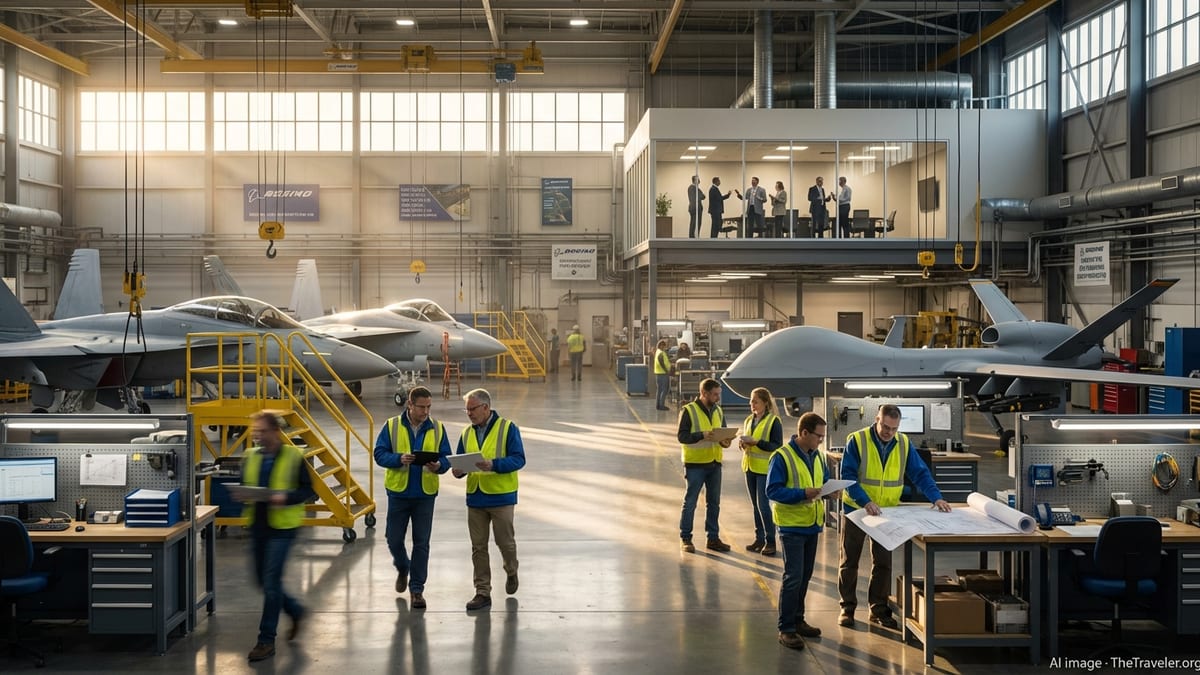
A Return to the Heartland for Boeing Defense Leadership
The aerospace giant confirmed this week that its Boeing Defense, Space & Security headquarters will relocate from Arlington, Virginia, to the St. Louis region, restoring a leadership base the company had maintained in Missouri from 1997 until 2017. The move effectively unwinds a near decade of Washington area centralization and signals that, for Boeing’s defense arm, proximity to production has again taken precedence over proximity to the Pentagon.
Senior executives framed the change as a deliberate attempt to put leaders closer to the more than 18,000 employees who design, assemble and support combat aircraft and weapons systems across Boeing’s sprawling campus in north St. Louis County and nearby facilities. By tightening the distance between conference rooms and the manufacturing floor, the company is betting it can speed decisions, strengthen quality control and better respond to both military customers and internal challenges.
The defense headquarters will operate from Boeing’s existing complex near St. Louis Lambert International Airport, where the company already manages engineering, prototyping, test and sustainment work. Corporate Boeing headquarters will remain in Arlington, separating the defense unit’s leadership from the company’s main executive offices but aligning it more closely with the day-to-day reality of production.
Company officials have not released a detailed timetable for the transition, but signaled that key leadership roles are already pivoting back to Missouri and that the realignment will be phased in to avoid disrupting ongoing programs.
Realigning Strategy Around the Factory Floor
Boeing’s defense chief executive, Steve Parker, has repeatedly emphasized a leadership philosophy that prizes visibility on the line and hands-on engagement with teams over distance management. The move back to St. Louis reinforces that approach, putting senior decision makers in the same buildings where aircraft fuselages are joined, avionics are installed and new concepts are prototyped.
Executives argue that closing the gap between headquarters and production allows them to identify bottlenecks earlier, intervene more quickly when quality issues arise and incorporate shop-floor feedback into design and scheduling decisions. In a defense environment where programs run on multi-billion-dollar contracts and tight delivery timelines, shaving days or weeks from internal decision making can carry significant financial and reputational consequences.
The shift also reflects Boeing’s broader effort to “stabilize and strengthen” its defense business after years of scrutiny on cost overruns, schedule delays and quality lapses across parts of its commercial and defense portfolio. By repositioning the center of gravity from an office tower in Northern Virginia to a manufacturing hub in the Midwest, the company is signaling that disciplined execution, not lobbying access, will be the benchmark for the next phase of its defense strategy.
While Boeing’s government relations and some senior corporate staff will remain in Arlington to maintain daily contact with policymakers and the Pentagon, defense leaders insist that core operational decisions will be anchored where jets roll out of hangars rather than where briefings are delivered.
What the Move Means for St. Louis and the Region
For the St. Louis region, the headquarters return is both symbolic and concrete. Symbolically, it restores the city’s status as the command center of one of the world’s largest defense manufacturers, reaffirming a legacy that stretches back through McDonnell Douglas and decades of military aircraft design and production in Missouri. Practically, it strengthens St. Louis as a national node of the United States defense industrial base at a time of heightened global security competition.
Regional economic and civic leaders have hailed the decision as a validation of the area’s skilled manufacturing workforce, supply chain and infrastructure. The designation bolsters a corridor that already includes key Boeing campuses in Berkeley and Hazelwood, advanced research and intelligence facilities, and nearby installations such as Scott Air Force Base across the Mississippi in Illinois.
The company has been investing billions of dollars in what it describes as some of the world’s most advanced combat aircraft production facilities in and around St. Louis. Those projects include new or upgraded buildings tailored for next-generation manufacturing techniques, high-security development spaces and test infrastructure designed for increasingly complex, software-rich aircraft and weapons.
City and state officials say the presence of a headquarters, not just manufacturing, tends to attract additional suppliers, professional services and high-wage engineering roles, magnifying the economic footprint beyond Boeing’s own payroll. The move is expected to solidify the region’s appeal as a magnet for aerospace talent at a time when many midwestern metros are competing to retain and recruit skilled workers.
Programs Anchored in the New Headquarters Hub
The St. Louis complex that will now serve as home base for Boeing Defense, Space & Security is already responsible for a roster of front-line U.S. and allied military systems. Among them are the F-15EX Eagle II, the latest evolution of the long-serving F-15 fighter; the T-7A Red Hawk advanced jet trainer for the U.S. Air Force; and the MQ-25 Stingray, the U.S. Navy’s first carrier-based unmanned aerial refueling aircraft.
Production and assembly for these aircraft are spread across multiple facilities in north St. Louis County and in nearby communities such as St. Charles, Missouri, and Mascoutah, Illinois. Components for Boeing’s 777X commercial aircraft, including folding wingtips and major control surfaces, also come out of the region’s plants, highlighting the crossover between the company’s commercial and defense supply chains.
Within the same campus, Boeing’s Phantom Works advanced prototyping organization maintains secure labs and test spaces focused on future platforms and classified projects. Virtual warfare centers on site allow military customers and Boeing engineers to simulate complex mission scenarios, test new concepts and refine tactics before aircraft and systems ever reach the field.
Bringing the defense headquarters back into this environment embeds leadership within a dense ecosystem of engineering, simulation and production activity. Executives contend that this proximity is particularly important as modern aircraft become more software-driven and reliant on integrated digital design tools, where misalignments between engineering, manufacturing and support can quickly ripple across programs.
Labor Relations and Workforce Stability After a Historic Strike
The headquarters announcement comes on the heels of a bruising labor dispute in the St. Louis region. In late 2025, more than 3,000 machinists represented by the International Association of Machinists and Aerospace Workers District 837 walked off the job, launching what became the longest strike in Boeing’s history. The stoppage, driven by demands for higher wages and improved benefits, stretched roughly 15 weeks before workers narrowly ratified a new three-year contract in November.
That agreement cleared a cloud of uncertainty over production schedules and future investment in the region. Executives and union leaders alike have characterized the subsequent months as an opportunity to reset relations and refocus on delivery commitments. By placing the defense headquarters back in St. Louis, Boeing is effectively committing its senior leadership to live with the daily consequences of that reset, for better or worse.
Union representatives have framed the headquarters move as recognition of the value of the local workforce, which combines legacy experience on long-running platforms with know-how on newer digital manufacturing methods. At the same time, they have underscored their expectation that closer leadership presence will translate into more attention to shop-floor concerns about safety, overtime and career development.
For Boeing, maintaining a stable, skilled workforce in St. Louis is essential to meeting rising global demand for combat aircraft and support services. The company is competing not only with other aerospace employers but also with advanced manufacturing firms across the Midwest, making pay, working conditions and career pathways central components of its long-term strategy.
Balancing Washington Access with Operational Focus
Relocating the defense headquarters away from the nation’s capital carries political and logistical implications. Boeing will no longer have its top defense executives based just minutes from the Pentagon and Capitol Hill, a convenience that has long been seen as advantageous in the government contracting world. Instead, the company is moving those offices roughly halfway across the country, relying on its remaining corporate presence in Arlington and frequent travel to preserve its influence and access.
Company officials argue that modern communications and regular executive rotations through Washington mitigate the need for a permanent headquarters there, especially when weighed against the gains of co-locating leaders with engineers and assembly crews. Government operations staff and some senior leaders will remain in Northern Virginia to manage daily interactions with defense officials and lawmakers.
Industry analysts note that Boeing’s defense realignment mirrors a broader shift among large manufacturers seeking to streamline sprawling corporate structures and bring decision making closer to operations. In an era when military customers are pressing contractors to deliver capabilities faster, at lower cost and with fewer technical missteps, organizational charts are being redrawn to shorten reporting lines and distribute authority more directly to program teams.
The separation of corporate and defense headquarters also offers Boeing some internal flexibility. While the Arlington base continues to anchor the company’s commercial and corporate strategy, St. Louis gains more autonomy to focus on defense priorities, from production ramp-ups to research investments, under a leadership team embedded in the industrial landscape.
Implications for the U.S. Defense Industrial Base
Boeing’s decision lands at a time of intense scrutiny of the U.S. defense industrial base, as the Pentagon grapples with supply chain vulnerabilities, workforce shortages and the demands of supporting allies in multiple theaters. Concentrating more leadership and investment in the American heartland is being read by some policymakers as a vote of confidence in domestic manufacturing hubs beyond the coasts.
Missouri officials have touted the headquarters return as a “win for the heartland,” arguing that it strengthens not only their state’s economy but also national resilience. By embedding a major defense headquarters amid production facilities rather than in a distant financial or political center, they contend, critical skills and capabilities are less likely to diffuse or atrophy.
For other regions, the move underscores the competition to attract and retain large defense employers. States and cities across the country have used incentives, workforce programs and infrastructure investments to court aerospace and defense firms. Boeing’s latest realignment suggests that, while policy environment matters, proximity to deep manufacturing talent pools and established facilities may ultimately carry more weight.
At the same time, the shift raises questions about how defense contractors balance regional loyalties and political expectations with purely operational considerations. As Boeing doubles down on St. Louis, other communities will be watching closely to see whether the move translates into new contracts, sustained hiring and long-term commitments, or whether it is one step in a continuing cycle of geographic repositioning.
What Comes Next for Boeing Defense
Looking ahead, Boeing is positioning the St. Louis headquarters as a platform for both stability and innovation. Ongoing investments in new production lines, digital engineering tools and high-security development spaces are meant to support not just current programs, but also future aircraft and weapons concepts that may define U.S. airpower in the 2030s and beyond.
Executives have hinted at a more distributed leadership model in which senior defense leaders regularly rotate through other major Boeing sites, from the Pacific Northwest to Oklahoma and Alabama, while still reporting into a St. Louis base. That approach is designed to keep headquarters grounded in the realities of multiple factory floors, not just one.
For employees, the headquarters relocation introduces a period of transition but also an opportunity to shape the culture and priorities of the renewed St. Louis command center. As teams absorb new leaders and reporting lines, the test will be whether the promised benefits of faster decisions, clearer accountability and a stronger voice for the shop floor materialize in day-to-day work.
For the broader defense and travel sectors, the move underscores a continuing trend: major industrial players are rethinking where leadership belongs, how closely it should sit to the machines and people that drive performance, and which cities will define the next chapter of the aerospace age.