

More news on this day
Bohai Ferry Group has listed its Chinese Taishan cruise ship, also known as Taishan, for sale at an asking price understood to be around 23 million US dollars, in a move that highlights the Chinese operator’s strategic shift away from independently operated cruise services and back toward its core roll-on/roll-off ferry and logistics business.
Get the latest news straight to your inbox!
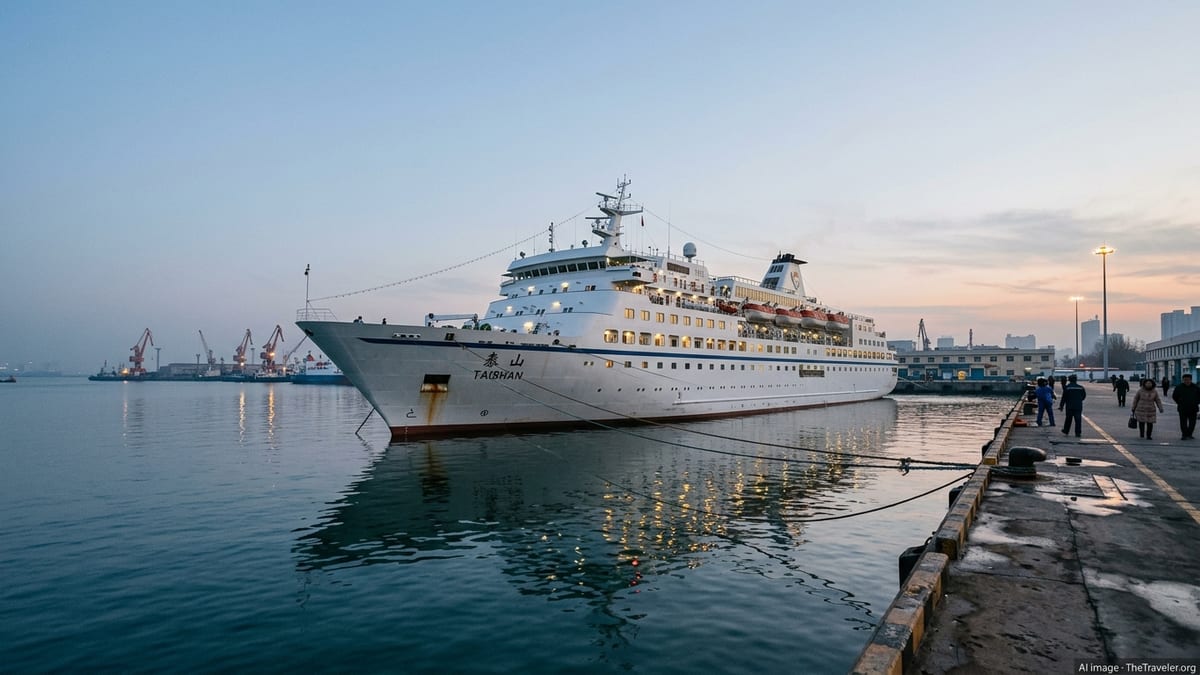
Sale of Chinese Taishan Marks an Exit from Stand-Alone Cruising
Publicly available industry sale-and-purchase data indicate that Bohai Ferry Group has placed Chinese Taishan on the market at approximately 23 million dollars, positioning the 1999-built vessel at the lower end of today’s global cruise ship price spectrum for mainstream tonnage. The figure reflects both the age of the ship and the still-recovering nature of the cruise market after several disrupted years.
Chinese Taishan, a 25,000-gross-ton ship with capacity for around 900 passengers, was acquired by Bohai Ferry from Costa Crociere in 2014 and rebranded for regional deployment from Chinese ports. The current listing effectively brings that chapter to a close, drawing a line under a decade-long experiment in offering dedicated cruise itineraries alongside the company’s extensive ferry network.
Reports from shipbrokers and cruise trade sources describe the Taishan listing as part of a broader restructuring of Bohai Ferry’s asset portfolio. Rather than reinvesting heavily in upgrading or redeploying the ship, the group appears to be prioritizing vessels that can serve multiple roles, including passenger and vehicle transport, cargo, and shorter tourism-focused sailings that complement its existing network in northern China.
The prospective sale also signals a recognition that operating a single, aging cruise ship in isolation from a larger fleet can struggle to deliver the economies of scale now common among global cruise brands. For Bohai Ferry, the economics increasingly favor focusing on high-frequency ferry routes and more versatile tonnage in the Bohai Rim region.
From Costa Voyager to Chinese Taishan: A Ship with a Storied Past
Before entering Chinese service, the ship now known as Chinese Taishan sailed under several identities, including Olympic Voyager and Grand Voyager, for European operators. Originally built for Royal Olympic Cruises and later sailing for Carnival Corporation subsidiaries, the vessel became known for its relatively high cruising speed and compact size compared with today’s mega-ships.
In 2011 the ship was operating for Costa Crociere as Costa Voyager, serving mainly Mediterranean and Red Sea itineraries. Industry records show that Bohai Ferry bought the vessel in 2014 for just under 44 million dollars, roughly double the figure it is now seeking, underscoring how secondhand cruise ship values have softened, particularly for older and smaller units.
Renamed Chinese Taishan, the ship was positioned as a pioneering locally branded cruise product, homeporting in cities such as Yantai and Dalian for itineraries to South Korea, Japan, and occasionally Taiwan. Marketing at the time emphasized accessibility for first-time Chinese cruisers, with shorter sailings and pricing tailored to the domestic leisure market.
Over time, however, the ship’s modest scale, dated onboard product, and limited cabin mix became more pronounced disadvantages as newer and larger vessels entered the Chinese market through international joint ventures and emerging domestic brands. By the mid-2020s, Chinese Taishan was no longer at the forefront of the country’s cruise ambitions, gradually shifting to a marginal role in regional tourism.
Strategic Refocus on Ferries and Flexible Passenger Tonnage
Bohai Ferry Group is best known in China for its extensive network of roll-on/roll-off services linking ports around the Bohai Gulf. The company moves millions of passengers and large volumes of vehicles and freight annually, and this segment remains structurally important for regional mobility and trade.
Corporate disclosures and sector analyses suggest that the group is now concentrating investment on vessels that can deliver both transport and tourism functions. These include modern ro-ro passenger ships that can serve as overnight ferries, seasonal tourist cruisers, or even short international links without the higher fixed costs and hotel-style operations associated with full-time cruise ships.
The divestment of Chinese Taishan fits into this pattern. Selling the dedicated cruise ship frees capital for newbuild ferry projects and potential hybrid designs that combine cabins, car decks, and leisure facilities. This approach aligns more closely with Bohai Ferry’s infrastructure, route structure, and expertise, while still allowing the group to tap into growing domestic tourism along China’s coasts and islands.
Analysts who track Asia’s ferry and short-sea sectors note that operators such as Bohai Ferry are positioning themselves to benefit from increasing regional travel, particularly where sea links compete favorably with air and rail on price, convenience, or the appeal of a slower, scenic journey.
Chinese Cruise Market Rebuilds with New Players and Larger Ships
The listing of Chinese Taishan comes at a time when China’s broader cruise sector is gradually rebuilding, but on different foundations than when Bohai Ferry entered the market a decade ago. Recent transactions show a clear tilt toward larger, more modern ships operated by dedicated cruise brands, often with state-backed financing or joint ventures.
Over the past two years, several former Costa and Carnival ships have been acquired by Chinese-linked operators for refurbishment and redeployment, including vessels now tied to Tianjin-based and Shanghai-based cruise companies. Parallel to these secondhand purchases, new domestically branded ships purpose-built for the Chinese market have entered service, reflecting long-term confidence in cruise demand but with an emphasis on scale and contemporary amenities.
Against this backdrop, a relatively small, late-1990s vessel like Chinese Taishan appears less aligned with the direction of the market. While it may still find a buyer for niche operations or deployment in another region, it no longer matches the aspirational positioning of China’s emergent cruise brands, which are targeting younger, increasingly experienced travelers familiar with global standards.
For Bohai Ferry, exiting the stand-alone cruise segment now reduces exposure to an arena dominated by much larger fleets and heavy marketing spend. The company can still benefit indirectly from the cruise rebound by providing feeder services, port access, and regional connectivity that support the broader tourism ecosystem.
What the Taishan Sale Means for Regional Tourism and Shipping
The potential sale of Chinese Taishan is unlikely to diminish northern China’s attractiveness as a cruise region, but it does illustrate how operators are recalibrating their strategies. Ports such as Tianjin, Qingdao, and Dalian are positioning themselves to welcome larger international and locally branded cruise ships while relying on ferry operators to handle shorter, high-frequency passenger movements.
Chinese Taishan’s withdrawal from Bohai Ferry’s fleet may open space at some terminals for newer cruise tonnage and refocus marketing efforts around integrated journeys, where travelers combine ferry segments with land-based itineraries. In this context, Bohai Ferry’s network could play a supporting role, delivering passengers to gateway cities where larger cruises begin or end.
For international observers, the Taishan listing offers a case study in how early movers in China’s cruise market are reshaping their portfolios after a turbulent period. Instead of persisting with a stand-alone legacy ship, Bohai Ferry is opting to double down on its strengths in ferry and ro-ro logistics, while the cruise segment is increasingly dominated by specialized operators with newer fleets.
Whether Chinese Taishan is acquired by another Asian company, redeployed in a different region, or ultimately sent for conversion or scrap will depend on market sentiment and regulatory considerations. Whatever the outcome, the sale underscores a clear message: in China’s evolving maritime tourism landscape, scale, specialization, and strategic focus now matter more than pioneer status alone.