

More news on this day
An anonymous bomb threat email sent to Hyderabad’s Rajiv Gandhi International Airport on Saturday prompted a full precautionary security sweep and significant disruption for passengers, even as authorities later assessed the threat as a likely hoax.
Security Alert Follows Anonymous Email to Airport Authorities
Authorities at Rajiv Gandhi International Airport in Hyderabad moved swiftly into emergency mode on March 8 after an email warned that a bomb had been placed on an outbound international flight. Airport officials confirmed that the message, sent from an unidentified account, specifically mentioned a Singapore-bound aircraft, triggering immediate concern for passengers and crew.
Security teams were alerted as soon as the email was detected, and standard aviation security protocols were activated. The flight, which had been scheduled to depart in the afternoon, was held on the ground while police and airport security coordinated their response and cleared the immediate vicinity around the aircraft.
Initial assessments pointed to the message being a hoax, but officials treated the communication as credible until comprehensive checks could be completed. Airport sources indicated that operations on other flights continued under heightened security, with additional screening and patrols across key areas of the terminal.
Thorough Checks Lead to Long Delay for Singapore-Bound Flight
The bomb threat led to extensive anti-sabotage checks on the affected aircraft, which was parked away from the main passenger areas as a precaution. Bomb disposal and dog squads carried out a detailed inspection of the cabin, cargo hold and surrounding tarmac, combing through the aircraft for any suspicious objects.
Passengers were kept away from the aircraft during the search, with some accommodated in the terminal and others asked to remain near designated waiting areas as security teams worked. The controlled response, while aimed at ensuring safety, resulted in a delay of around 13 hours before the flight finally departed later in the night.
Airport officials said that no explosive devices or suspicious materials were found on board. The aircraft was cleared for operation only after multiple layers of checks and verification by specialized teams, in line with international aviation safety standards and protocols that require authorities to treat every such threat with utmost seriousness.
Police Register Case and Launch Cyber Investigation
Following the incident, the airport police registered a case and began tracing the origin of the threat email. Investigators from specialized cyber units are examining the message headers, routing details and associated digital footprints to identify who sent the communication and from where.
Police officials noted that determining whether the email was routed through proxy servers or spoofed addresses will be key to the investigation. Cybercrime specialists are also expected to review whether the language and format of the message resemble other recent hoax threats directed at institutions in Hyderabad and elsewhere in India.
Officers indicated that, if identified, the sender could face serious charges under Indian law for issuing a false bomb threat, disrupting public services and causing panic. Such offences can attract substantial prison terms and fines, reflecting the high priority placed on protecting critical infrastructure like international airports.
Fresh Scare Follows Earlier Hoax Threats in Hyderabad
The bomb scare at Rajiv Gandhi International Airport comes just days after a separate hoax threat targeted the India Meteorological Department office in Hyderabad’s Begumpet area. In that incident, staff received an email claiming multiple RDX devices had been planted on the premises, prompting evacuation and a lengthy building-wide search that ultimately yielded no explosives.
Police have also been probing a broader pattern of false threats directed at public institutions across the city in recent weeks, including earlier reports of hoax calls aimed at flights and critical facilities. Security officials say they are examining whether the airport email fits into a wider trend of copycat behaviour or coordinated mischief designed to test response systems and sow anxiety.
Analysts point out that busy transport hubs such as Hyderabad’s international airport remain high-profile targets for such malicious messages, with even a single email capable of causing hours of disruption. Each incident forces authorities to balance the need for rapid, visible action with the imperative to avoid unnecessary alarm once a threat is deemed unfounded.
Impact on Travelers and Ongoing Vigilance at the Airport
Saturday’s security operation caused considerable inconvenience for passengers booked on the delayed Singapore flight, many of whom faced missed connections and last-minute changes to onward travel plans. Airline staff worked through the day to manage rebookings, meal arrangements and communication with travelers, while emphasizing that the measures were taken strictly in the interest of safety.
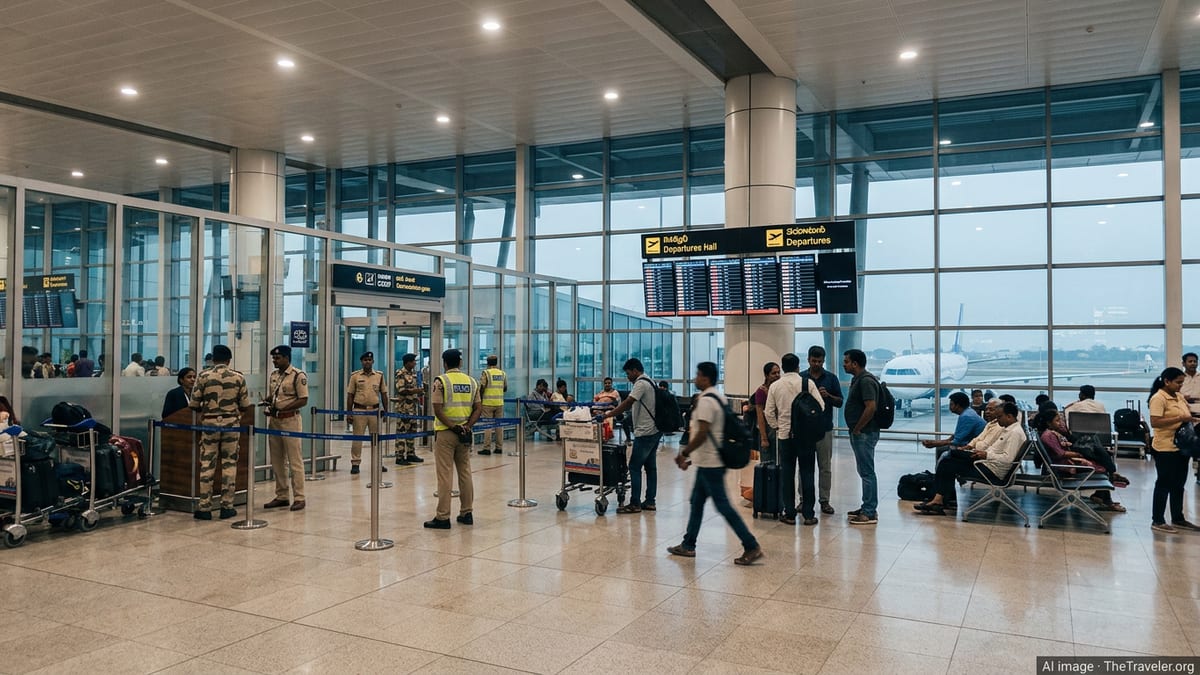
Within the wider terminal, operations continued but with visible signs of tightened security. Additional checks were carried out at screening points, patrols were stepped up across arrival and departure halls, and staff were instructed to report unattended baggage or unusual behaviour immediately. For much of the day, announcements reminded passengers of security protocols and advised them to factor in extra time for pre-flight procedures.
Airport authorities stressed that Rajiv Gandhi International Airport remains safe for travel and that there was no evidence of any active threat by the time normal schedules resumed on the affected route. Even so, officials indicated that enhanced vigilance would continue in the near term, with security and cyber teams closely monitoring for any similar communications targeting flights, terminals or other critical facilities at the airport.