

Scotland’s Borders Railway is poised for a significant transformation as Network Rail and the Scottish Government advance plans to partially electrify the route between Edinburgh and Tweedbank, a move designed to cut emissions, modernise infrastructure and future proof one of the country’s fastest growing commuter and leisure rail corridors.
Strategic Route Linking Edinburgh and the Borders Enters New Phase
The Borders Railway, reopened in 2015 after almost half a century of closure, has become a vital artery connecting Edinburgh with Midlothian and the Scottish Borders, carrying millions of passenger journeys and stimulating new housing, tourism and investment along its 30 mile length. A decade on from its return, the line is once again at the centre of Scotland’s transport policy agenda as attention turns to how it can support the country’s net zero ambitions.
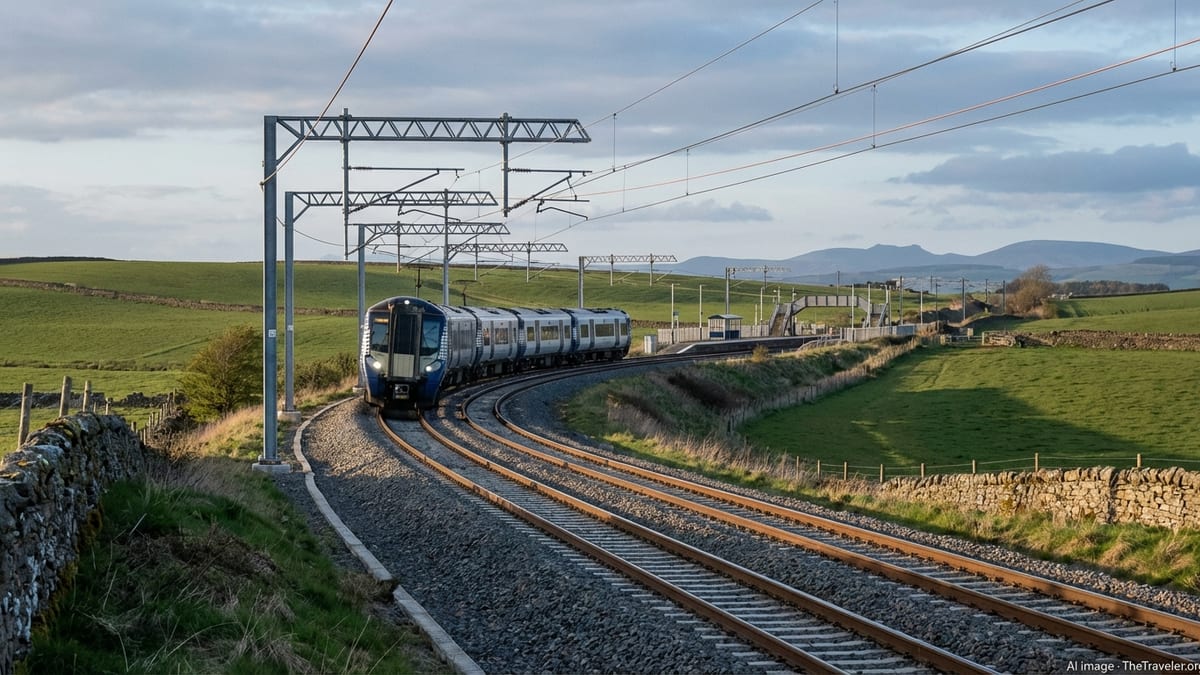
The planned electrification works will target key sections of the single track route that are currently diesel operated, complementing existing overhead wires between Edinburgh Waverley and Newcraighall. By installing new overhead line equipment and associated power infrastructure on strategically chosen stretches, engineers aim to prepare the railway for a new generation of cleaner rolling stock while minimising disruption to communities and services.
Officials and industry leaders frame the upgrade as both a climate measure and an investment in reliability. Electrified railways typically deliver faster acceleration, reduced noise and lower long term operating costs. For passengers travelling between towns such as Gorebridge, Galashiels and Tweedbank and the Scottish capital, the project promises smoother journeys and more capacity in the years ahead.
Network Rail Confirms Early Works and Market Engagement
Network Rail has begun early works on the Borders corridor following design and consenting activity that has been progressing since initial plans to electrify parts of the line emerged in recent years. These preparatory activities include detailed site surveys, ground investigations and the identification of locations for overhead line masts, substations and feeder stations, particularly at the Tweedbank end of the route where extra power capacity is planned.
At the same time, the infrastructure owner has launched preliminary market engagement for a Scotland wide electrification framework worth hundreds of millions of pounds. The framework is intended to provide a pipeline for projects including the Borders Railway and other priority routes identified in the Scottish Government’s rail decarbonisation strategy, giving contractors and supply chains visibility over forthcoming work.
Project managers emphasise that the Borders route has a head start compared with some older lines. When it was rebuilt ahead of its 2015 reopening, designers allowed generous clearances under bridges and through tunnels to accommodate future overhead wires, significantly reducing the need for disruptive civil engineering such as track lowering. This advance planning is now expected to help keep closures and bus replacement services to a minimum during the main construction phases.
Battery Electric Trains and a New Rolling Stock Era
The electrification of the Borders Railway is being closely linked with ScotRail’s wider programme to procure a new generation of suburban and regional trains capable of running under the wires and on non electrified stretches. The operator has signalled that future fleets are likely to include battery electric units designed to recharge on electrified sections before switching to battery power where overhead lines are not present.
On the Borders route, this approach is expected to result in a “partial electrification” strategy, where wires are installed at either end of the line and trains use stored energy to bridge the central gap. This reduces the scale and visual impact of infrastructure in sensitive rural landscapes and lowers upfront costs, while still delivering the bulk of decarbonisation benefits by removing diesel multiple units from daily service.
Passengers can anticipate a step change in the onboard experience once the new fleets are introduced in the early 2030s. Modern trains are set to offer quieter interiors, improved accessibility, dedicated space for bikes and buggies, power and data connectivity and more efficient heating and cooling systems. For commuters on the busy morning and evening peaks into Edinburgh, the combination of new trains and upgraded infrastructure should help ease crowding and improve punctuality.
Supporting Scotland’s Rail Decarbonisation Targets
The Borders Railway upgrade forms part of a broader national effort to remove diesel passenger trains from Scotland’s rail network within the next two decades. After revising its rail decarbonisation plan, the Scottish Government has placed greater emphasis on a mix of solutions that includes targeted electrification of core routes, battery and hydrogen technologies for rural lines, and modern, energy efficient rolling stock.
Within this context, the Edinburgh to Tweedbank corridor is seen as a strong candidate for early investment because of its high and growing ridership, its role in supporting regional regeneration and the relatively modern condition of its infrastructure. Electrifying key sections will also improve network resilience by allowing electric or battery electric trains to be flexibly diagrammed across other routes radiating from Edinburgh, such as lines to Fife and East Lothian.
Transport planners argue that shifting more journeys from road to rail is essential if Scotland is to meet its wider climate targets for 2030 and 2045. By offering faster, more reliable and lower carbon alternatives to private car use for travel into Edinburgh and across the Borders, the upgraded line is expected to play a disproportionate role in cutting transport emissions, which remain one of the country’s most challenging sectors.
Economic and Tourism Benefits for the Borders Region
Since its reopening, the Borders Railway has been credited with unlocking new development sites, supporting the growth of towns such as Tweedbank and Galashiels, and encouraging visitors to explore attractions from the Great Tapestry of Scotland to historic abbeys and walking routes. Enhanced rail services are widely seen as a cornerstone of regional economic strategy, helping to draw investment and talent while allowing more people to live in the Borders and work or study in Edinburgh.
The electrification programme is expected to reinforce these trends. Quicker, quieter trains and more frequent services could strengthen the appeal of the corridor for new housing and commercial schemes located within walking distance of stations. Developers and local authorities are already examining how stations can act as hubs for compact, transit oriented communities with reduced reliance on cars.
Tourism bodies also see an opportunity to promote the line as a sustainable gateway to the Borders, marketing rail as the preferred way to reach festivals, outdoor activities and cultural venues. As travellers become more conscious of their carbon footprints, the ability to offer low emission rail journeys is increasingly important for destinations seeking to attract both domestic and international visitors.
Minimising Disruption During Construction
While large scale rail upgrades inevitably bring some short term disruption, planners for the Borders Railway electrification are working to keep impacts on passengers and local communities as limited as possible. The relatively recent reconstruction of the line means most bridges and structures already provide the clearance required for overhead wires, reducing the need for prolonged closures.
Network Rail has indicated that much of the installation work for masts and wiring can be undertaken during overnight and weekend possessions, combined with carefully planned blockades at quieter times of year. Where line closures are unavoidable, rail replacement bus services will be provided, and local stakeholders have called for clear, early communication on timetables and alternative travel options.
Community engagement will be a key part of the programme, particularly in rural areas where construction traffic, visual changes in the landscape and temporary noise may be of concern. Project teams are expected to work with residents, landowners and councils to fine tune access routes, select the most appropriate mast designs and colours, and ensure that environmental mitigation measures are in place along sensitive stretches of the railway.
Integrating with Wider Improvements Around Edinburgh
The Borders Railway upgrades are unfolding alongside a series of other rail investments in and around Edinburgh designed to increase capacity, cut journey times and improve reliability across the central belt. Recent and ongoing schemes, such as the electrification of the East Kilbride line and enhancements on routes between Edinburgh and Glasgow, are gradually knitting together a more modern, largely electrified suburban network.
This integrated approach means that passengers using the Borders line will benefit not only from improvements on their own corridor but also from a wider pattern of better connections, new trains and more resilient timetables across Scotland’s busiest rail hub. As additional routes around the capital go electric, operational flexibility increases, allowing services and rolling stock to be reallocated dynamically in response to demand and disruption.
For visitors arriving into Edinburgh by long distance rail or air, a fully modern suburban network makes it easier to travel onwards by train rather than by car or coach. The Borders Railway, in particular, provides a direct rail link from the city centre into a rural region known for its scenery, heritage towns and outdoor pursuits, positioning it as a flagship example of how rail investment can support more sustainable tourism flows.
A Future Proofed Corridor with Potential for Further Extension
Transport campaigners have long advocated not only for the electrification of the Borders Railway but also for its eventual extension southwards towards Hawick and Carlisle, restoring more of the historic Waverley Route. While the current upgrade programme is focused on the existing Edinburgh to Tweedbank section, designing new infrastructure with future expansion in mind is seen as a practical way to keep options open.
By standardising electrification equipment, control systems and power supplies with those being rolled out elsewhere in Scotland, engineers can help ensure that any later extension or infill schemes can be integrated smoothly. The adoption of battery electric trains further increases flexibility by reducing the need to electrify every mile of any potential extended route, lowering barriers to incremental growth of the network.
For now, the electrification of the existing Borders corridor represents a significant statement of intent: that Scotland views rail as a central pillar of its efforts to build a cleaner, better connected transport system. As preparatory works progress and the first masts and wires appear along the line, passengers heading south out of Edinburgh will see visible signs that their railway is being readied for the next generation.