

More news on this day
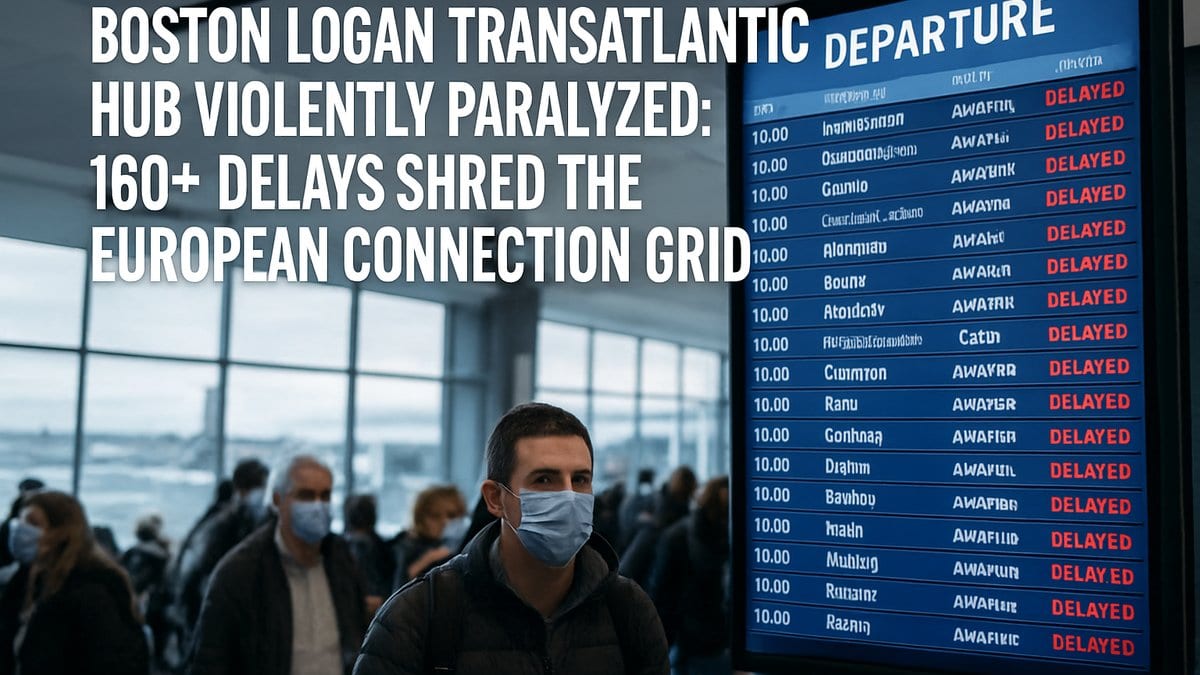
Boston Logan International Airport’s role as a critical transatlantic gateway came under acute strain on April 3, as more than 160 delayed flights disrupted connections between New England and major European hubs.
Get the latest news straight to your inbox!
Fresh Wave of Disruption Hits a Key Atlantic Gateway
Publicly available flight status boards and operational trackers for April 3 indicate that Boston Logan International Airport is experiencing a dense wave of disruption, with more than 160 delayed departures and arrivals and at least a dozen cancellations concentrated around busy domestic and transatlantic banks. Services operated by large U.S. carriers on routes to and from London and Frankfurt feature prominently among the interruptions, complicating itineraries for travelers relying on Boston as a springboard into Europe.
The pattern reflects Boston’s evolution into a significant transatlantic node. In recent seasons, carriers have added nonstop links from Logan to cities including Dublin, Rome and Nice, supplementing long established services to London and major continental hubs. On a typical spring day, this network allows New England travelers to access a broad European grid via early evening eastbound departures and tightly timed morning connections.
When those departure banks slip, as they did on April 3, the impact extends far beyond Massachusetts. Even modest schedule changes on Boston to London or Boston to Frankfurt flights can cause passengers to miss onward morning departures deeper into Europe, fragmenting itineraries that often depend on narrow transfer windows at constrained hubs.
Logan’s importance also runs in the opposite direction. Overnight flights from Europe feed into Boston early in the day, with many travelers connecting onward to other U.S. cities. Delays on those inbound services, or on the domestic legs that follow, feed back into the same network that European bound passengers rely on hours later.
How 160 Delays Ripple Across the European Connection Grid
A transatlantic delay at Boston rarely remains a local problem. When an aircraft operating a Boston to London rotation departs late on a busy spring Friday, that schedule slip can cascade into at least three distinct layers of disruption: passengers who miss banked morning connections at the European hub, aircraft and crews that arrive late for subsequent intra European segments, and return flights to North America that start the day behind schedule.
In recent weeks, reports from European aviation monitors have already highlighted mounting delay pressure at major hubs in the United Kingdom and northern Europe. Weather affected operations, crew availability and air traffic control constraints have all contributed to rolling queues on both arrivals and departures. When Boston’s own departures to those congested airports are pushed back, the slack within the system narrows even further.
The result on days like April 3 is a visibly shredded connection grid. Travelers heading from Boston to secondary European cities via London or Frankfurt face elevated risk of missed or rebooked onward flights. Those returning from Europe through Boston to smaller U.S. markets encounter similar uncertainty, with late arriving transatlantic services missing carefully constructed domestic connection windows.
Network specialists often describe this as a hub and spoke system starved of resilience. With aircraft fleets and crews tightly scheduled, a single wave of late departures can take many hours and multiple rotations to unwind. The more than 160 delays logged around Logan on April 3 illustrate how quickly this fragility becomes visible to passengers and airlines alike.
Weather, Network Strain and Recent Storm Legacies
The disruption at Boston Logan on April 3 cannot be understood in isolation from the broader weather and network context of late winter and early spring. In February and March, powerful winter systems repeatedly swept across the northeastern United States, at times closing or severely constraining operations at airports across New England and the Mid Atlantic. During peak episodes, hundreds of flights at Logan were canceled or delayed as snow, wind and visibility issues overwhelmed runways, deicing capacity and staffing plans.
Even after the most severe storms cleared, their operational legacy persisted. Aircraft and crew rosters were left out of position, and carriers required several days to rebalance schedules across domestic and international networks. Publicly available operational summaries for late March and early April show that many U.S. hubs have continued to experience elevated delay rates, with Boston frequently absorbing knock on effects when inbound aircraft arrived late from already stressed airports.
At the same time, European hubs have faced their own weather and capacity challenges. Winter storms and low visibility episodes across northwestern Europe have periodically slowed departure and arrival flows, lengthening taxi times and reducing the number of flights that can be safely managed per hour. When Boston bound and Boston originated flights are slotted into those constrained periods, small shifts in timing at either end of the route can translate into long waits for passengers on connecting itineraries.
This combination of recent storm legacies, constrained capacity and lean scheduling helps explain why a single day’s tally of 160 plus delays at Logan can reverberate so sharply through the North Atlantic system. The margin for error is small, and every new disruption consumes scarce operational flexibility.
Passengers Confront Longer Lines, Missed Links and Limited Options
For travelers, the operational dynamics translate into a familiar list of frustrations. On April 3 at Logan, long queues at check in counters and security lines have been reported as passengers adjust to rolling departure time changes. Flight information displays cycling through a wall of “delayed” indicators add to uncertainty, especially for those holding tickets that rely on same day connections in Europe.
Passengers booked onto Boston to London or Boston to Frankfurt flights face particular exposure. These routes typically feed into tight morning or early afternoon connection banks at two of Europe’s busiest hubs. When departures from Boston slip by an hour or more, onward flights to destinations such as Copenhagen, Milan or smaller regional airports can quickly fall out of reach, forcing rebookings that may push arrival into the evening or even the following day.
Those trying to return to the United States via Boston encounter similar challenges in reverse. A late departing intra European sector can jeopardize the single daily transatlantic link that feeds into Logan, where late arriving passengers may miss onward domestic flights to smaller New England or Midwestern cities. With spring schedules already busy and many services close to full, the pool of alternative same day options is limited.
Publicly available guidance from passenger rights organizations in Europe notes that travelers affected by long delays or cancellations on European carriers may be entitled to support or compensation in specific circumstances. However, the practical reality on a day of widespread disruption is that hotel rooms near major hubs fill rapidly and alternative flights are heavily contested, leaving many travelers facing extended waits in terminals as airlines work through the backlog.
Logan’s Growing Transatlantic Role Raises Stakes for Future Disruptions
The timing of April 3’s disruption is particularly sensitive because Boston Logan is in the midst of a steady expansion as a transatlantic hub. Airlines have announced new or increased services to European cities, including additional summer frequencies to Dublin and planned seasonal routes to Mediterranean destinations such as Nice and extended service to Rome. These additions are designed to give New England travelers greater non stop access to Europe and more options for onward connectivity.
From a network perspective, that growth increases both connectivity and vulnerability. A larger portfolio of nonstop links means that more passengers now use Boston as either their origin, destination or transfer point for trips that cross the Atlantic. When the airport experiences a day with more than 160 delays, the number of itineraries affected is higher than it would have been just a few years ago, and carriers have more complex webs of aircraft rotations to protect.
Industry analysis referenced in recent coverage notes that similar multi hub disruptions elsewhere in the world have taken between two and three days to fully unwind, even when weather rapidly improves. The pattern suggests that for Boston bound and Boston originated transatlantic passengers, the fallout from April 3 could extend across the weekend as airlines reposition aircraft, cycle crews and attempt to rebuild punctuality on both sides of the Atlantic.
For travelers planning upcoming trips through Logan, the latest episode serves as another reminder of the importance of buffer time on critical connections, especially when relying on a single daily transatlantic flight to reach a European hub. With Boston’s role in the transatlantic market set to grow further in 2026 and 2027, the airport’s ability to absorb and recover from days like April 3 will be central to how reliably New England connects to the wider European air network.