

More news on this day
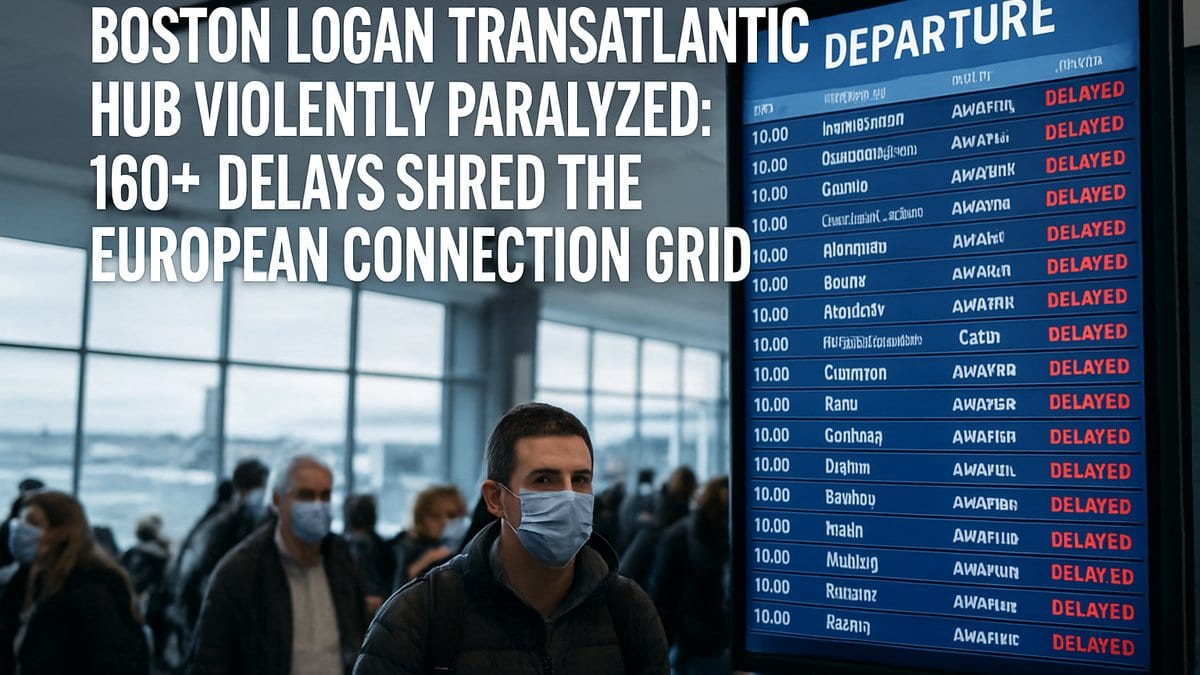
Boston Logan International Airport’s role as a key transatlantic gateway came under intense strain on April 3, as more than 160 delayed flights and a cluster of cancellations fractured the delicate web of connections between New England, major European hubs and onward destinations across the continent.
Get the latest news straight to your inbox!
Disruption Peaks as Spring Travel Surges
Publicly available flight status boards and operational trackers for April 3 show Boston Logan moving from a routine busy spring day into a zone of acute disruption, with delays mounting across both departures and arrivals. Tally figures compiled from those boards indicate more than 160 delayed flights by late evening, alongside at least a dozen cancellations concentrated around key domestic and long haul banks.
The impact was most noticeable in the midafternoon and evening periods, when Logan typically handles dense waves of departures to major US hubs and overnight departures to Europe. Delayed turnarounds on inbound aircraft, congestion on taxiways and temporary spacing restrictions in the airspace pushed scheduled pushback times later, then cascaded into missed slots further down the network.
Although the airport was not contending with a major storm on April 3, the disruption arrived at the end of a week marked by unsettled weather and earlier system wide slowdowns across the United States. Tracking data from recent days shows Logan repeatedly appearing among the country’s top airports for delays, reflecting how residual backlogs can quickly resurface once schedules tighten again.
The Federal Aviation Administration’s real time airport status page listed Logan as operating without a formal ground stop or major flow program for much of the day, underscoring how even in the absence of headline restrictions, a mixture of minor constraints and tight scheduling can still generate high numbers of late flights.
Transatlantic Banks Hit at a Critical Moment
As numbers climbed on April 3, the disruption cut directly into Logan’s expanding transatlantic portfolio. Published coverage and airline schedules show Boston now linked nonstop to major European hubs including London, Dublin, Frankfurt, Amsterdam and Paris, along with growing seasonal service to cities such as Rome and Milan. These routes function as essential bridges for passengers connecting between secondary US cities and destinations across Europe, North Africa and the Middle East.
Flight status boards captured rolling delays on services between Boston and London and between Boston and Frankfurt, two of the most important connection points for European itineraries. When departures from Logan left late or arrived late into those hubs, onward flights within Europe were frequently already boarding or closed, leaving travelers facing missed connections and overnight stays despite relatively clear weather at both ends.
The timing is sensitive. Airlines and airports on both sides of the Atlantic are preparing for an intense summer travel season, with carriers adding capacity from Boston to Europe and tourism agencies promoting new city pairs. Logan’s recent traffic reports highlight steady growth in international operations, while European regulators have updated passenger rights frameworks to reflect persistent congestion and delay across the region’s airspace.
In this context, a single day with more than 160 delays at a key US gateway can reverberate across the Atlantic. Passengers booked on carefully timed itineraries that rely on an evening departure from Boston and a morning wave of European connections can see their plans unravel in hours, with missed business meetings, interrupted cruises and lost short break weekends among the consequences.
Knock‑on Effects for European and Domestic Networks
The April 3 pattern at Logan did not occur in isolation. Recent disruption tallies for late March and early April show a run of severe weather and operational strain affecting multiple US hubs, including Chicago Midway, Atlanta, Philadelphia, Washington National and San Francisco. When connecting banks at these airports falter, aircraft and crews arrive late into Boston, compressing already narrow turnaround times and increasing the risk of subsequent delays on transatlantic departures.
The knock on effects reach deep into European networks. Late arriving overnight flights from Boston into London and Frankfurt can miss their planned slots in increasingly crowded morning airspace, forcing further hold times or re sequencing on busy routes into continental Europe. Eurocontrol and national air navigation providers have highlighted capacity constraints and rising average delay minutes per flight in recent seasonal reports, pointing to structural pressure that amplifies the impact of any disruption originating in North America.
Domestically, the same April 3 disruptions complicated travel for passengers using Boston as a connection point between smaller US cities and the West Coast. Flights from Logan to major domestic hubs departed out of sequence, weakening the logic of banked schedules that are designed to deliver tight connection times under normal conditions. For some travelers, this meant a two step chain of missed connections, first at Logan and then again at a downstream hub.
Analyses by transport researchers and congressional staff in recent years have underscored Boston’s vulnerability to exactly this kind of ripple effect. Studies of passenger delay hours place Logan among the US airports where a high share of delays is driven by network wide issues rather than purely local weather, a pattern that appears to be repeating in the current spring cycle.
Capacity Growth Collides With Operational Limits
The turbulence of April 3 arrives just as Logan and its airline partners are promoting new long haul links and higher frequencies that further cement Boston’s role as a transatlantic hub. Recent announcements point to expanded seasonal service from Boston to Dublin, increased frequencies to popular European capitals and new winter season connectivity to Rome. US carriers are also adding domestic flights timed to feed these international departures, reinforcing Logan’s competitive stance relative to New York area airports.
At the same time, the broader US system continues to wrestle with air traffic control staffing challenges, maintenance pressures on aging fleets and congested terminal and runway infrastructure at key airports. Travel industry analyses note that when facilities run close to capacity for long stretches, even modest disruptions in weather or staffing can translate quickly into widespread delays.
Logan itself is in the midst of multi year infrastructure work, terminal upgrades and technology rollouts intended to relieve pressure points. Local discussions have highlighted forthcoming tools to provide more transparent security wait times and to smooth passenger flows through the terminals. Yet the April 3 disruption underlines that efficiency gains inside the terminal can only do so much when the limiting factors sit in the runway system and the regional air traffic network.
The tension between rapid capacity growth and the finite limits of airspace and ground infrastructure is becoming more visible as each new route announcement lands alongside reports of chronic delays. For travelers, the message is that increased choice of nonstop destinations from Boston is arriving together with heightened exposure to systemic volatility.
What Travelers Can Expect in the Weeks Ahead
Looking beyond April 3, travel data from the end of March and the first days of April suggests that Boston Logan is likely to remain under pressure as spring break and early holiday traffic continue. Severe storms across large swaths of the United States have already triggered thousands of delays and cancellations in recent days, and the return of unsettled conditions could once again test the system’s resilience.
Consumer guides and passenger rights organizations advise travelers connecting between the United States and Europe through Boston and other hubs to build additional time into their itineraries wherever possible. Longer connection windows, earlier departures in the day and flexibility around travel dates can help reduce the risk of missed long haul flights or stranded overnights when bottlenecks like the one seen on April 3 emerge.
For those flying to or from the European Union and certain associated countries, the EU’s air passenger rights regulations continue to define compensation and assistance obligations for airlines in the event of long delays, cancellations or denied boarding under qualifying circumstances. However, many delay events are categorized as outside carrier control, leaving travelers reliant on rebooking policies, travel insurance and personal contingency planning.
As airlines, airport operators and regulators refine their responses to growing demand and recurrent operational strains, travelers using Boston Logan’s transatlantic services face a landscape of both expanded opportunity and elevated risk. The events of April 3 demonstrate how quickly a high volume hub can tip from smooth operations into cascading disruption, with consequences felt not just in New England but across the European connection grid that depends on its punctuality.