

More news on this day
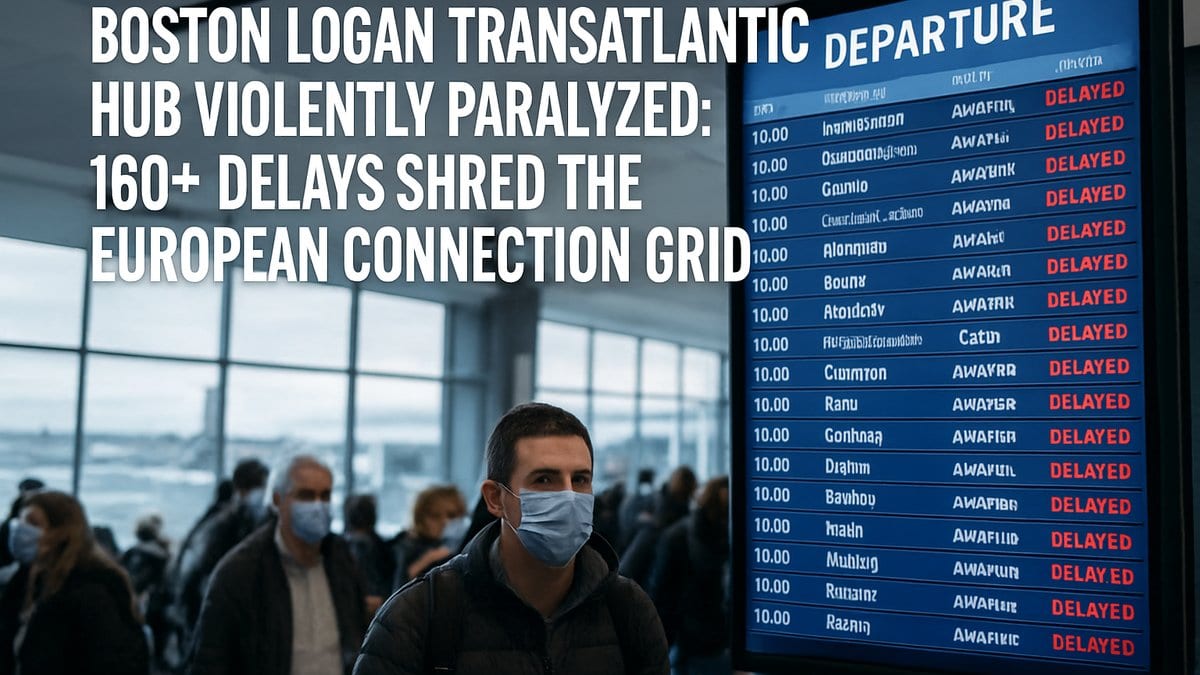
Boston Logan International Airport’s role as a key transatlantic gateway came under heavy strain on April 3 as more than 160 delayed departures and arrivals rippled through the European flight network, shredding tightly timed connections and leaving travelers scrambling to reassemble disrupted itineraries.
Get the latest news straight to your inbox!
Transatlantic Hub Struggles Under Wave of Delays
Preliminary tallies drawn from flight tracking dashboards and operational updates indicate that Boston Logan recorded well over 160 delayed movements by midday on April 3, with a disproportionate share affecting long haul services that connect New England to major European gateways. The disruption occurred at the height of the late afternoon and evening transatlantic bank, when Boston typically dispatches and receives a dense cluster of flights linking to London, Dublin, Paris, Amsterdam and southern European hubs.
Real time airport status information showed a reduced arrival and departure flow as light precipitation and low clouds combined with already compressed runway capacity. The resulting bottlenecks cascaded through the schedule, forcing aircraft to wait for departure slots and stretching turnaround times at the gates. Short haul services bearing connecting passengers to and from Europe were particularly exposed, with delays on feeder routes quickly undermining carefully constructed itineraries.
Boston’s emergence in recent years as a competitive transatlantic hub has magnified the impact. Airlines have steadily layered in new routes and seasonal frequencies to European cities, relying on Boston’s geography and strong local demand to feed long haul services. On a normal day this creates efficient cross Atlantic connectivity. On a day riddled with delays, it multiplies the number of travelers caught in a widening web of missed connections.
European Connection Grid Hit by Missed Links
Published coverage of recent transatlantic performance trends highlights how even modest disruption at a single hub can shred connection banks across multiple continents. With Logan serving as both origin point and transfer node for Europe bound passengers from across the United States, the delay burst on April 3 reverberated into the evening departure waves at key European airports and overnight inbound banks to Boston.
Travel data platforms and consumer rights resources point out that many Boston Europe itineraries are stitched together via one stop routings through major hubs such as London Heathrow, Amsterdam, Dublin and Paris Charles de Gaulle. When Boston departures leave one or two hours behind schedule, those onward connections can become mathematically impossible, especially at congested European airports where gate changes, security checks and lengthy walks between terminals consume valuable time.
Reports from recent European disruption events underscore the fragility of this grid. Weather related capacity cuts, staffing shortages and air traffic control constraints in Europe have already produced elevated delay levels in early 2026. When those pressures coincide with an American hub struggling to dispatch aircraft on time, passengers can find themselves trapped between two stressed systems, with limited rerouting options on fully booked transatlantic services.
Weather, Runway Work and a Tight Summer Build Up
Logan’s current operational squeeze cannot be separated from broader infrastructure and weather patterns documented over the past year. Official summaries of recent winter storms show that the airport has already endured multiple major weather events in 2026, including blizzards that triggered large scale cancellations and forced airlines to reassemble schedules in compressed time frames. Each new disturbance adds further complexity to already tight aircraft and crew rotations.
Separately, publicly available notices on airfield projects have described periods of runway and taxiway work that reduce the number of available arrival and departure slots during peak hours. Previous advisories regarding ground delay programs at Logan noted that structural capacity cuts can push average waits close to an hour for some services, with knock on effects across connecting banks. Even when weather on a given day is relatively benign, those infrastructure constraints can leave little margin for recovery once the first wave of flights begins to slip.
Looking ahead, carrier announcements confirm that Boston is on track for another year of expanded transatlantic flying, with additional European destinations and seasonal frequencies scheduled to start from spring 2026 onward. That growth will further thicken the connection grid, raising the stakes when operational hiccups occur and reinforcing the need for resilient runway, taxiway and air traffic management capacity.
Passenger Rights and Limited Room for Recovery
Consumer travel advisories reviewing the 2026 delay environment emphasize that passengers on transatlantic routes sit at the intersection of multiple regulatory and contractual frameworks. Many Boston to Europe itineraries are covered by European Union compensation rules when flights depart from EU airports or are operated by EU based carriers, while others fall solely under United States disclosure and refund obligations. The patchwork can be confusing for travelers attempting to understand their options once a missed connection becomes inevitable.
Specialist guides note that high spring demand limits the ability of airlines to absorb stranded passengers when a hub experiences a concentrated delay surge. With transatlantic loads already elevated across many carriers, spare seats on later departures may be scarce. In practice, this can mean extended overnight stays near Boston or in European hubs, as well as complex rebookings that route travelers through intermediate cities far from their original plans.
Travel insurance and credit card protections can mitigate some of the financial fallout, but only when policies are clearly understood in advance. Analysts caution that each additional transfer point built into an itinerary increases the statistical risk that at least one link will fail on a day of heavy disruption. The April 3 gridlock at Logan offers a sharp illustration of how quickly that risk can materialize when multiple flights in a connection chain are delayed by even modest amounts.
Practical Strategies for Future Boston Europe Flyers
Aviation data and advisory services that track Logan’s performance suggest several practical steps for travelers planning Europe trips through Boston in the coming months. Booking nonstop services where possible reduces exposure to missed connections, particularly when traveling during seasons prone to severe weather on either side of the Atlantic. When a connection is unavoidable, longer layovers provide a critical buffer against routine delay spikes.
Experts also recommend monitoring both airline and airport status tools closely during the 24 hours before departure. Real time dashboards from air navigation authorities and flight tracking platforms can reveal when a ground delay program or flow control initiative has been introduced at Logan, signaling a heightened likelihood of schedule slippage. Armed with that information, some passengers may be able to adjust departure times, request alternative routings or proactively secure hotel options before demand surges.
For Boston itself, the latest disruption underlines the importance of aligning infrastructure upgrades, technology investments and schedule growth. As Logan cements its status as a leading transatlantic gateway, days like April 3 demonstrate how quickly strain at a single hub can radiate across the wider European connection grid, leaving travelers and airlines to navigate the consequences of a network pushed beyond its limits.