

More news on this day
Hundreds of passengers were left stranded across the northeastern United States today as a fast‑intensifying winter storm forced airlines to cancel at least 389 flights and delay more than 100 at Boston Logan International Airport alone, with ripple effects snarling air travel at major hubs in New York, Philadelphia, Washington and beyond.
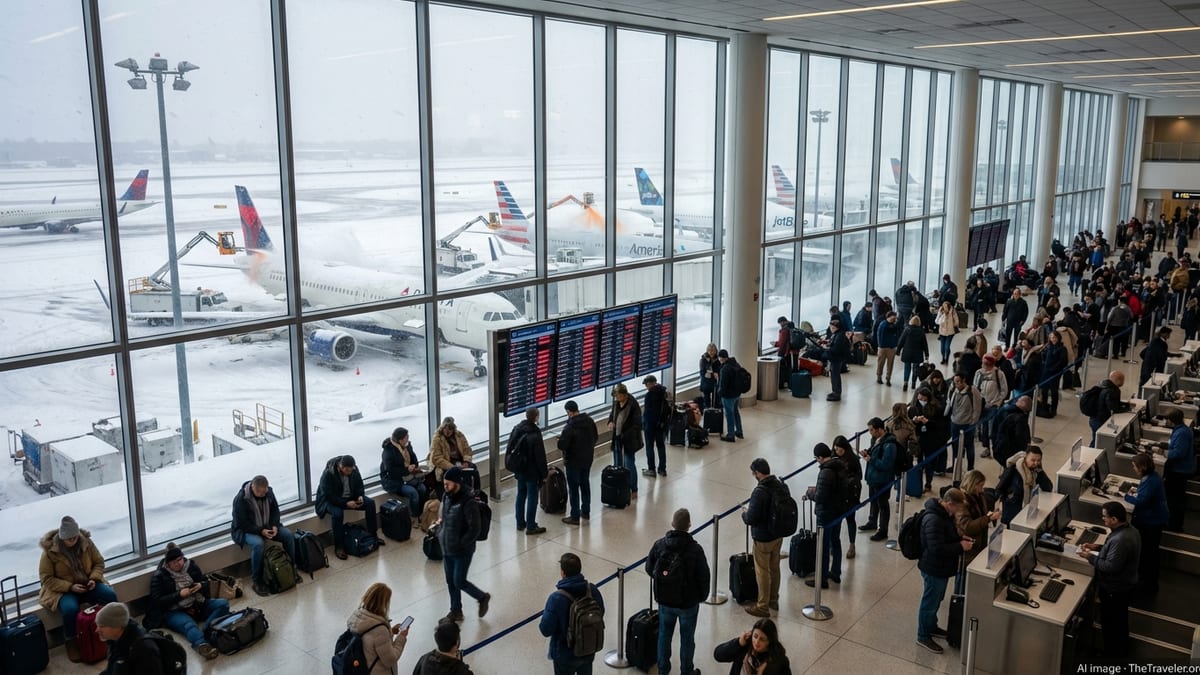
Boston Logan Becomes Epicenter of Weather-Driven Disruptions
Boston Logan International Airport emerged as one of the hardest-hit hubs in the country as heavy, wind-driven snow reduced visibility, slowed ground operations and forced airlines to preemptively thin their schedules. By late morning, at least 389 flights into and out of Logan had been canceled, with more than 100 others delayed, according to aggregated flight-tracking data. For much of the day, the airport operated on significantly reduced capacity as plows and de-icing crews struggled to keep up with fast-accumulating snow on runways and taxiways.
While Logan technically remained open, airport officials urged travelers to stay away unless they had confirmed departure times. Check-in halls saw long but sluggish queues, as many counters were staffed primarily for rebooking rather than departures. Digital boards across terminals were a sea of red, flashing “canceled” or “delayed” beside flights for Delta Air Lines, American Airlines, JetBlue, Republic Airways and other carriers that serve Boston as a major gateway to the rest of the country and to Europe.
Outside the terminals, the storm’s intensity compounded the disruption. Bands of heavy snow reduced visibility on access roads around the airport, while gusty coastal winds pushed the wind chill into the teens. Ride-share pick-up areas were clogged with cars circling as passengers called off trips or redirected to hotels, adding another layer of congestion to an already overwhelmed transport hub.
For many travelers, the challenge was not only getting in or out of Boston but simply getting accurate information. With schedules changing by the minute, airlines repeatedly advised passengers to rely on app notifications and text alerts rather than overhead announcements, which struggled to keep pace with the shifting situation.
Airlines Slash Schedules as Storm Wallops the Northeast Corridor
The cuts at Boston came amid a broader, region-wide response from airlines to the potent winter system sweeping up the East Coast. Across the United States, carriers scrapped nearly 3,000 flights scheduled for today and delayed close to 2,000 more, with the heaviest concentration of cancellations clustered at major northeastern hubs including New York’s John F. Kennedy International, LaGuardia and Newark Liberty, as well as Philadelphia and Washington-area airports.
Regionally focused carriers and large network airlines alike were forced into widespread schedule reductions. Republic Airways, a major regional operator flying under the banners of several legacy airlines, logged some of the highest cancellation rates as its smaller jets connect dozens of mid-sized cities to hubs like Boston, New York and Washington. JetBlue, whose operation is heavily concentrated in the Northeast, also canceled a substantial share of its Sunday flights, as did Delta Air Lines and American Airlines, both of which operate significant transcontinental and international services from affected airports.
Airline executives and operations managers framed the cancellations as a necessary step to avoid even more disruptive last-minute disruptions. By pulling flights in advance, carriers aimed to keep crews and aircraft properly positioned and to limit the number of planes and passengers stranded on tarmacs or diverted to already-stressed airports. The strategy, now standard across the industry for major storms, still translates into thousands of ruined itineraries, but airlines argue it shortens overall recovery times once conditions improve.
The cascading effect of these cancellations stretched far beyond the immediate path of the storm. Travelers booked on flights from the West Coast, the Midwest and the Sun Belt found their journeys abruptly cut short or rerouted, as aircraft that were supposed to operate their flights never left the Northeast. Connections through Boston, New York and Philadelphia evaporated from schedules, leaving many passengers stranded at their origin cities or mid-route stopovers.
Passengers Face Long Lines, Thin Answers and Uncertain Timelines
Inside Boston Logan and other affected airports, the human impact of the storm played out in slow-moving lines, crowded gate areas and growing frustration. Families returning from school vacations, business travelers trying to make Monday meetings and international passengers facing missed connections all converged at customer service desks in search of alternatives that were increasingly scarce as the day wore on.
With so many flights grounded at once, rebooking often meant days rather than hours of delay. In some cases, the first available seats to or from the Northeast were midweek, as carriers struggled to rebuild their schedules and clear backlogs. Agents frequently advised passengers flexible on their destination to consider alternate airports, such as flying into Baltimore instead of Washington, or Providence instead of Boston, in hopes of finding a route around the worst of the disruptions.
The strain on call centers and digital channels was intense. Hold times for many airlines stretched beyond an hour, and some customers reported app crashes or error messages as they tried to change bookings simultaneously with tens of thousands of others. For travelers already at the airport, gate agents became the main point of contact, but their ability to offer solutions was constrained by the lack of open seats and the continuing uncertainty around when the storm’s impact on operations would ease.
Concerns about lodging and meals added to the anxiety. While certain airlines offered hotel and meal vouchers when eligible, many passengers booked on weather-impacted fares were left to shoulder the costs themselves, scrambling to find last-minute rooms in airport-adjacent hotels that quickly filled up as cancellations mounted.
Heavy Snow, Fierce Winds and Low Visibility Drive Safety Decisions
The immediate cause of the disruption was a robust coastal winter storm that deepened quickly off the Mid-Atlantic and New England coasts, drawing frigid air over relatively mild ocean waters and generating bands of heavy snow, strong winds and dangerous wind chills. Meteorologists warned that snow totals could reach well over a foot in parts of eastern Massachusetts, with Boston itself expecting significant accumulation, while powerful gusts threatened to topple tree limbs and power lines along the shoreline.
For aviation, the combination of snowfall rates, crosswinds on runways and sudden drops in visibility created conditions that airlines and air-traffic controllers deemed incompatible with regular operations. Even when runways could technically support limited arrivals and departures, the pace of activity was sharply reduced. Aircraft required extended de-icing procedures, taxi speeds were slowed, and extra spacing was introduced between departures and arrivals for safety.
Similar conditions prevailed further down the Interstate 95 corridor. New York-area airports faced strong winds and bursts of heavy snow that at times obscured runway markings and approach lights. Philadelphia and the Washington region dealt with a mix of snow, sleet and freezing rain that made surfaces treacherous for ground crews and vehicles. In several locations, airport authorities brought in additional staff and equipment to keep critical infrastructure like runways, taxiways and ramps as clear as possible, but acknowledged that nature ultimately dictated how many flights could move.
Officials repeatedly stressed that the decision to cancel flights was rooted in safety rather than convenience. By minimizing airborne traffic during the height of the storm, they said, pilots and air-traffic controllers could focus on maintaining safe separation for the limited number of aircraft still in the sky, and emergency services could respond more effectively if problems arose on the ground.
New York, Philadelphia and Washington Report Parallel Turmoil
Beyond Boston, some of the nation’s most critical aviation hubs experienced their own waves of cancellations and delays. New York’s major airports, including JFK, LaGuardia and Newark Liberty, together recorded several hundred canceled flights as the storm pushed north and east along the coast. Burst of heavy snow and swirling winds complicated approaches and departures, while ground operations slowed as crews worked within tightly controlled safety protocols.
Philadelphia International Airport also endured a punishing day, with a large share of its arrivals and departures scrubbed as forecasters warned of double-digit snowfall totals for parts of the region. Airlines with a strong presence in Philadelphia, particularly American Airlines and its regional partners, saw a heavy concentration of cancellations as they attempted to consolidate passengers from multiple scrapped flights onto a smaller number of operating services.
In the Washington region, Ronald Reagan Washington National Airport faced high winds and mixed precipitation that caused widespread delays and dozens of cancellations. Nearby Baltimore/Washington International Thurgood Marshall Airport reported similar difficulties, as slushy, refreezing surfaces required constant attention from plows and de-icing trucks. The disruptions in the nation’s capital region amplified knock-on effects across national networks, especially for airlines that use Washington-area airports as key connectors for government, business and international traffic.
The combined effect of these regional hot spots was to create what one aviation analyst described as a “broken link in the national chain.” With so many core northeastern gateways constrained at once, airlines had few options left to reroute traffic around the storm, ensuring that the fallout reached well beyond the immediate radius of the weather system.
Operational Recovery Expected to Stretch Into the Week
Even as forecasters signaled that conditions would gradually improve after the storm’s peak, industry observers warned that the operational recovery could take days. Aircraft and crews were scattered out of position as airlines canceled and diverted flights, and overnight curfews at certain airports limited how quickly carriers could make up lost flying time once weather conditions stabilized.
At Boston Logan and other heavily impacted airports, early Monday schedules were already being trimmed as airlines tried to build a buffer into their operations to guard against lingering snow, icy taxiways or residual crew shortages. Travelers with flights early in the week were being encouraged to monitor their reservations closely and, where possible, take advantage of flexible rebooking policies many carriers issued in advance of the storm.
Airlines also faced the task of rebuilding trust and managing passenger expectations. While many customers have grown accustomed to storm-related disruptions during winter months, the concentration of cancellations today highlighted lingering vulnerabilities in an aviation system that often runs near full capacity during peak travel periods. Analysts noted that once a major weather event closes multiple hubs simultaneously, there are simply not enough spare seats or aircraft available to absorb the shock quickly.
Industry groups, meanwhile, reiterated calls for ongoing investment in airport infrastructure and air-traffic control modernization to help mitigate the impact of severe weather. Although no technology can eliminate storms, advocates argue that more precise forecasting and flexible routing capabilities could reduce the number of flights that need to be canceled outright in future events.
Advice for Stranded and Future Travelers
With thousands still facing disrupted itineraries, travel experts offered practical advice for those caught in today’s storm-related chaos and for passengers planning to fly through the region in coming days. Their central message was to stay proactive, flexible and digitally connected. Passengers were urged to use airlines’ mobile apps and websites as the primary tools for rebooking and status updates, since these platforms often refresh more quickly than airport displays or call centers.
Experts also recommended that travelers consider alternate routings and nearby airports if their original connection through Boston, New York or Philadelphia was no longer viable. In some cases, booking a flight into a secondary airport and completing the final leg by train, bus or rental car could significantly shorten delays, provided road conditions were safe enough to permit ground travel.
For those yet to begin their journeys, the advice was simple but direct: check flight status repeatedly before leaving for the airport, and be prepared for last-minute changes even after arriving at the terminal. Packing essential medications, chargers, snacks and a change of clothes in carry-on luggage, rather than checked bags, was emphasized as a critical step in case travelers ended up spending unplanned hours or an overnight stay in the airport.
As the storm continued to swirl over New England and the Mid-Atlantic, one reality became increasingly clear to passengers and airlines alike: in the face of heavy snowfall, biting winds and constrained infrastructure, the nation’s busiest travel corridor once again proved how vulnerable it remains to the whims of winter weather.