

I arrived at Boulders Beach with the kind of giddy anticipation I usually reserve for big wildlife moments. This was the famous African penguin colony on the Cape Peninsula, one of those places that features in every glossy Cape Town itinerary.
I had seen the photographs of penguins waddling past sunbathers and bobbing in turquoise water between massive granite boulders. In my mind, it was going to be half postcard, half documentary.
What I actually found was far more complex: a beautiful but heavily managed site, crowded and expensive by South African standards, yet still capable of delivering small, unforgettable encounters if I was willing to navigate the practical frustrations and recalibrate my expectations.
First Impressions: A Nature Reserve Wrapped In a Tourist Machine
My first impression of Boulders was not penguins or ocean, but traffic. As I approached Simon’s Town, the road thickened with rental cars, tour vans and people clearly doing the same mental calculation I was: keep circling and hope for a parking spot, or abandon ship and walk from further away. Boulders has a reputation for limited parking and that is not an exaggeration. On a busy day it felt like a game of vehicular musical chairs, with some cars edging into illegal spots that blocked driveways or squeezed into no-parking zones. I watched more than one traffic officer walk past with a notebook, and I understood why locals talk about the area being overwhelmed in peak season.
Once I finally parked legally, the mood shifted. Walking down the residential road toward the entrance, the air turned salty, the sound of waves took over, and I caught my first glimpse of a penguin silhouette on a rock far below. At the main gate, the experience snapped sharply back into a structured, controlled attraction. There are turnstiles, card-only payment, and clearly marked conservation fees that are noticeably higher for international visitors than for South African citizens and SADC residents. The dual identity of the site was obvious from the start. It is a national park conservation area that also functions as a high-throughput tourist attraction, and that tension shapes almost every part of the visit.
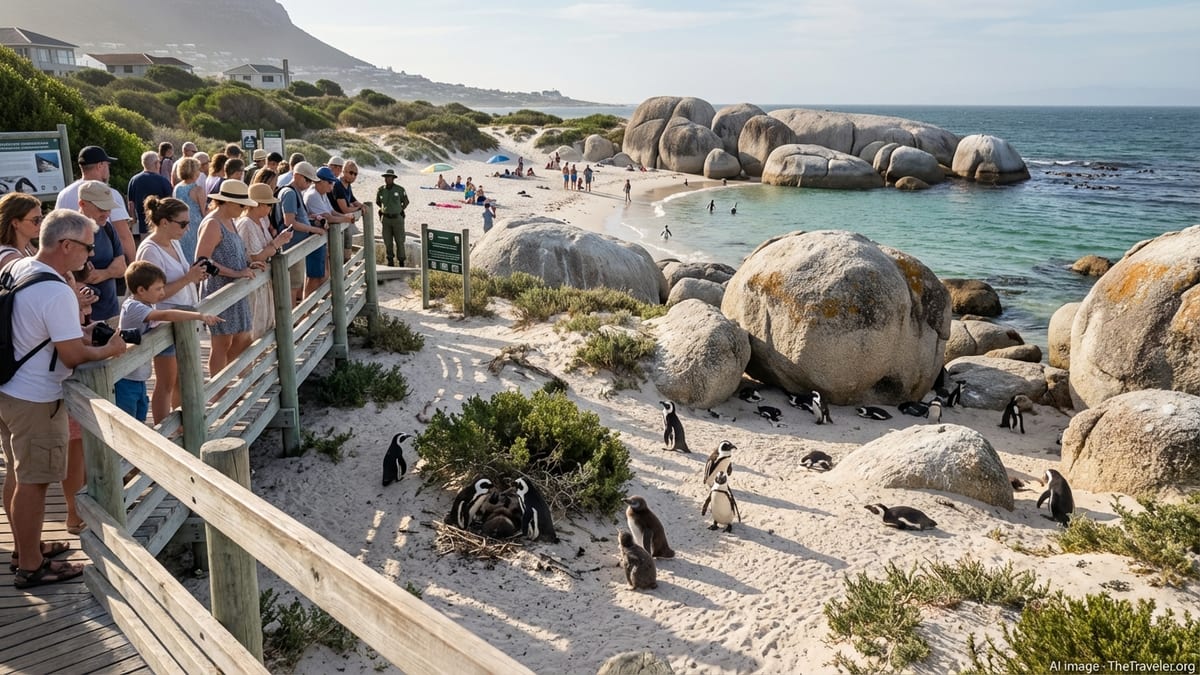
Inside, wooden boardwalks funnel visitors in single directions, rangers in green uniforms keep watch, and a steady flow of people enters with cameras ready. It felt organized and safe, but not exactly tranquil. My romantic vision of strolling quietly along the beach with penguins all around evaporated instantly. Instead, I found myself in a managed, semi-urban wildlife viewing area, which is not necessarily a bad thing, but it is very different from the wild coastal experience I had imagined.
Practical Realities: Fees, Hours, Cards Only
Before visiting, I knew there was a conservation fee, but I had not fully understood the pricing structure. At the gate, I had to think fast while a growing queue stacked up behind me. South African residents, SADC nationals and international visitors all pay different rates, with international adults paying several times the local rate. The fee is not outrageous compared to other global wildlife attractions, but in the South African context it felt steep, especially if you are traveling as a family. Knowing that the colony needs funding for protection and management softened the sting, but I still felt that moment of hesitation as I tapped my card.
The site has gone fully cash free, which is worth underlining. There is no option to hand over bills or coins at the gate. If you show up with only cash, you will have a problem. I watched one couple shuffle awkwardly aside to figure out a card solution while a queue formed behind them. The messaging about this is present online, but it is easy to miss if you do not read the fine print. My advice to my past self would be simple: treat Boulders like a modern urban attraction and arrive with a working debit or credit card, not like a casual beach where you can improvise.
The opening hours are seasonal and surprisingly generous in summer. In December and January, the gates open early in the morning and stay open into the evening, while winter hours are shorter, typically around 8:00 to 17:00. I appreciated the clear signage at the entrance with the current seasonal times. What I did not fully anticipate was how much those times intersect with the behavior of the penguins and the flow of crowds. Midday in summer can be intense: heat, bright sun, reflective sand and boardwalks packed shoulder to shoulder. Arriving early or later in the afternoon made a huge difference to my comfort and to how much I enjoyed being there.
The Boardwalk Experience: Closer Than a Zoo, Less Wild Than I Hoped
The classic Boulders experience is all about the boardwalks. Once you pass the visitor center, you follow a raised wooden path through dense coastal vegetation, with glimpses of sandy coves and granite boulders between the bushes. Every bend in the path reveals another cluster of penguins: one standing guard over a nest, another shuffling awkwardly across the sand, a few resting under a bush in the shade. Being elevated gives you a surprisingly intimate view of their lives while keeping a strict barrier between people and birds.
In some ways, the boardwalks were better than I imagined. I could see penguins up close without feeling that I was intruding on them. I watched parents feeding fluffy, shockingly ungainly chicks and adults preening each other in the sun. I could smell the colony before I saw it fully, an acrid, fishy odor that reminded me that this is a working breeding colony, not a staged set. The scenes felt real, uncurated and undeniably absorbing. It was more like standing on a viewing platform in a nature reserve than being in a city zoo.
At the same time, the boardwalks made the experience feel more constrained than I had expected. The paths are narrow, and when several tour groups arrive at once, you end up in slow-moving clusters, shuffling along and waiting for everyone to get their photos. People lean into the railings, phones extended, sometimes blocking others from passing or from seeing. At peak times, it felt more like moving through a busy attraction than communing with wildlife. I found myself doing that slightly guilty, hurried walk, trying to get past a knot of people without bumping anyone or missing the moment completely.
What surprised me most was how much my enjoyment depended on micro-timing. On my first walk, late morning, the crowds were dense and I felt hurried. Later, when I doubled back close to closing time, the boardwalks had thinned out dramatically. I suddenly had space to linger, to watch a single bird for several minutes and to listen to the odd braying calls that give these penguins their old nickname. In those quieter minutes, the place felt exactly as special as the marketing makes it sound. The wildlife was the same. The difference was how many humans were sharing the space with me.
The “Beach With Penguins” Myth vs Reality
The phrase “swim with penguins at Boulders Beach” creates a powerful mental image. I had, admittedly, built up a fantasy of wading into the water with penguins bobbing around my knees. The reality is more nuanced and more regulated. There are two main areas: the dedicated penguin viewing boardwalks and a separate swimming beach section, also protected and controlled by the park. They connect indirectly via the wider protected area, but your experience in each zone is quite different.
On the swimming side, you do sometimes share the water with penguins, but not in the close, interactive sense that some social media posts imply. The birds are not props and they are not particularly interested in people. They may glide past, pop up unexpectedly near you, or waddle across the sand your towel is on, but they often keep to themselves. Park rules are strict about not touching or feeding them, and rangers enforce that. I was glad to see that enforcement in action. When one visitor tried to edge closer for a selfie, a ranger stepped in quickly and firmly.
The beach itself is beautiful, a small, sheltered cove framed by massive granite boulders that break the swell and create calm, shallow pools. The water in this part of the peninsula is cold, but on a hot day it feels bracing rather than unbearable. Low tide reveals more sandy space; at high tide, the beach shrinks considerably, which means that on busy days people bunch up and personal space evaporates. That dependence on tide was not obvious beforehand, and it made a real difference. I arrived once at high tide and it felt almost claustrophobic, with people wedged between rocks, families competing for a flat patch to set up.
So did I “swim with penguins”? Technically, yes. There were penguins in the water while I floated nearby. But it was not the immersive, quasi-magical encounter I had pictured. I was always aware of the crowds behind me, the watchful eyes of rangers, and the need to be constantly respectful of where the birds were and how close I was getting. The experience is more like sharing a small beach with a group of wild animals than playing with them, which is absolutely how it should be, but not how it is often described or marketed.
Crowds, Noise and the Strain of Being Famous
The sheer popularity of Boulders is both its making and its curse. On the one hand, a steady stream of visitors brings money, attention and political will to protect a vulnerable species. On the other, it creates a daily strain on a small residential area and on the site itself. Standing on the boardwalk, I heard several languages in a single minute, saw at least three tour groups clustered around their guides, and watched an almost constant procession of people entering and exiting through the gates.
The crowding manifests most obviously on the walkways and the beach, but the effects ripple outward. Local streets turn into overspill parking lots. Residents near the gates coexist with a daily tide of people drifting past their homes. The city and park authorities have spoken publicly about congestion, ticketing and signage, and when you are actually there, those issues feel very visible. Parking signs are sometimes ignored, and frustration flares when drivers circle repeatedly without luck. It is easy to see how conflict between tourism and local quality of life can simmer in a place like this.
On the boardwalks, noise is a subtler issue. Most visitors are well behaved, but there are always a few loud voices, a speaker playing music, or a drone of chatter that never quite fades. In an ideal world, a penguin colony would be experienced in near silence, with only waves and bird calls. That is not the reality here. What surprised me, though, was how quickly my brain tuned out the human soundtrack when a particularly engaging scene unfolded: a pair nesting under a bush, a small procession of birds hopping down to the water, a chick begging for food. For short stretches, the background noise faded and I found myself fully absorbed in the penguins again.
If you arrive expecting a peaceful, meditative nature retreat, especially in peak season, you are likely to be disappointed. Boulders is not that type of place anymore, if it ever was. It is a small, intensely visited window into the life of an endangered species, complete with all the human clutter that comes with mass tourism. I had to accept that and adjust my mindset instead of fighting it.
Conservation, Compromises and Ethics
Underneath the tourist façade, Boulders is fundamentally about conservation. The African penguin is endangered, and this land-based colony is one of the few accessible places where people can see these birds up close without a boat trip. The rules about no feeding, no touching, staying on the boardwalks, and respecting the no-take marine reserve are not bureaucratic annoyances; they are an attempt to balance access with the birds’ survival.
Walking through the colony, I found myself really wrestling with that balance. Is it ethical to bring thousands of people a day into a breeding area, even on raised walkways, simply for the sake of their experience? Are the conservation fees and educational signs enough to offset the disturbance and the cemented infrastructure along the shore? It is not a simple equation. On one hand, I saw clear signs that the penguins were habituated to humans. They barely flinched at the constant streams of people above them. On the other hand, the same birds are facing threats at sea from overfishing, pollution and climate shifts that dwarf the impact of boardwalk foot traffic.
The educational content at the site helped a little. Information boards explain the species’ decline, the reasons behind specific rules, and what visitors can do to support broader conservation work, such as supporting specialist organizations. I appreciated that the messaging did not sugarcoat the situation. It was frank about the species’ endangered status and the fact that this colony is not guaranteed a happy ending.
In the end, I came away believing that Boulders is a compromise. It is not perfect, and it can feel uncomfortably commercial at moments, especially when you add in the souvenir shops and day tours that package it as a quick stop. Yet it also creates a direct, emotional connection between people and a vulnerable species, and that connection matters. Watching a child see a penguin up close for the first time, with that unmistakable look of awe, I could not help but think that this is how future advocates are made, however messy the setting may be.
What I Would Do Differently Next Time
My biggest lesson from Boulders is that timing and planning matter far more than I initially thought. If I were to repeat the experience, I would avoid the late morning slot entirely on a sunny weekend or school holiday. Instead, I would aim for one of two windows: right after opening in the quieter months, or a couple of hours before closing when day tours have thinned out and the light is softer. On my second visit, when I arrived later in the afternoon, the atmosphere was dramatically better and the photos were far less harsh.
I would also build in extra time simply to deal with logistics. That means assuming that parking will not be easy and being mentally prepared to walk a bit from wherever I eventually find a space. It may be worth considering leaving the car in Simon’s Town and walking or using a ride-hailing service to bypass the parking fight altogether. What felt like a small detail beforehand turned out to be a major factor in my stress levels on arrival.
I would treat the beach portion as a bonus rather than the main event. The boardwalks are where you see the density of the colony and the most interesting behavior. The swimming cove is charming, but small and constrained. If the tide is high and the sand is crowded, I would not force the “penguin beach day” idea. I would instead enjoy the views, maybe dip into a quieter corner of the cove, and accept that this is a place to share space respectfully with wildlife, not to own it for a day.
Finally, I would dial down my expectations of intimacy. Boulders is not a private encounter. It is a shared spectacle, and my presence is part of a much larger footprint. Keeping that in mind made me more patient with the crowds and more appreciative of the quiet, unscripted moments that did break through.
The Takeaway
Boulders Beach was not the serene, quasi-wild penguin encounter I had envisioned, but it was still a meaningful experience. I left with a more grounded appreciation of what it means to protect a fragile species in a heavily populated, highly touristed corner of the world. The scenery is gorgeous, the penguins are as charismatic in person as in any photograph, and there are genuine flashes of magic when a bird shuffles inches from your shoes or when a whole group porpoises out of the water at sunset.
At the same time, it is crowded, structured and expensive by local standards. Traffic and parking can be genuinely frustrating, and the sense of being funneled along with the masses detracts from the wild romance of the setting. If your mental picture is of a quiet, empty cove shared with a few penguins, you will almost certainly be disappointed. If you understand from the outset that you are entering a busy, tightly managed conservation site, you are more likely to appreciate what it does offer rather than resent what it cannot.
I would recommend Boulders Beach to travelers who care about wildlife, are willing to tolerate crowds for the sake of a close look at an endangered species, and who do not mind a bit of logistical hassle. Families with children, in particular, are likely to find it memorable, as the boardwalks are safe and the birds are almost guaranteed. Photographers will find the site rewarding if they plan around light and crowd levels. Highly crowd-averse visitors might be happier choosing a quieter coastal walk elsewhere on the peninsula and supporting penguin conservation remotely.
Viewed honestly, Boulders Beach is a compromise that still manages to deliver something important. It is not untouched nature, but it is not a theme park either. It sits uncomfortably in between. If you go in with realistic expectations, a charged card, and a flexible attitude about timing, you are likely to leave, as I did, with a mix of small frustrations and a lingering sense of gratitude that places like this still exist at all.
FAQ
Q1. Do I need to book tickets in advance for Boulders Beach?
It is not mandatory to book in advance, as you can usually buy your conservation ticket at the gate, but on busy days that means queuing and dealing with more congestion. Buying an entry ticket online beforehand can streamline the process and reduce the time you spend at the entrance, especially in peak holiday periods.
Q2. What are the current opening hours and do they change seasonally?
Yes, the hours change with the seasons. In the summer months around December and January the gates typically open early in the morning and stay open into the early evening, while in winter the opening time is usually 8:00 with a closing time around 17:00. Transitional months like October, November, February and March have intermediate hours. It is worth checking the latest times before you go.
Q3. Can I pay in cash for the entrance fee?
No. The Boulders section operates as a cash free gate, which means you need a debit or credit card to pay your conservation fee. If you arrive with only cash, you may not be able to enter, so it is important to plan accordingly.
Q4. Is it really possible to swim with penguins there?
Yes, you can swim in the same cove where penguins sometimes enter the water, and they may pass by you or surface nearby. However, it is not an interactive experience. You are not allowed to touch, feed or approach the birds, and they often keep their distance. Think of it as sharing the sea with them rather than swimming with them in a close or playful way.
Q5. How bad is the parking situation and can I avoid the worst of it?
The parking situation can be quite challenging, especially during weekends, public holidays and school vacations. The lots near the main gates are small and fill quickly, which leads to congestion and illegal parking in nearby streets. To avoid the worst of it, consider arriving early, visiting later in the afternoon, parking further away in Simon’s Town and walking, or using a ride hailing service or organized tour that does not rely on you finding a spot yourself.
Q6. Are the penguins guaranteed to be there year round?
The colony is present all year, but penguin activity and visibility vary with the breeding and molting cycles. There are usually birds on land at any time of year, but some months and times of day are busier than others. During breeding and molting periods, more penguins stay ashore, while at other times many may be out at sea feeding. You should still expect to see penguins whenever you visit, but the numbers and behavior will differ.
Q7. Is Boulders Beach suitable for young children and less mobile visitors?
Yes, in many ways it is. The main viewing areas are connected by wooden boardwalks with railings, which are relatively flat and manageable for prams and people with limited mobility, although there can be some slopes. The swimming cove is sheltered and generally calm, making it safer for children compared to more exposed beaches. The main challenge for less mobile visitors is the distance from parking if nearby spaces are full.
Q8. What should I wear and bring for a visit?
Plan for strong sun and variable coastal weather. A hat, sunglasses, sunscreen and comfortable walking shoes make a big difference, as you will likely be on the boardwalks for a while. If you intend to swim, bring a swimsuit, towel and perhaps a light cover up for the wind. A reusable water bottle is useful, and a camera or phone with good zoom helps you capture the penguins without needing to get too close.
Q9. Are there food and drink options close by or inside the site?
There are no big restaurants directly inside the boardwalk area, but there are small shops and places to buy snacks and drinks in the immediate vicinity and in nearby Simon’s Town. Many people combine a visit to Boulders with a meal in town. It is a good idea to eat before or after rather than relying on substantial food options right at the penguin viewing platforms.
Q10. Is it still worth visiting if I dislike crowds?
It can be, but you need to be strategic. If you are strongly crowd averse and can only visit on a peak summer weekend at midday, you may find the experience stressful. If you have flexibility to go in the shoulder seasons, on weekdays, or during early morning or late afternoon, the crowds are thinner and the atmosphere more relaxed. In those conditions, even someone who dislikes crowds can still appreciate the setting and the penguins without feeling overwhelmed.