

More news on this day
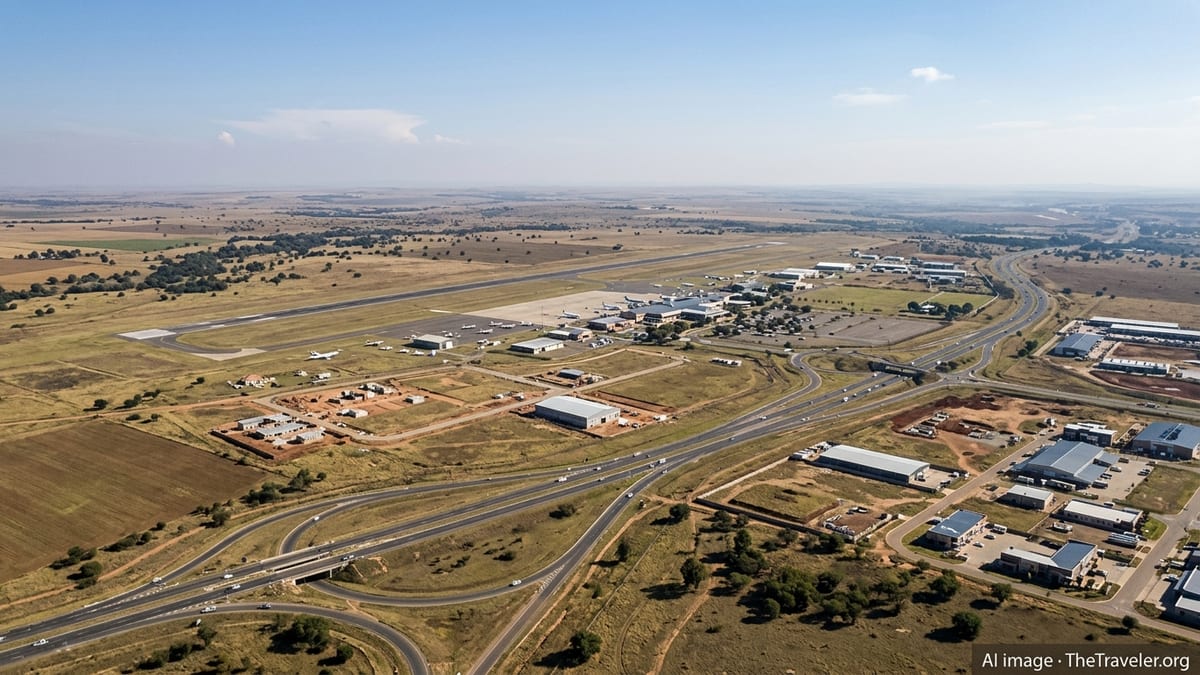
Bram Fischer International Airport in Bloemfontein is being positioned as the anchor of a new tourism and logistics hub under a partnership framework between Airports Company South Africa (Acsa) and the Mangaung Metropolitan Municipality, signalling a scaled-up effort to convert the Free State gateway into a multi-use investment node along the N8 corridor.
Get the latest news straight to your inbox!
Airport at the Heart of an Integrated Development Vision
Publicly available planning documents and investment prospectuses show that Bram Fischer International Airport is central to Mangaung’s long-term economic strategy, with Acsa identified as a key implementing partner. Strategic frameworks for the metro describe the airport as a catalyst for local economic development, spatial restructuring and improved connectivity for Bloemfontein and surrounding towns.
The metro’s integrated development and spatial plans highlight the airport’s growing role not only in serving business and leisure travellers, but also in shaping higher-value commercial activity on the city’s eastern flank. The surrounding land has been earmarked for intensive, mixed-use development designed to pull investment closer to key transport corridors and to create a more compact, efficient urban form.
Within this framework, the Acsa–Mangaung alignment is framed as a platform to coordinate infrastructure, land use and private-sector participation. Planning records emphasise that airport upgrades and adjacent real-estate projects are to be guided by an airport master plan, implemented in concert with municipal and provincial strategies for logistics, tourism and human settlements.
Airport Development Node to Combine Tourism, Retail and Industry
A flagship component of the emerging hub is the Airport Development Node, a large mixed-use precinct located along the N8 highway opposite Bram Fischer International Airport. Recent investment material describes the node as a potential “mini-city” around the transit hub, combining commercial, residential, retail and light industrial functions over several hundred hectares.
The node is structured in phases. The first phase focuses on a business district including an international conference centre and hotel, regional shopping mall, tertiary education facilities, and mixed-use commercial and residential blocks. This combination is intended to support tourism and business travel by clustering accommodation, events facilities and services within minutes of the terminal.
A planned second phase is set to deepen the logistics role of the airport. Project descriptions indicate that an industrial node will be integrated with a future air cargo terminal at Bram Fischer International, linking warehousing, distribution and value-added processing directly to air and road networks. The overall development is situated adjacent to a purpose-built N8 interchange, with bulk services such as water, sanitation and electricity already in place, which project summaries present as a drawcard for investors.
Logistics Ambitions Tied to National Corridors
The Acsa–Mangaung approach builds on earlier national infrastructure initiatives that identified Bram Fischer International as a strategic logistics asset within the Durban–Free State–Gauteng corridor. Historical policy documents and speeches from the Free State’s economic authorities have referred to the airport’s potential to evolve into a regional gateway and logistics hub, linked to road and rail freight systems.
Recent municipal planning again underscores the combined importance of Bram Fischer International Airport and the Mangaung rail hub precinct. Together, these sites are described as critical to attracting logistics-related industrial and commercial development, supporting a broader shift towards higher-value activities along the N8 corridor. The intention is to leverage existing national highways and freight routes to grow warehousing, distribution and agro-processing capacity.
Published analyses of Mangaung’s major projects note that the Airport Node is one of several strategic land parcels earmarked to promote densification and spatial integration. By concentrating logistics, industrial and residential development along key transport spines, planners aim to curb urban sprawl, improve access to jobs and services, and enhance the metro’s overall attractiveness to investors.
Tourism Growth Targeted Through Better Air Access and Services
Tourism is another pillar of the envisaged hub around Bram Fischer International Airport. National and provincial tourism publications point to the wider Free State’s mix of heritage attractions, events and nature-based destinations, while noting that improved air access and airport-area amenities are seen as crucial to capturing more visitor spend in Bloemfontein and beyond.
The Airport Development Node’s first-phase components, including an international conference facility, hotel capacity, shopping and leisure offerings, are positioned to support events tourism and short-stay itineraries. These facilities are expected to complement existing attractions in Mangaung, such as cultural and historical sites and the nearby Naval Hill precinct, which is already the focus of separate tourism infrastructure upgrades.
Recent coverage of Acsa’s national programmes also points to ongoing maintenance and service-improvement efforts at Bram Fischer International, including upgrades to passenger facilities. In combination with the planned logistics and commercial investments, such improvements are presented as part of a broader effort to enhance the airport’s competitiveness for airlines and passengers while anchoring it more firmly within the regional visitor economy.
Opportunities and Risks for the Mangaung Partnership
The Acsa–Mangaung pact around the airport hub unfolds against a backdrop of both opportunity and constraint. Investment marketing material highlights the Free State’s established institutional and educational assets, as well as strong road links and existing industrial parks, as ingredients that can support an airport-led node. The promise of shovel-ready land parcels, approved township establishment and installed bulk services around the airport is promoted as reducing lead times for prospective investors.
At the same time, publicly available commentary on Mangaung’s fiscal position and governance challenges indicates that execution capacity will be closely watched. National Treasury communications and local media reports in recent months have pointed to financial pressures at the metro, raising questions about its ability to sustain infrastructure commitments and service delivery at the scale envisaged for an aerotropolis-style development.
Analysts of South African city-region projects note that airport cities and logistics hubs typically require long-term coordination among spheres of government, state-owned companies and private developers. For Bram Fischer International Airport’s new tourism and logistics hub, that coordination will hinge on how effectively the Acsa–Mangaung framework aligns land use, transport planning and investment promotion over time.
For now, the designation of the airport as the anchor for an expanded tourism and logistics node signals a renewed attempt to translate long-discussed plans into a more concrete development pipeline along the N8 corridor, with Bram Fischer International positioned as the central gateway for both visitors and cargo.