

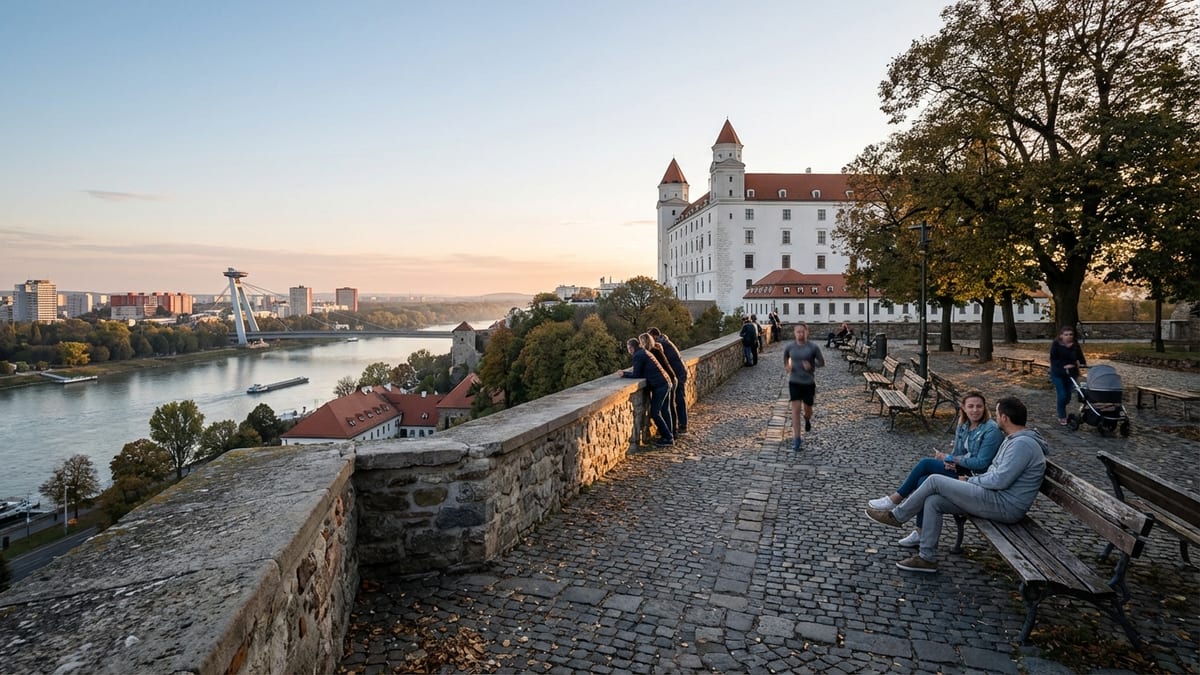
I had seen the classic postcard photo of Bratislava a hundred times before I ever set foot in the city: a square white castle sitting above the Danube, with four stubby corner towers and the old town spilling away below. Castle Hill looked like the obvious place to go.
When I finally made it there myself, the experience turned out to be more nuanced than the pretty photos suggested. It was part viewpoint, part museum, part city park, and part tourist trap. If you are trying to decide whether Castle Hill in Bratislava is really worth your time, my honest answer is: it depends what you are hoping to get out of it, and how you approach it.
First Impressions: The Walk Up And The Setting
I decided to approach Castle Hill on foot from the old town, partly because I wanted that slow reveal of the castle as I climbed. There is no funicular or special shuttle that whisks you up. The options are either a fairly short but steep walk, a city bus to the top, or a taxi or ride share. I took one of the winding streets up from the direction of the St Martin’s Cathedral, ducking under the freeway bridge and then zigzagging along cobbled lanes past residential buildings.
The walk itself was pleasant, but it was not the romantic, purely historic climb I had expected from travel photos. In reality you pass under modern road infrastructure, there is traffic noise from the big bridge over the Danube, and some of the lower streets are a little scruffy. It felt safe enough in broad daylight, just not especially atmospheric. Once I reached the upper terraces, though, the mood shifted. Trees, open spaces and the stout castle walls started to dominate, and I began to understand why locals use this hill as an everyday park as much as a tourist landmark.
One thing that surprised me was how open the grounds felt. The castle courtyards and terraces are free to enter and, according to the Slovak National Museum which manages the site, are currently open from 8:00 in the morning until 22:00 in the evening. The hill is ringed by walks and viewpoints, with benches, lawns and some thoughtfully restored sections of fortifications. My very first impression after reaching the top was that this might actually be more of an outdoor experience than a “castle tour” in the traditional sense.
Architecture, Atmosphere And The “Rebuilt” Problem
If you are imagining a moody medieval ruin with crumbling stonework and dark corners, Castle Hill in Bratislava will probably disappoint you. The building you see today is largely a reconstruction, and it looks like it. The castle has been destroyed and rebuilt multiple times over the centuries, and after a major fire in the early nineteenth century it lay in ruins for a long period. The current version is the result of extensive postwar and more recent restoration, and it leans hard into a clean, symmetrical, almost austere look.
Standing in the main courtyard, I personally found the architecture somewhat sterile. The white facades and red roofs are picturesque from a distance, but up close the castle feels more like a government building or a conference venue than a place where kings and queens actually lived. The interiors have been heavily adapted to house museum exhibitions, which is understandable, but it means you are not walking through a preserved historic residence in the way you might at, say, Bojnice Castle or older palaces elsewhere in Central Europe.
This is not to say it lacks charm entirely. In the softer light of late afternoon, with the shadows stretching across the walls, the square courtyard and arcades took on a certain quiet dignity. I liked the way the four corner towers anchored the building against the sky, and from the outside terraces the castle does look striking perched above the river. But if your main interest is “authentic” castle interiors, you may find that Castle Hill feels more like an exhibition complex inside a castle-shaped shell than a time capsule of aristocratic life.
The Museum Inside: Exhibitions, Tickets And Time
Bratislava Castle houses the Slovak National Museum’s Museum of History. As of early 2026, the museum is typically open daily except Tuesday from 10:00 to 18:00, with last admission at 17:00. The grounds remain accessible beyond that, but the exhibitions and interior spaces close. I arrived early afternoon and bought a ticket at the on-site counters, which were clearly marked but not especially inviting. You can also use the city’s tourist card for free entry to the main history exhibition, but special temporary shows can require an additional ticket.
The ticketing process itself was straightforward, though the signage about what was included felt a bit fragmented. There were separate notices for the permanent history displays, a special exhibition on Marie Antoinette that charged a supplement, and access to the Crown Tower viewpoint. In total, if you try to see and do everything, you can easily spend several hours inside. I opted for the standard museum ticket with access to the tower, skipping the paid special exhibition because by that point the cumulative price for one afternoon felt a little steep compared with other attractions in the city.
Inside, the museum is better than the bland corridors might initially suggest. There are nicely curated sections on Slovak history, medieval artifacts, the city’s role in the Hungarian Kingdom, and more modern political developments. Labels are generally bilingual, with English text of decent quality. I appreciated the chronological flow and some thoughtful contextual panels that helped situate Bratislava in a broader Central European story. On the downside, the museum is very object-heavy and text-dense. After an hour or so, I found myself skimming rather than absorbing.
The Crown Tower was the interior highlight. Climbing the stairs up through the tower to reach the viewing level added a welcome bit of physicality to what was otherwise a fairly static museum visit. The views at the top, taking in the Danube, the old town rooftops and the far edge of the city, were exactly what I had hoped for when I decided to visit Castle Hill. However, the space is compact, and when a tour group squeezed in behind me it quickly became crowded and noisy. If panoramic views are a priority, I would recommend timing your climb early or late in the day outside peak visiting hours.
Views, Gardens And Just Wandering The Hill
For many visitors, Castle Hill is essentially a free viewpoint. You can wander the outer terraces, sit on the walls and stare down at the Danube and UFO Bridge, or look back over the old town’s church spires and red roofs. On a clear day, the views are genuinely rewarding. I spent a solid half-hour just moving from one spot to another, framing the city in different ways and watching river traffic slide past below. There is something satisfying about seeing how compact the historic center is from above, and how quickly it gives way to residential blocks and the big panelák housing on the far bank.
The Baroque garden behind the castle is another focal point. Officially, it has varying seasonal hours, typically opening at 9:00 and closing between 16:00 and 21:00 depending on the month, with longer hours in summer. In late season when I visited, it closed fairly early in the evening, which caught a few people by surprise. The garden itself is carefully manicured and symmetrical, with gravel paths, low hedges and formal plantings. I liked it as a quiet place to sit and take a breather, but it did not have the wild romance of older palace gardens. It felt newer, almost like a very well executed stage set.
One thing I genuinely enjoyed was simply walking the outer paths along the fortifications, where the formal landscaping gives way to more casual greenery. There are spots where the medieval walls are noticeably thicker and older, and although much has been reconstructed, there are glimpses of older stonework and defensive structures. I took one of the quieter paths overlooking the neighborhoods to the west and felt, for the first time that day, that I had stepped out of the tourist treadmill and into the city’s everyday rhythm. Joggers passed by, couples walked dogs, and parents pushed strollers. It was a reminder that Castle Hill is as much a local hilltop park as it is a sightseeing ticket.
Practicalities: Getting There, Opening Hours And Crowds
In terms of logistics, Castle Hill is fairly easy to visit, but not completely frictionless. The walk from the old town is short, roughly 10 to 20 minutes depending on your route and pace, but parts of it are quite steep and cobbled. If you have mobility issues or are traveling with small children, the incline can be a barrier. City buses stop near the castle, but I found that working out which line to take and where to get off required more attention than I wanted to spend on such a short hop. A taxi or ride share directly to the upper courtyard is the simplest solution if you do not want to walk uphill.
Opening hours are somewhat fragmented. As of early 2026, the general castle grounds open at 8:00 and close at 22:00. The Museum of History inside the castle runs from 10:00 to 18:00, closed on Tuesdays, with last entry at 17:00. The Baroque garden operates on its own seasonal schedule, with earlier closing times in winter and later in summer. None of this is especially complicated, but you do need to pay attention if you have limited time in the city. I saw a few frustrated travelers turned away from locked garden gates late in the day or arriving on Tuesday expecting to see the museum, only to find the interior closed.
Crowds are an important part of the reality here. On my first visit, a sunny weekend afternoon, the main courtyard was thick with tour groups, school excursions and people testing the acoustics of the space by shouting to each other across it. The museum corridors felt congested, and there was a steady wait to climb the tower. On a return visit early on a weekday morning, long before the museum opened, the hill felt completely different. The grounds were almost empty, the air was calmer, and it suddenly became a peaceful place to wander. If you are sensitive to crowds and noise, I would strongly recommend visiting in the morning or evening primarily for the grounds and views, and slotting the museum into the less busy shoulder of the day if you can.
Costs, Value And The Comparison Question
There is a two-part value calculation with Castle Hill. The grounds, viewpoints and much of the hill experience are free. You can simply walk up, wander the terraces, sit on the walls and take photographs without paying anything. In that sense, it is hard to argue that Castle Hill is not worth visiting at all. Even if you only spend half an hour at the top catching your breath and looking out over the Danube, you will have gained something from the trip. For travelers on a tight budget, this free aspect is one of Castle Hill’s biggest advantages.
The question becomes more complicated when you add the museum ticket and any special exhibitions. Standard admission to the Museum of History and the tower is not outrageous by Western European standards, but it is not a trivial expense either, especially if you are traveling as a family. I found the museum interesting but not essential. The exhibitions are solid and educational, but they do not have a single unmissable, world-class object or room that would justify a visit on its own. If you have already spent time in major history museums in Vienna, Budapest or Prague, the displays at Bratislava Castle will feel competent but not particularly distinctive.
When I compared the castle’s interior experience with other activities in and around Bratislava, such as Devín Castle along the Danube or the Old Town Hall and Michael’s Gate in the historic center, I felt that the museum at Castle Hill was one of the more skippable paid attractions. Devín, even with its seasonal restrictions, offers a more atmospheric ruin and landscape combination. The Old Town Hall museum gives more of a sense of old-city interiors. If you only have one day and must choose, I would personally keep Castle Hill as a free-viewpoint stop and invest my ticket money elsewhere.
Expectations Versus Reality: What Disappointed Me
My biggest mismatch between expectation and reality at Castle Hill was the overall sense of atmosphere. From travel brochures and social media, I had imagined a slightly romantic, historically rich site, somewhere between a fortress and a fairy-tale castle, with evocative interiors and maybe a touch of mystery. What I got instead was a polished, well-managed, but rather impersonal complex that felt like it had been smoothed over too often. The heavy reconstruction is obvious, and much of the inside space could belong to any national museum anywhere if you stripped away a few heraldic motifs.
The second disappointment was how little of the hill’s elevation is truly exploited for quiet, contemplative viewing. The main viewpoints are beautiful but often crowded and noisy, and some of the best vantage points are surprisingly cluttered with railings, signage and ad hoc selfie-taking zones. I had hoped to find a few corners where I could just stand and watch the city without feeling like I was in a funnel of tourists, and I had to walk further along the side paths than expected to get that experience.
I was also underwhelmed by the on-site food and drink options. There are places to get coffee and snacks near the castle, but nothing that felt particularly atmospheric or good value during my visit. Prices skewed higher than equivalent cafes a short walk back into the old town, and the quality did not justify the markup. This is not unusual for a flagship tourist site, but it meant that Castle Hill did not work well as a place to linger over a meal or drink while enjoying the view, which is something I often like to do at hilltop castles.
What Surprised Me In A Good Way
Despite the criticisms, there were several aspects of Castle Hill that exceeded my expectations. The first was how integrated it felt with local life. It is easy to assume that a major castle atop a city will be almost exclusively a tourist zone, but in Bratislava I repeatedly saw locals using the hill much like any other green space. Children played on the lawns, people met friends on benches, and office workers walked up to eat sandwiches on the walls at lunchtime. That ordinary, lived-in dimension softened the site for me and made it feel less like a theme park.
I was also positively surprised by the clarity and quality of the historical interpretation inside the museum. Even if the displays sometimes felt dense, the curators had clearly worked to present Slovak history in a way that was accessible and balanced for visitors without prior knowledge. In particular, the sections covering the twentieth century did a thoughtful job of explaining the shifting political context without resorting to overly patriotic narrative. If you are interested in the region’s complex past, there is real educational value in spending time with these exhibitions.
Finally, when I visited in the evening just before the grounds closed at 22:00, the atmosphere changed again. The castle was lit up, the crowds had thinned, and the city lights reflected on the river below. That was the moment when the postcard image and the reality merged most closely. Even with my internal critic noting the reconstruction and the straightforward geometry of the building, I could not deny that the sight of the illuminated castle watching over the old town was genuinely beautiful.
Would I Do It Again, And What Would I Change Next Time?
If I were to visit Bratislava again, I would absolutely return to Castle Hill, but I would treat it very differently. I would go primarily for the free aspects: the walk up, the open grounds, the outer walls and viewpoints, and the sense of the city’s layout from above. I would time my visit for early morning or late evening to avoid the worst of the crowds and the heat, and I would plan to bring my own coffee or snack rather than relying on the eateries at the top.
I would probably skip the main museum exhibitions unless I was traveling with someone particularly keen on them or it was a rainy day with few better indoor options. I do not regret having gone once, but I do not feel the need to repeat the interior experience any time soon. Instead, I might combine a second visit to Castle Hill with a walk out to Devín on another day, or focus more on the city’s smaller, more atmospheric historical sites.
If you are someone who loves castle interiors above all else and has limited time, I might suggest prioritizing other castles in Slovakia or nearby countries that lean less heavily on reconstruction. If you are more interested in urban viewpoints and easy green spaces, then Castle Hill becomes a much clearer yes. The key is to be honest about what you want in advance and to calibrate your expectations accordingly, rather than arriving with a mental image that no longer matches the site’s present-day reality.
The Takeaway
So, is Castle Hill in Bratislava worth visiting? In my experience, yes, but with important caveats. As a free, easily accessible lookout over the city and the Danube, it is an obvious and enjoyable stop. The walk up from the old town, while a bit steep, gives you a sense of transition from the compact historic core to a more open, elevated vantage point. The grounds are pleasant, the views are genuinely rewarding, and the hill functions as a rare combination of major attraction and everyday city park.
Where expectations often run into trouble is with the idea of Bratislava Castle as a deeply atmospheric, historically intact fortress or palace. The heavy reconstruction and the museum-style interior mean that if you arrive hoping for medieval authenticity, you will likely come away underwhelmed. The museum’s exhibitions are competent and educational, but they are not unmissable in a broader Central European context, and the ticket cost may feel relatively high if you are comparing it with other experiences in and around Bratislava.
For first-time visitors to the city, I would still put Castle Hill on the must-see list, but mainly for the outdoor experience. Go for the viewpoints, the sense of orientation, the evening lights and the simple pleasure of being above the river. Treat the museum and tower access as optional extras, best suited to those with a particular interest in Slovak history or a strong desire to tick every official attraction off the list. If you adjust your expectations accordingly, Castle Hill becomes a solid, if not transformative, part of a visit to Bratislava rather than a disappointment.
Ultimately, Castle Hill is worth it for travelers who enjoy pairing urban exploration with relaxed time outdoors, who do not mind that the castle they are looking at is more a symbol and reconstruction than a preserved original, and who are prepared to navigate some crowds and fragmented opening hours. Go in with clear eyes, a bit of patience and comfortable shoes, and you will likely come away with a more balanced, realistic appreciation of both the castle and the city spread out beneath it.
FAQ
Q1. Is it free to visit Castle Hill in Bratislava?
The castle grounds, terraces and most viewpoints on Castle Hill are free to access. You only need to pay if you want to visit the Museum of History inside the castle and certain special exhibitions or the tower, which require a ticket.
Q2. What are the current opening hours for Bratislava Castle and the grounds?
As of early 2026, the general castle grounds are open from 8:00 to 22:00. The Museum of History inside Bratislava Castle usually opens daily except Tuesday from 10:00 to 18:00, with last admission at 17:00. The adjacent Baroque garden has separate seasonal hours, typically opening at 9:00 and closing between 16:00 and 21:00 depending on the month.
Q3. How difficult is the walk up to Castle Hill from the old town?
The walk from the old town to Castle Hill is relatively short, around 10 to 20 minutes, but it is moderately steep and includes cobbled streets. Most reasonably fit visitors manage it without trouble, but it can be challenging for people with mobility issues, those pushing strollers, or anyone not comfortable with uphill walking.
Q4. Are there public transport options to reach Bratislava Castle?
Yes. City buses run close to the castle, and you can get off within a short walk of the main entrance. However, figuring out the exact lines and stops can be slightly confusing for first-time visitors. If you want to avoid both the uphill walk and the fuss of public transport, taking a taxi or ride share directly to the castle courtyard is the simplest alternative.
Q5. Is the interior of Bratislava Castle worth paying to see?
That depends on your interests. The Museum of History inside the castle offers well-presented exhibitions on Slovak and regional history, and access to the Crown Tower viewpoint is a highlight. However, the interiors themselves are heavily reconstructed and feel more like modern museum spaces than preserved historical rooms. If you already visit many history museums, you may find it interesting but not essential.
Q6. When is the best time of day to visit Castle Hill?
Early morning and late evening are the most pleasant times to visit Castle Hill. The grounds are quieter, temperatures are usually more comfortable, and the light for photography is better. Midday, especially on weekends and in peak season, tends to be crowded, with tour groups filling the courtyard and viewpoints.
Q7. Can I visit Castle Hill in winter, and are there any seasonal closures?
You can visit Castle Hill year-round. The castle grounds generally remain open throughout winter, though the Baroque garden has shorter opening hours and closes earlier in the day. The museum keeps its regular schedule but may close or reduce hours on certain public holidays, so it is wise to check ahead if you are visiting around Christmas or New Year.
Q8. Are there good places to eat or drink on Castle Hill?
There are a few cafes and places to get snacks near the castle, but in my experience they were relatively expensive for the quality offered and did not have much atmosphere. For better value and more character, I found it preferable to eat and drink back down in the old town, using Castle Hill mainly for views and walking rather than dining.
Q9. Is Bratislava Castle a good choice for families with children?
Castle Hill can work well for families, especially because the open grounds and lawns give children space to run around, and the views can be engaging for all ages. However, the museum itself is quite text-heavy and may not hold younger children’s attention for long. The uphill walk and cobblestones are also worth considering if you have strollers or very young kids.
Q10. If I have only one day in Bratislava, should Castle Hill be a priority?
With just one day in Bratislava, I would still include Castle Hill, but I would focus on the free outdoor experience: walk up, enjoy the viewpoints, spend some time on the terraces, and then head back down into the old town. If time allows and you are particularly interested in history, you can add the museum and tower, but I would not sacrifice too much of the city’s street life and other attractions just to see the castle’s interior.