

More news on this day
Bratislava, long overshadowed by nearby Vienna and Budapest, is fast gaining attention as a compact European capital where trip budgets stretch further without sacrificing history, culture or atmosphere.
Get the latest news straight to your inbox!
Affordable Capital in the Heart of Europe
Recent travel cost comparisons indicate that Bratislava remains among Central Europe’s better-value capitals, with typical daily spending for visitors often landing below that in Vienna or Prague. Budget-focused travel guides for 2026 put average on-the-ground expenses, excluding accommodation, in the range of roughly 50 to 80 euros per person per day, covering meals, local transport and basic sightseeing. Public information on ticketing shows that a 24 hour public transport pass costs under 5 euros, allowing visitors to cross the compact city freely without resorting to taxis.
Published cost of living indices that compare European capitals regularly place Bratislava below nearby Vienna and only slightly below or on par with Prague and Budapest for everyday prices. While accommodation rates have risen in recent years, mid range hotels and apartments in Bratislava still tend to undercut equivalents in the Austrian capital, especially outside peak summer and Christmas market periods. Analysts note that food, public transport and attraction tickets remain the strongest value drivers for short city breaks.
Research into holiday affordability across Europe has also highlighted Bratislava as a competitively priced stop. A 2024 survey of capital city vacation costs placed Bratislava in the lower third of total spend for a multi day stay, reflecting comparatively modest hotel and dining prices. For travellers linking several cities in the region, itineraries that include Bratislava often report noticeable savings compared with itineraries focused only on Vienna or Prague.
Low cost flight connections continue to support this value proposition. Budget airlines maintain routes from major hubs such as London, Milan and Brussels to Bratislava or to Vienna Airport, which is less than an hour by public transport from the Slovak capital. Rail and coach links from Vienna and Budapest add further options, allowing visitors to treat Bratislava as an affordable hub in a wider Central European journey.
Old Town Charm and Layers of History
Beyond budget advantages, Bratislava’s historic core remains one of its strongest draws. The compact Old Town is a tangle of cobbled streets, pastel facades and baroque courtyards, much of it pedestrianised and easy to explore on foot in a single morning. Publicly available tourism material highlights how medieval and baroque townhouses, palaces and churches cluster around main squares such as Hlavné námestie and the area near the Old Town Hall, creating an intimate streetscape that contrasts with the wide boulevards of larger capitals.
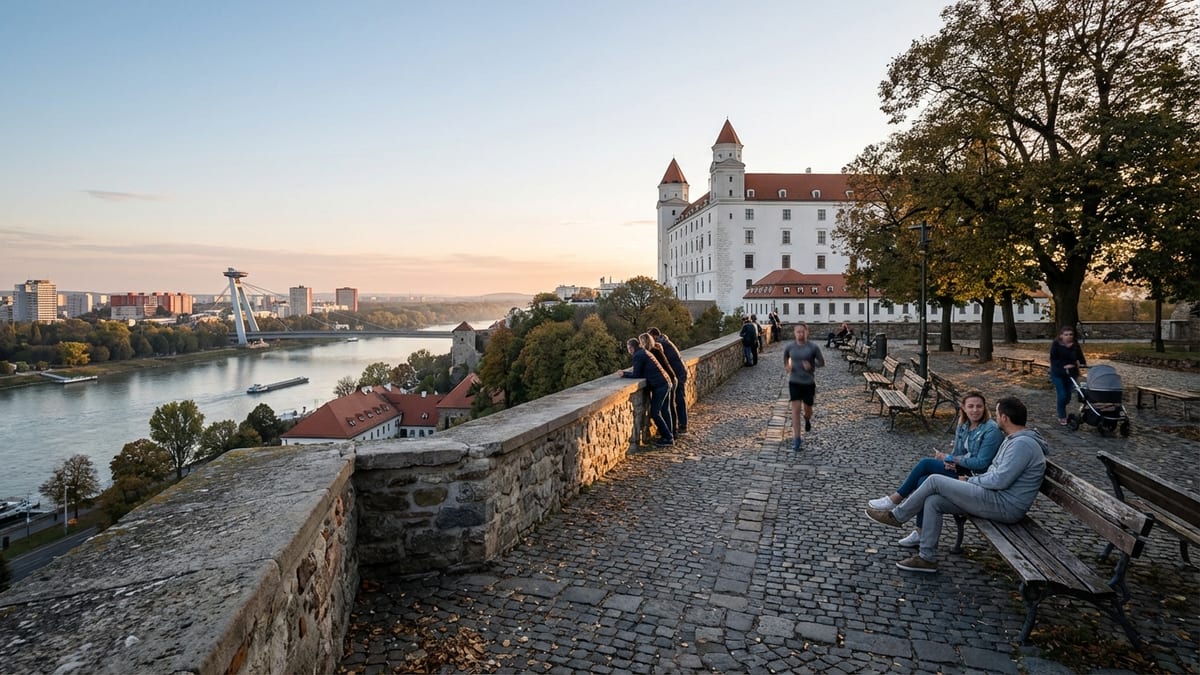
Bratislava Castle, perched on a hill above the Danube, dominates the skyline and offers broad views over the city and into neighbouring Austria. The current four towered structure reflects extensive postwar reconstruction, but its roots as a fortification date back many centuries. Exhibitions inside trace Slovak and regional history, while the surrounding terraces and gardens give visitors a sense of how closely the city has long been tied to the river below.
The city’s role as a coronation centre for Hungarian royalty between the sixteenth and nineteenth centuries provides another historical layer. Information from local cultural institutions notes that the so called coronation route, marked through the Old Town, connects key churches and squares associated with royal ceremonies. Along the way, visitors encounter surviving gates, fountains and plaques documenting the period when the city, then known as Pressburg or Pozsony, served as a political and religious focal point of the Habsburg lands.
Museums housed in historic buildings deepen this journey into the past. Apponyi Palace and the adjacent Old Town Hall, for example, form part of a network of city museums covering topics from decorative arts and civic history to historic wine production. Nearby palaces and churches, some reconstructed after wartime damage, reflect architectural fashions from Gothic and Renaissance through to high baroque, giving the compact centre an unusually dense concentration of styles.
Architecture from Baroque Facades to Futuristic Towers
Bratislava’s appeal increasingly lies in the contrast between its preserved historic core and a fast changing skyline along the Danube. On one side of the river, visitors find the atmospheric Old Town, baroque palaces and the castle. On the other, new quarters such as Eurovea City and the Nivy zone showcase glass fronted residential towers, office blocks and shopping centres that signal the city’s recent economic shifts.
One of the most visible symbols of this newer Bratislava is the Eurovea Tower, a residential skyscraper that opened in 2023 and now ranks as Slovakia’s tallest building. Rising beside the Danube promenade, it caps an expanded mixed use development that includes a large riverside shopping mall and public squares. Planning documents describe Eurovea City as a new social and cultural focal point, with landscaped parks, sports areas and waterfront terraces that have drawn both residents and visitors toward the river.
Further east, the Nivy district adds another contemporary layer. The recently completed Nivy bus station and shopping centre integrate regional transport with a multi level mall and a rooftop park, while the adjacent Nivy Tower, inaugurated in 2020, still stands among the tallest office buildings in the country. Architectural features in this cluster, combining international design firms with Slovak studios, signal Bratislava’s ambition to position itself as a modern business and retail hub while remaining physically close to its older quarters.
Across the river, the distinctive bridge commonly known as the UFO Bridge, with its saucer like structure above the main span, continues to be one of the city’s most photographed modernist landmarks. Together with riverside residential projects and refurbished embankments, it frames views that juxtapose centuries old silhouettes against contemporary high rise profiles, an urban landscape that many recent travel reports describe as unexpectedly dynamic for a city of just over 400,000 residents.
Cafes, Markets and Everyday Local Life
For travellers seeking a sense of local rhythm alongside the main sights, Bratislava offers a growing cafe and market culture that remains relatively accessible on a mid range budget. Coffeehouses line Old Town streets and newer neighbourhoods, with typical prices reported between two and four euros for espresso based drinks. Many operate in vaulted historic interiors or on small terraces, reinforcing the city’s reputation as a place to linger rather than rush between attractions.
Food pricing also contributes to the destination’s value image. Travel planning resources note that lunchtime fixed menu offers, known locally as denné menu, often fall in the seven to twelve euro range, including soup and a main course. Evening mains at mid range restaurants typically start around twelve euros and extend to the mid twenties, allowing visitors to sample Slovak specialities such as bryndzové halušky alongside Central European classics without facing the higher bills common in Vienna or other Western capitals.
Markets provide another window into daily life. The historic Old Market Hall, or Stará tržnica, hosts regular community markets featuring local produce, baked goods and small batch drinks, particularly at weekends. Newer retail environments, including indoor food halls within recent developments, reflect changing tastes in the city while still offering price points that remain attractive for travellers monitoring their spending.
Beyond the centre, public parks, riverbank paths and neighbourhood squares round out the picture. The Danube embankment near Eurovea has become an evening promenade zone, while trams and buses connect central streets with residential districts and nearby natural areas. Reports from visitors frequently describe Bratislava as a city where it is easy to shift from sightseeing to everyday observation, moving from castle views to local playgrounds and from baroque courtyards to modern housing estates within the same afternoon.
Strategic Stop on the Central European Circuit
Bratislava’s geography underpins much of its growing visibility on the travel map. The city sits less than 60 kilometres from Vienna and lies on rail and bus corridors linking Prague and Budapest. As a result, it often features as a stop on multi city routes, either for a dedicated two or three night stay or as an overnight break between larger capitals. Rail journey times of around one hour from Vienna and several hours from Prague or Budapest make it a convenient detour without substantial additional transport cost.
Tourism boards and independent travel planners increasingly promote triangle style itineraries that connect Vienna, Bratislava and Budapest, presenting the Slovak capital as the most affordable of the three and the easiest to navigate on a short timetable. Publicly available guidance often suggests that even a single full day allows for a walk through the Old Town, a visit to Bratislava Castle and an evening on the Danube promenade, while longer stays open up nearby excursions to castle ruins and wine growing villages.
For city break travellers seeking a blend of historical depth, emerging architecture and manageable costs, Bratislava’s current trajectory makes it an appealing alternative to more established Central European favourites. The combination of compact scale, cross border connections and a still favourable price environment means that, at least for now, this riverside capital continues to live up to its reputation as a hidden gem with one of the more compelling value propositions in the region.