

More news on this day
What began as a handful of viral drone shots hovering above the rooftops of Rocinha, Rio de Janeiro’s largest favela, has rapidly evolved into a global “Rocinha trend” that is reshaping how travellers and tourism marketers in Brazil and Portugal present working-class urban neighborhoods to the world.
Get the latest news straight to your inbox!
From Viral Drone Video to Global Travel Aesthetic
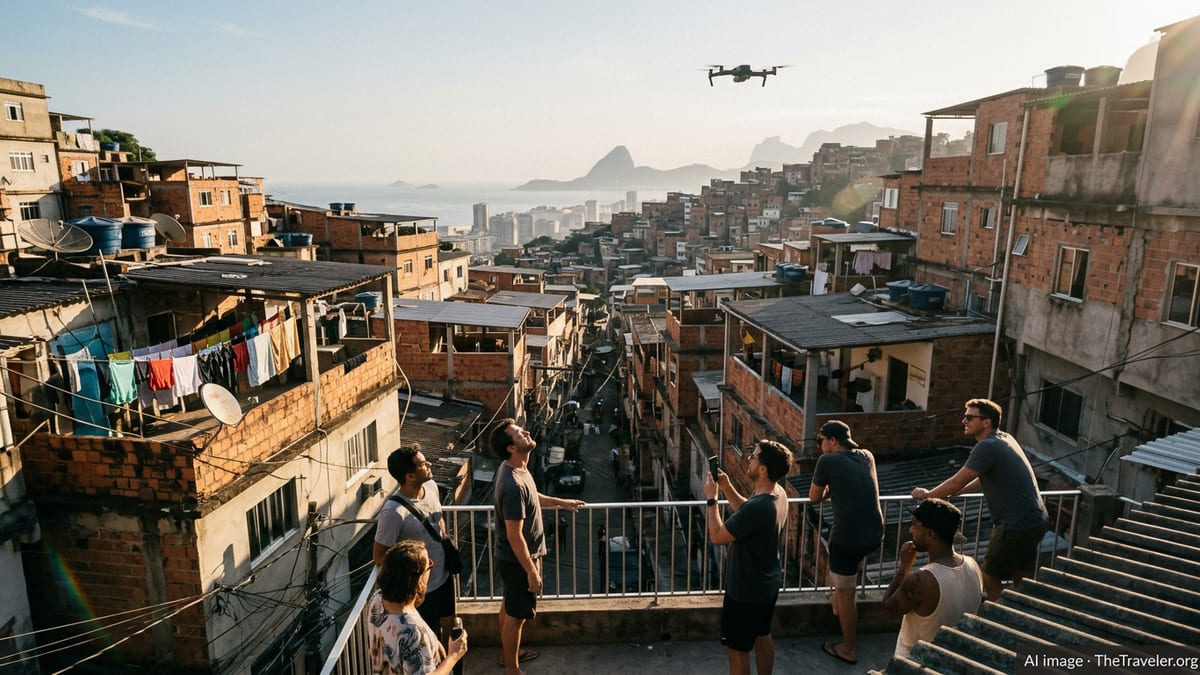
The latest surge of attention on Rocinha followed a widely shared drone video released in early March, set to upbeat Brazilian funk and sweeping across the community’s dense hillside skyline. Publicly available coverage describes tourists queueing on exposed concrete rooftops at viewpoints such as the so-called “Porta do Céu,” waiting for their moment in front of the camera as the drone traces an arc over their heads and out toward the ocean-framed city below.
Reports indicate that this type of content now forms a recognizable social media aesthetic: neon trainers on bare slabs of concrete, laundry lines fluttering beside panoramic vistas, and carefully framed shots that contrast informal brick housing with the sculpted silhouettes of Rio’s coastal mountains. Travel outlets and lifestyle sections in Europe and Latin America have begun referring to this constellation of images as part of a “Rocinha trend,” shorthand for an aspirational, street-level view of Rio that is spreading across TikTok, Instagram and YouTube.
Tourism-focused reporting also notes that Rio is entering a new high in international visitor numbers, and Rocinha has emerged as one of the most visible symbols of this shift. Visitors are increasingly skipping traditional postcard angles of Copacabana in favor of alleys, staircases and rooftops in favelas that offer both skyline views and a sense of proximity to everyday life.
Researchers who have tracked favela tourism for years point out that guided visits in Rocinha began long before the current wave of social media interest. However, the speed and scale of the recent boom, propelled by influencers and viral trends, is changing the profile of who comes, how they move through the neighborhood and what they expect to see.
Favela Tourism Reimagined in Brazil
Recent articles on Brazil’s tourism sector suggest that Rocinha and other Rio favelas are now firmly positioned within the city’s mainstream visitor economy. Public data from the national tourism promotion agency indicates that international arrivals to Brazil are climbing, with Rio capturing a significant share thanks in part to demand for “authentic” urban experiences that highlight daily life away from formal beachfront districts.
In Rocinha, walking tours led by residents have multiplied, adding to a landscape that already includes hostels, guesthouses and rooftop bars catering specifically to visitors. Travel features describe itineraries that thread together narrow lanes, local markets, samba schools and community art projects, often ending at elevated terraces where guests pose for the now-iconic drone or smartphone shots looking out toward the coast.
Guides and community organizations quoted in past research on favela tourism have long advocated for models that prioritize storytelling, local entrepreneurship and transparency around issues such as inequality, policing and urban policy. The current Rocinha trend, however, sits at a complicated intersection between those aims and a new wave of visual tourism that can easily slide into treating the favela as an exotic backdrop.
Commentary in Brazilian and international media highlights this tension. Some residents welcome the visibility and income that tourism brings, citing new jobs in guiding, hospitality, gastronomy and creative services. Others voice concern that the most widely shared images flatten Rocinha into a dramatic contrast between poverty and spectacle, downplaying the community’s complexity and the structural challenges that shape daily life.
How Portugal Is Adapting the Rocinha Look
While the Rocinha trend is rooted in Rio, tourism and lifestyle coverage in Portugal shows how its visual language is travelling. In Lisbon and Porto, tour operators, content creators and neighborhood businesses are increasingly promoting experiences in historically working-class or rapidly gentrifying quarters using imagery that echoes the Rocinha aesthetic: high viewpoints over tightly packed housing, graffiti-filled stairways, sunset rooftops and alleyway scenes framed as “real life” beyond standard tourist circuits.
Publicly available marketing materials for urban tours in districts such as Lisbon’s Mouraria and Graça or Porto’s Campanhã lean into this mood with compositions that feel familiar to viewers of Rocinha content. Influencers based in Portugal have begun referencing favela imagery directly in captions and hashtags, drawing comparisons between Atlantic-facing hillsides in Rio and Lisbon’s own stacked neighborhoods.
Portuguese travel commentators have also noted a surge of interest in Brazil among younger travellers, partly fuelled by social media trends that showcase favelas as vibrant cultural spaces rather than purely sites of deprivation. Airlines and tour companies promoting Brazil-bound itineraries from Lisbon now routinely feature rooftop views of Rio’s hillsides alongside more traditional imagery of Christ the Redeemer and coastal beaches.
This cross-Atlantic feedback loop means that visual ideas originating in Rocinha are being reinterpreted within Portugal’s own tourism landscape, even as Portuguese-based media outlets report on the debates in Brazil about the ethics of turning marginalized neighborhoods into Instagram-ready stages.
Ethical Questions Around the Rocinha Trend
As the Rocinha trend grows, so does scrutiny of its implications. Comment pieces in Brazilian and European outlets point out that the same images attracting visitors can reinforce longstanding stereotypes if stripped of context. When short-form videos focus solely on dramatic skylines, gunshot soundtracks or choreographed dances on rooftops, they risk reducing a complex urban community to a consumable spectacle.
Human rights organizations and urban policy researchers quoted in recent coverage argue that tourism in favelas should be evaluated against basic questions of consent, benefit and representation. They raise concerns about visitors entering areas without understanding security dynamics, photographing residents without permission or treating visible poverty as a prop for social media engagement.
At the same time, many studies highlight that tourism, when driven by local residents and grounded in clear community priorities, can be a tool for visibility and economic opportunity. In Rocinha, reports describe cooperatives, social enterprises and independent guides experimenting with models that reinvest income in education, cultural programs and public space improvements, and that encourage longer stays rather than quick “safari-style” visits.
The debate now unfolding in Brazil and echoed in Portugal centers on how to differentiate between what some call “poverty tourism” and forms of travel that foster mutual learning. The Rocinha trend, with its unmistakable visual signature, has become a litmus test for these broader questions about how social media is reshaping the ethics of urban exploration.
What Travellers Will Find on the Ground
For visitors following the Rocinha trend to Brazil, the experience on the ground is more layered than the clips scrolling past on their phones. Travel and culture articles describe a favela with busy commercial streets, multi-story brick homes, community media projects and an intricate web of social and economic ties that has developed over decades. Rooftop vistas exist alongside schools, health clinics, churches and small businesses that sustain daily life for tens of thousands of residents.
Guides featured in tourism coverage emphasize that conditions can change quickly and that safety considerations remain central, including the need to monitor police operations and local dynamics. Responsible operators encourage small-group visits, clear briefings on where photography is appropriate, and itineraries that include local cafés, artisan workshops and cultural centers rather than only elevated viewpoints.
In Portugal, travellers drawn by Rocinha-inspired imagery will typically encounter a different urban reality, one framed by European planning norms and regulations but still marked by questions of inequality, housing access and gentrification. Neighborhood tours that borrow from the Rocinha look often blend viewpoints with stops at community-run venues, traditional eateries and contemporary creative spaces, inviting visitors to think about how global tourism and social media are reshaping old districts.
Across both sides of the Atlantic, the Rocinha trend underlines how quickly a single neighborhood’s image can reverberate worldwide. For destinations, it offers an opportunity to highlight underrepresented stories and diversify tourism beyond classic icons. For travellers, it presents an invitation to look past the trending visuals, ask who is narrating the city and seek out experiences that contribute meaningfully to the places they have come to see.