

More news on this day
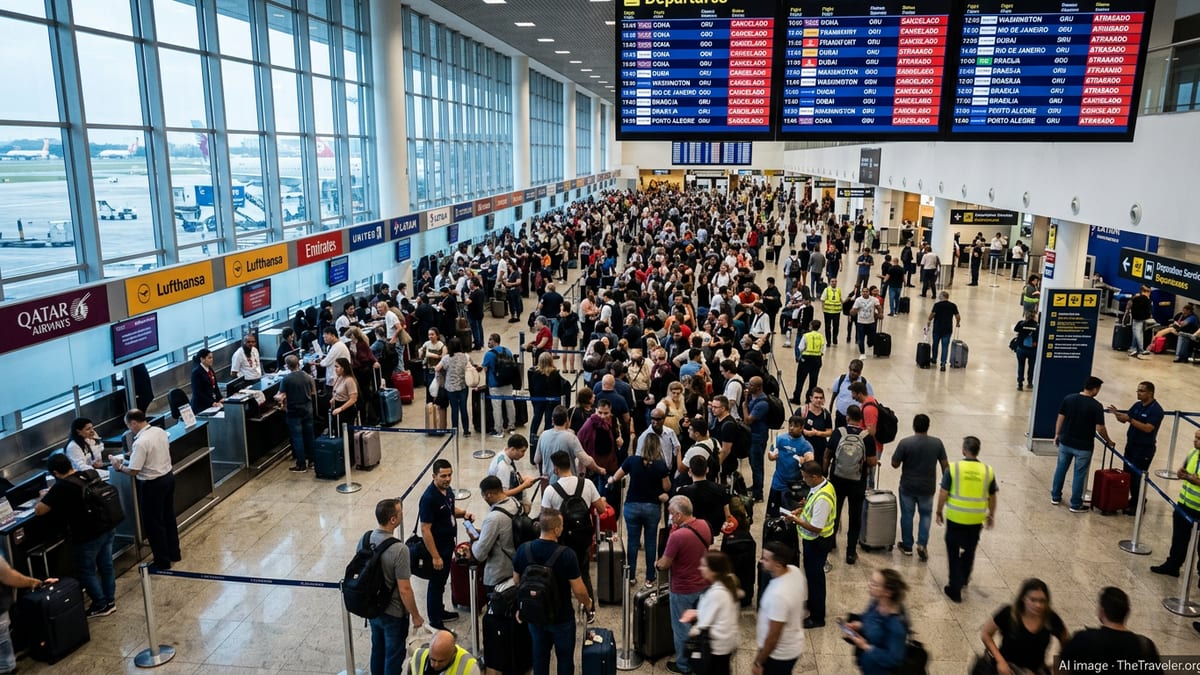
Travelers across Brazil faced fresh disruption on March 13 as more than 20 international and domestic flights operated by Qatar Airways, Lufthansa, Emirates, United Airlines, LATAM and other major carriers were cancelled or heavily delayed, hitting key routes to Doha, Frankfurt, Dubai, Washington, São Paulo, Rio de Janeiro, Brasília, Porto Alegre and other hubs.
Get the latest news straight to your inbox!
Middle East Airspace Turmoil Reaches Brazilian Hubs
The latest wave of cancellations in Brazil is closely tied to the ongoing closure and restriction of airspace across parts of the Middle East, which has forced airlines to reroute or suspend long-haul services. Following Iranian strikes on Qatar and the temporary closure of Qatari airspace in late February, Hamad International Airport in Doha has been operating with limited corridors, constraining Qatar Airways’ global network and leading to rolling cancellations and schedule cuts.
As carriers juggle longer routings to avoid conflict zones and cope with congestion at alternative waypoints, aircraft and crews have been left out of position. The knock-on effect is now being felt on South American sectors, where widebody aircraft are in high demand for transatlantic and transpacific links. Flights between Brazil and major connecting hubs in the Gulf, Europe and North America have been among the first to be trimmed as airlines prioritize core corridors and repatriation needs.
Across Asia, the Gulf and Europe, thousands of flights have already been cancelled or delayed in recent days, with Qatar Airways, Emirates and other carriers reporting widespread disruption. The tightening of schedules at these hubs has reduced flexibility for airlines to recover when something goes wrong downstream, leaving Brazilian departures and arrivals particularly vulnerable when aircraft are late arriving from earlier legs.
Industry analysts note that while Brazil is geographically far from the Middle East flashpoints, its reliance on long-haul connections to Doha, Dubai and European hubs means that any severe disruption in those regions quickly reverberates through São Paulo, Rio de Janeiro and Brasília, especially during peak travel periods.
Key International Routes Hit: Doha, Frankfurt, Dubai and Washington
Among the most closely watched cancellations on March 13 were long-haul services linking Brazil with Doha, Frankfurt, Dubai and Washington. Qatar Airways, still operating a reduced schedule from Doha, has cut selected rotations on its São Paulo–Doha service as it works within constrained airspace corridors and reallocates aircraft to priority routes. Passengers scheduled to connect onwards to Asia and Africa from Doha are being rebooked on later dates or rerouted via partner airlines where seats are available.
Lufthansa, already contending with broader Middle East-related restrictions on certain destinations, has also adjusted its long-haul program. Its Frankfurt–São Paulo and Frankfurt–Rio de Janeiro flights have seen isolated last-minute cancellations and aircraft swaps as the German carrier redistributes capacity across its network. Some Brazilian passengers booked via Frankfurt onward to the Middle East have been rerouted through alternative European gateways or placed on later departures.
Emirates’ Dubai–São Paulo and Dubai–Rio de Janeiro routes have been affected as the airline rebuilds its schedule after significant disruption earlier in the month. With Dubai International facing elevated levels of cancellations and delays, selective Brazilian services have been pulled from the timetable or consolidated, leaving some travelers in São Paulo and Rio scrambling for alternatives at short notice.
In North America, United Airlines has seen schedule strain on its Brazil services to and from Washington and other U.S. hubs. The carrier is managing equipment and crew rotations that pass through European and Middle Eastern airspace, and in several cases has opted to cancel or retime Brazilian legs to maintain operational resilience elsewhere in its network.
Domestic Ripple Effects for São Paulo, Rio, Brasília and Porto Alegre
The international cancellations have quickly translated into domestic disruption, particularly at Brazil’s busiest hubs. At São Paulo–Guarulhos, where LATAM, Qatar Airways, Lufthansa and Emirates all operate, the loss of inbound long-haul flights has meant missed connections for passengers heading on to domestic destinations such as Brasília and Porto Alegre. With some long-haul arrivals scrubbed from the board, LATAM and other Brazilian carriers have had to rebook travelers onto later domestic departures, often resulting in long queues at service desks.
Rio de Janeiro has seen a similar pattern, with cancelled or heavily delayed overseas flights creating a cascade of missed onward connections. Travelers arriving late on substitute services, or not arriving at all due to cancellations at origin, have forced airlines at Galeão and Santos Dumont to reshuffle seat allocations and in some cases operate domestic flights with lighter loads while others are overbooked.
In Brasília and Porto Alegre, which act as important secondary hubs and feeders into São Paulo and Rio, schedule irregularities have been compounded by aircraft rotation challenges. Planes and crews that normally cycle through a predictable pattern of long-haul and domestic legs are now being repositioned on an ad hoc basis. This has led to punctuality problems and sporadic cancellations across Brazil’s internal network, even on routes far removed from any international gateway.
LATAM, Brazil’s largest carrier, has been under particular pressure, balancing its role as a domestic backbone with its own long-haul commitments to Europe and North America. While most LATAM flights are operating, the carrier has confirmed isolated cancellations and retimings where inbound connecting traffic has evaporated due to overseas disruptions or where aircraft have been redeployed to cover stronger-performing routes.
What Affected Passengers in Brazil Should Do Now
Travel experts are urging passengers booked to or from Brazil in the coming days to treat their flights as “at risk” and to monitor status updates closely. Airlines including Qatar Airways, Lufthansa, Emirates, United and LATAM are updating their schedules frequently as conditions evolve, and changes may not be reflected immediately on third-party travel sites or older itineraries. Checking airline apps and airport departure boards on the day of travel has become essential.
Most major carriers have introduced or expanded flexible rebooking policies in response to the ongoing disruption, allowing passengers on affected dates to change their travel plans without additional change fees. Depending on the airline and fare type, travelers whose flights are cancelled may be entitled to a full refund or a free rebooking to a later date, although options can be limited on heavily booked routes. Passengers are being advised to accept viable alternatives quickly, as remaining seats on other services are filling fast.
At the airport, Brazilian authorities and ground handlers are preparing for further days of irregular operations. Travelers are being encouraged to arrive early, particularly if they need to check baggage or resolve ticketing issues at the counter. With phone and chat support lines from global airlines heavily congested, many passengers are finding that in-person assistance at the airport or through local ticket offices yields faster results than remote channels.
For those with time-sensitive trips, such as business travelers or those connecting to cruises and tours, experts suggest exploring contingency options that bypass the most affected hubs. This can include flying via less congested European gateways or using alternative Latin American connections where available, even if it means a more complex itinerary in the short term.
Outlook: More Volatility Ahead for Brazil’s Long-Haul Links
While airlines and aviation authorities stress that safety is not at risk, there is little expectation that schedules will stabilize immediately. The combination of restricted Middle Eastern airspace, displaced aircraft, and ongoing adjustments by carriers suggests that Brazilian long-haul routes will continue to experience volatility through at least the second half of March.
Qatar Airways and Emirates are gradually rebuilding capacity but remain constrained by airspace rules and operational complexities, limiting their ability to restore full service to Brazil at short notice. European carriers such as Lufthansa are likewise dealing with network-wide disruptions tied to rerouted flights and crew duty limitations, leaving limited slack in their systems to absorb further shocks.
For Brazil, the timing is particularly challenging, as demand for international travel remains robust and key markets in Europe, the Middle East and North America rely on consistent connectivity. Airports in São Paulo, Rio de Janeiro, Brasília and Porto Alegre are working closely with airlines to manage congestion, improve communication in terminals and minimize overnight strandings, but much depends on developments far beyond Brazilian airspace.
Industry observers say travelers should prepare for a period in which sudden cancellations, aircraft swaps and extended layovers become more common on journeys linking Brazil with Doha, Frankfurt, Dubai, Washington and other global hubs. Flexibility, real-time information and a willingness to adjust plans are likely to remain essential tools for anyone flying in and out of Brazil’s major airports in the days ahead.