

More news on this day
Hundreds of air travelers across Brazil faced unexpected disruption today as airports in Rio de Janeiro, São Paulo, and Florianópolis reported 227 delayed and 30 canceled flights, tangling schedules for LATAM Brasil, GOL Linhas Aéreas Inteligentes, Azul Brazilian Airlines, and several smaller carriers.
Get the latest news straight to your inbox!
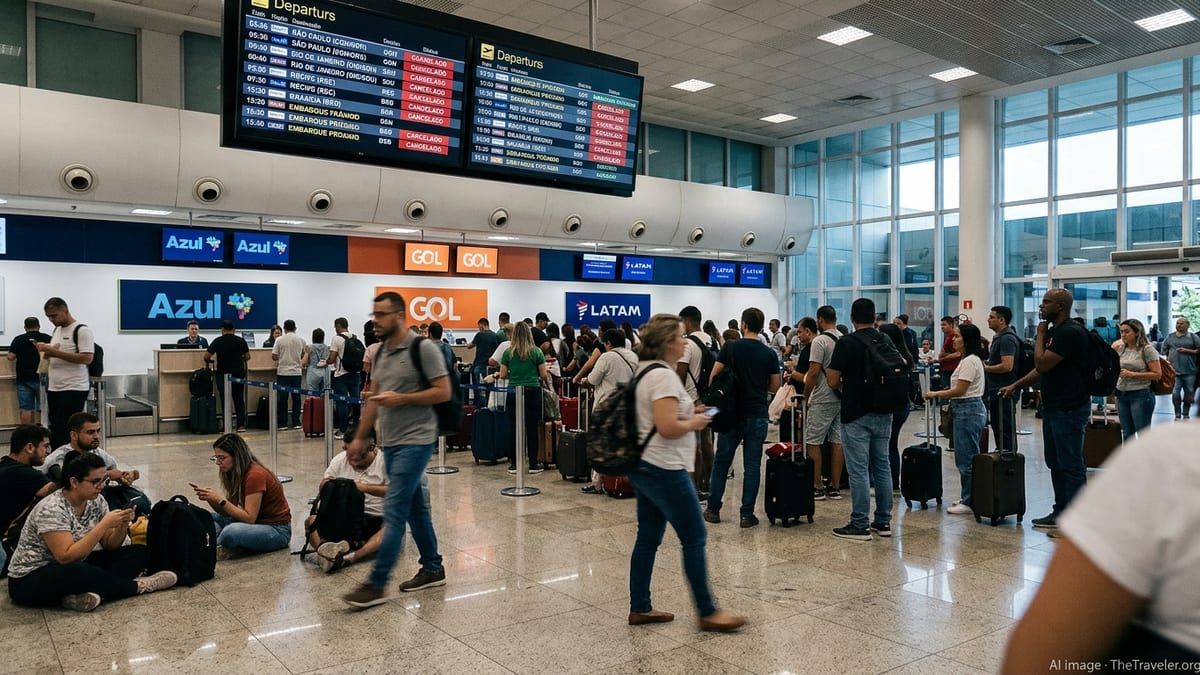
Wave of Disruptions Across Key Brazilian Hubs
Aggregated data from Brazilian airport monitoring platforms for April 11, 2026 indicate a fresh wave of operational problems centered on the country’s busiest air corridors. Rio de Janeiro, São Paulo, and Florianópolis recorded a combined 227 delayed flights and 30 cancellations, affecting a mix of domestic trunk routes and shorter regional sectors.
Published coverage from aviation and travel outlets notes that São Paulo’s dual airports, Guarulhos and Congonhas, once again sit at the heart of the turbulence, with delays in departure banks quickly rippling through to Rio de Janeiro’s Galeão and Santos Dumont airports. Florianópolis, a key leisure gateway in southern Brazil, has also reported a notable rise in late operations as aircraft struggle to arrive on time from the large southeastern hubs.
While the disruption totals are lower than nationwide peaks reported on April 9 and 10, when hundreds of additional services were impacted, today’s figures show that Brazil’s domestic network is still recovering. Airlines are operating full weekend schedules at the same time as they work to reposition aircraft and crews, increasing the risk of knock-on delays.
According to publicly available tracking data, the majority of the affected flights are shorter domestic legs of one to two hours, suggesting that congestion in terminal operations and scheduling constraints are contributing to the difficulties rather than long-haul operational issues.
LATAM, GOL, and Azul Bear the Brunt
The country’s three largest carriers, LATAM Brasil, GOL Linhas Aéreas Inteligentes, and Azul Brazilian Airlines, appear to be absorbing most of the impact. These airlines dominate domestic traffic in São Paulo and Rio de Janeiro and operate many of the shuttle-style “air bridge” flights linking the two metropolitan areas with southern destinations such as Florianópolis.
Reports drawing on airport boards and flight-tracking platforms show clusters of late departures and arrivals on high-frequency routes, particularly between São Paulo and Rio de Janeiro, and between São Paulo and Florianópolis. Delays on these core links can quickly cascade throughout carrier networks, as aircraft scheduled for onward connections arrive late into the next city on their rotation.
Smaller regional and international carriers serving the three cities have also been drawn into the disruption. When gate space, departure slots, and ground handling resources are under strain, even airlines with otherwise punctual operations can experience knock-on delays, adding to the tally of affected flights.
Some recent reports have tied broader disruption across Brazil’s airspace to an earlier technical issue at the São Paulo Area Control Centre, which triggered significant disruption on April 9. Although that event occurred days earlier, its effects on fleet positioning and crew rosters are still filtering through weekend schedules.
Travelers Face Missed Connections and Airport Congestion
For passengers, the operational statistics translate into missed connections, long queues, and extended waits in crowded terminals. São Paulo’s Guarulhos and Congonhas airports, which function as primary transfer points for domestic and international itineraries, are particularly sensitive to rolling delays.
Travel and aviation coverage from Brazil describes passengers confronting rows of departure boards dominated by yellow and red status indicators, with estimated departure times pushed back in small increments. In some instances, travelers connecting from international flights into domestic services toward coastal and southern cities risk losing same-day onward options and being forced to rebook for later in the day or the following morning.
In Rio de Janeiro, Santos Dumont’s role as a high-frequency business and leisure gateway amplifies the human impact of even modest levels of disruption. A relatively small number of cancellations can strand large numbers of travelers concentrated on short-haul routes, particularly on busy Friday and weekend travel periods.
Florianópolis, whose airport serves popular beaches and resort towns, is entering a period of heightened demand from both domestic and international tourists. Delays and cancellations there risk unsettling carefully timed itineraries involving hotel check-ins, tour departures, and cruise or bus connections along the Santa Catarina coast.
Ongoing Recovery After Earlier Nationwide Turmoil
The latest figures come on the heels of several days of turbulence for Brazilian aviation. On April 9 and 10, nationwide tallies compiled from airport and industry data showed far higher numbers of delays and cancellations across a wider set of cities, including Brasília, Belo Horizonte, Curitiba, Porto Alegre, and others.
According to published analyses, those earlier disruptions were linked in part to a technical failure affecting air traffic control operations in the São Paulo area, triggering a ground stop and backlog that radiated outward through Brazil’s dense domestic network. As airlines worked to absorb those cancellations and roll disruptions into revised weekend schedules, residual effects have continued to appear in subsequent days.
Industry observers note that Brazil’s air transport system carries heavy traffic through a relatively small number of critical hubs. When one of those hubs faces operational constraints, even briefly, it can force carriers to re-time or cancel flights in multiple regions as aircraft and crew rotations fall out of sequence.
The current pattern of delays and cancellations confined largely to Rio de Janeiro, São Paulo, and Florianópolis suggests that airlines and airport operators have contained the most severe nationwide impacts. Even so, the elevated disruption totals reported today indicate that the network has not yet fully stabilized.
What Passengers Should Expect in the Coming Days
With Brazil’s main carriers still working through a backlog of repositioning movements and schedule adjustments, aviation analysts expect some continued operational instability over the next 24 to 48 hours, particularly on trunk routes between São Paulo, Rio de Janeiro, and southern Brazil. Travelers planning to fly through these cities are likely to encounter extended check in and security lines, as well as last minute gate or timing changes.
Publicly available passenger rights guidance from Brazil’s aviation framework states that customers affected by significant delays and cancellations may be eligible for forms of assistance such as communication support, meal vouchers, accommodation, and rebooking options. The precise level of support typically depends on the length of the delay, the total journey disruption, and the underlying cause.
Travel specialists recommend that passengers keep digital boarding passes and airline contact details readily accessible, monitor airline apps and airport screens frequently, and build additional connection time into itineraries involving transfers in São Paulo or Rio de Janeiro. Those with fixed onward commitments, such as cruises, tours, or long distance bus departures, may wish to consider arriving at their departure city at least a day early until operations show clearer signs of normalization.
As Brazil’s aviation sector continues to expand following the pandemic years, recent events highlight the importance of resilient infrastructure and contingency planning at major hubs. For now, travelers across Rio de Janeiro, São Paulo, and Florianópolis are likely to face at least short term inconvenience as airlines and airports work to bring the system back on schedule.