

More news on this day
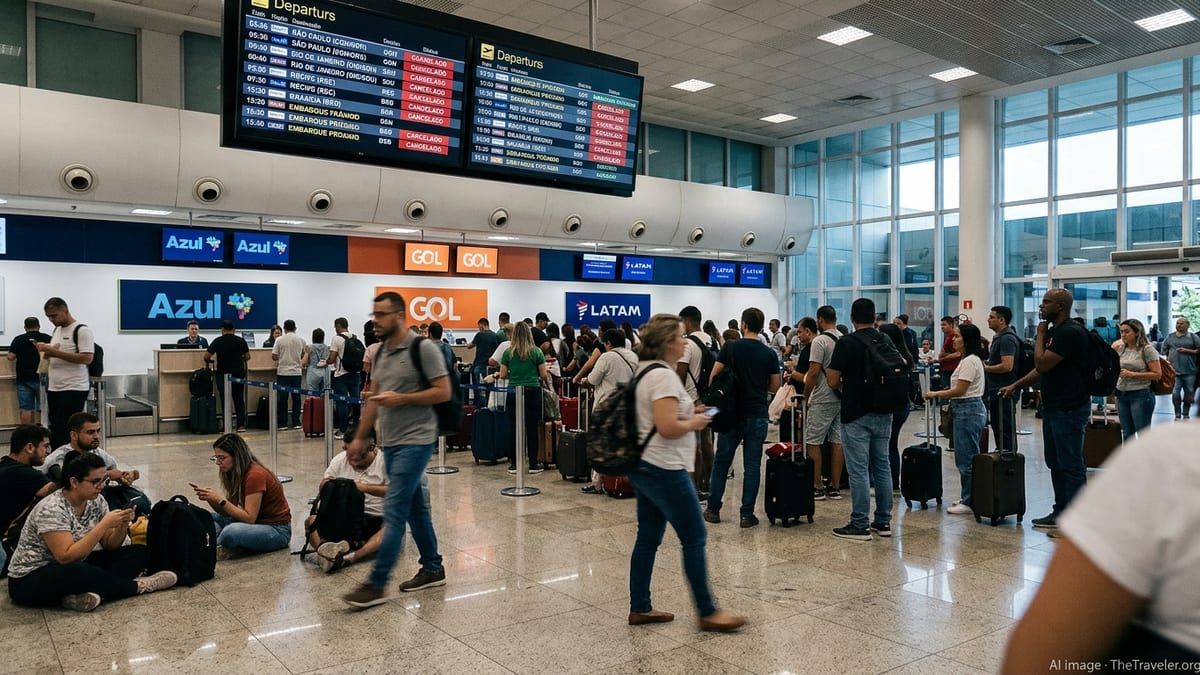
Hundreds of air travelers across Brazil faced long queues, missed connections and disrupted holiday plans as airports in Rio de Janeiro, São Paulo and Florianópolis reported 227 delayed flights and 30 cancellations, affecting operations at LATAM Brasil, GOL Linhas Aéreas Inteligentes, Azul Brazilian Airlines and other carriers.
Get the latest news straight to your inbox!
Disruptions Concentrated at Brazil’s Busiest Coastal Hubs
The latest disruption has centered on three of Brazil’s most important coastal gateways: Rio de Janeiro, São Paulo and Florianópolis. Aggregated schedule and airport data indicate that, across these hubs, 227 departures and arrivals have been delayed and 30 flights cancelled, rippling through domestic and regional networks.
In São Paulo, both Congonhas and Guarulhos have experienced rolling delays, with knock-on effects for shuttle services between São Paulo and Rio de Janeiro and for connections feeding into Florianópolis and other southern cities. Publicly available information shows that even modest schedule changes at these high-frequency routes quickly cascade, tying up aircraft and crews that would normally rotate to other destinations.
Rio de Janeiro’s Santos Dumont and Galeão airports have also been affected, particularly on shuttle and leisure routes along the southeast and southern coasts. Passengers heading to and from beach destinations reported extended waits in terminal areas, with some departures pushed back by more than an hour as airlines worked through congestion.
In Florianópolis, a key entry point for Santa Catarina’s resort region, delays have disrupted both inbound tourism and local residents returning from business trips. While the overall rate of cancellations there remains lower than in São Paulo and Rio de Janeiro, the timing of the disruption during busy travel periods has magnified its impact on travelers.
LATAM, GOL and Azul Operations Under Strain
Brazil’s three largest carriers have borne the brunt of the schedule upheaval. Data compiled from airport boards and flight tracking platforms indicate that LATAM Brasil, GOL Linhas Aéreas Inteligentes and Azul Brazilian Airlines account for most of the delayed and cancelled services across the affected airports.
LATAM’s dense schedule between São Paulo, Rio de Janeiro and southern Brazil means even minor disruptions to a few rotations can accumulate quickly across the network. When aircraft arrive late into São Paulo or Rio, subsequent legs to Florianópolis, Porto Alegre or Brasília often depart behind schedule, leaving travelers facing missed connections.
GOL and Azul, with large domestic footprints and strong regional coverage, have faced similar challenges. According to published coverage, these airlines have seen clusters of delays on high-demand routes, particularly those linking São Paulo with other major Brazilian capitals. Secondary airports feeding into the three main hubs have also reported scattered delays as carriers reposition aircraft.
Other operators, including international airlines relying on connections through São Paulo and Rio de Janeiro, have had to adjust their handling of transit passengers. While most long haul flights have continued to operate, the domestic disruption has complicated onward travel for visitors arriving from North America and Europe.
Knock-on Effects for Passengers and Tourism
The operational turbulence has translated into a difficult day at the airport for many travelers. Reports from passenger forums and local coverage describe crowded check in halls, long security lines and departure boards dominated by delayed statuses at the three hubs.
Tourism businesses have begun to feel the impact as well. São Paulo, Rio de Janeiro and Florianópolis serve as gateways to some of Brazil’s most visited beaches and urban attractions, and delays on domestic legs can cause travelers to lose prepaid nights at hotels or to miss scheduled tours. Industry commentary notes that frequent disruptions add to costs for local operators that depend on predictable arrivals.
Travelers with tight connections have been particularly exposed. A delayed arrival into São Paulo or Rio de Janeiro can mean missing onward flights to smaller destinations that do not operate multiple frequencies per day, forcing passengers to overnight unexpectedly and rearrange itineraries at short notice.
Consumer advocates highlight that, under Brazil’s aviation framework, affected travelers may be eligible for assistance such as meals, communication support or accommodation, depending on the length and cause of the disruption. However, in practice, passengers often report confusion about their exact entitlements when multiple flights across several airlines are disrupted simultaneously.
Persistent Infrastructure and Capacity Challenges
The latest wave of delays has revived questions around capacity and resilience in Brazil’s air transport system. Recent months have already seen episodes of widespread disruption linked to technical issues and weather events, underscoring the sensitivity of the network to bottlenecks at a handful of major hubs.
Published analyses of Brazil’s aviation sector point to a combination of factors behind recurrent congestion, including aging infrastructure at some terminals, high demand on the São Paulo to Rio de Janeiro air bridge and the growing role of secondary hubs. While investments have improved facilities at airports such as Florianópolis, system-wide recovery can still be slow when operations are disturbed at the largest nodes.
Industry observers note that airlines have limited flexibility when disruptions spread across multiple cities at once. With aircraft utilization already high on busy domestic routes, spare capacity to absorb cascading delays is constrained, increasing the likelihood of cancellations once delays exceed certain thresholds.
For international visitors, the pattern of rolling disruption may influence decisions about routing and buffer times. Travel advisors increasingly recommend that passengers build longer layovers in São Paulo or Rio de Janeiro when connecting to leisure destinations in southern Brazil, particularly during peak seasons or periods of unsettled weather.
What Travelers Can Do if Their Flight Is Affected
For those caught up in the latest disruption, travel experts suggest several practical steps to minimize inconvenience. Monitoring flight status through airline apps and airport information screens remains essential, as schedules can change repeatedly throughout the day while carriers work through backlogs.
Passengers are generally encouraged to check in as early as possible and to keep boarding passes, receipts and any written notices related to delays or cancellations. Such documentation can be helpful later when seeking rebooking assistance, refunds or compensation under applicable regulations and airline policies.
Travel planning guidance also recommends allowing generous connection times when routing through São Paulo, Rio de Janeiro or Florianópolis, especially when combining separate tickets issued by different airlines. Travelers with nonrefundable bookings for hotels or tours may wish to confirm change policies in advance and consider travel insurance products that explicitly cover missed connections and delays.
While operations typically normalize over the following days once immediate bottlenecks are cleared, the latest figures from Brazil’s key hubs suggest that travelers using these airports should remain prepared for further schedule adjustments as airlines realign aircraft and crews across their networks.