

More news on this day
Travelers across Brazil faced widespread disruption as more than 40 domestic flights operated by LATAM, GOL and Azul were reportedly cancelled, affecting key routes to São Paulo, Rio de Janeiro, Brasília, Salvador, Campinas and other major hubs.
Get the latest news straight to your inbox!
Wave of Cancellations Across Brazil’s Busiest Corridors
Publicly available flight monitoring data and local media coverage indicate that a concentrated wave of cancellations hit Brazil’s domestic network, with LATAM, GOL and Azul all scrubbing services on some of the country’s busiest corridors. The impact was felt most strongly on routes linking São Paulo, Rio de Janeiro, Brasília, Salvador and Campinas, where dense schedules mean that even a limited number of cancellations can quickly cascade into delays and missed connections.
Reports show that the majority of the affected services were short haul domestic flights scheduled throughout the day from early morning to late evening. While the total number of cancellations surpassed 40 across the three carriers, partial delays and aircraft swaps added further complexity for travelers trying to rebook or make onward connections.
The disruptions come at a time when Brazil’s aviation sector has been working to balance strong demand for domestic travel with infrastructure constraints, crew availability and operational challenges that have periodically strained the system. Recent incident investigations and regulatory actions in the broader market have already put airline reliability and safety culture under increased public scrutiny.
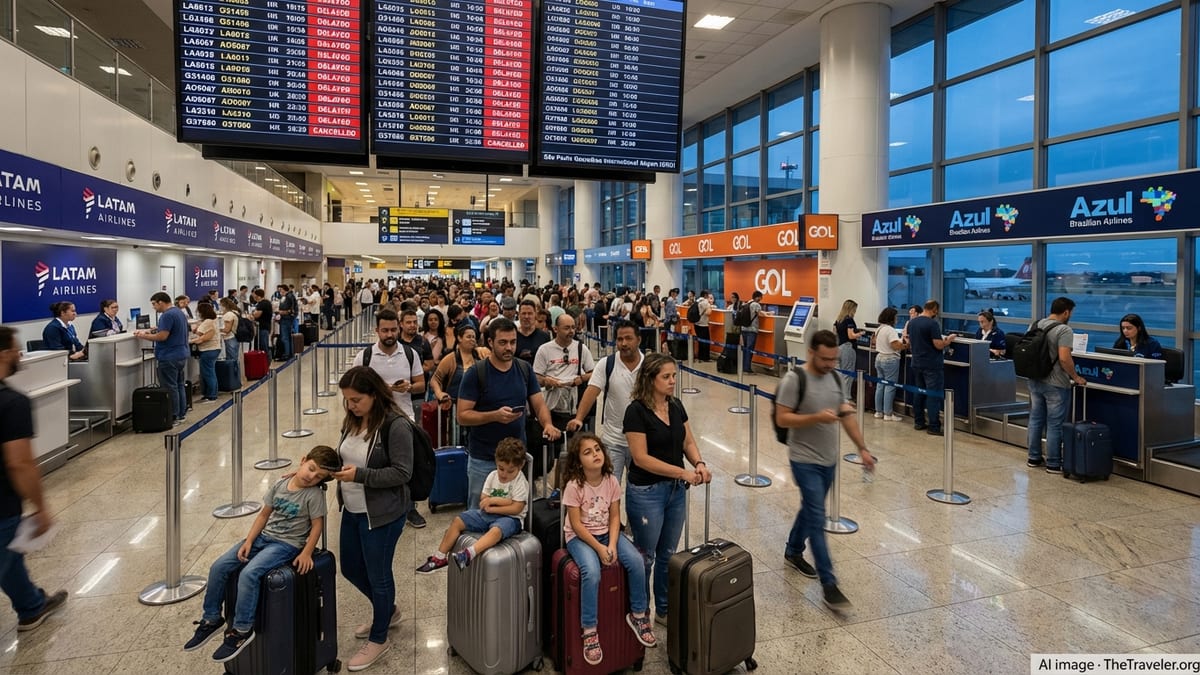
In large metropolitan regions such as São Paulo and Rio de Janeiro, passengers reported congestion at airline desks and longer lines at check in counters as travelers sought alternative flights. Local coverage described scenes of crowded departure halls, with some passengers being shifted to later departures in the evening or the following day.
Key Hubs Affected: São Paulo, Rio, Brasília, Salvador and Campinas
According to live departure boards and tracking platforms, the disruptions were most visible at São Paulo’s Guarulhos and Congonhas airports, which together form the country’s primary domestic and international gateway. Flights linking these airports to Rio de Janeiro’s Santos Dumont and Galeão terminals recorded multiple cancellations, interrupting one of South America’s highest frequency air corridors.
In Brasília, where the airport functions as a central connecting hub for flights across the country, cancellations by LATAM, GOL and Azul reduced options for travelers heading to northern and northeastern destinations. Fewer departures from the federal capital meant longer rerouting times and, in some cases, overnight stays for passengers unable to secure same day alternatives.
Salvador and Campinas also featured prominently in the disruption pattern. Salvador, a key leisure and regional business destination, saw several flights cut from schedules, affecting connections to southeastern cities. Campinas, home to a major Azul base, experienced cancellations that rippled outward to secondary and regional airports, illustrating how issues at one hub can quickly spread through a carrier’s network.
Smaller airports feeding these hubs felt knock on effects as aircraft and crews were repositioned or taken out of service. Even where flights were not fully cancelled, schedule changes and rolling delays made planning more difficult for travelers relying on tight connections.
Operational Pressures and Regulatory Backdrop
Brazil’s aviation sector has been under intensified pressure following a series of operational incidents and regulatory actions in recent years. Published reports from regulators and aviation bodies highlight how carriers are being pushed to improve safety adherence while still meeting strong post pandemic demand on domestic routes.
Available industry filings and analyses suggest that airlines have been contending with a complex mix of factors, including tight crew rosters, aircraft maintenance requirements and congestion at key airports. When disruptions occur early in the day, they can lead to aircraft and crew being out of position, increasing the likelihood of further cancellations or lengthy delays as the schedule progresses.
Observers note that cooperation agreements and shared capacity arrangements between Brazilian airlines can both help and complicate recovery efforts. While these partnerships sometimes allow carriers to place passengers on alternative flights, they also require careful coordination across different operational systems and airports, which can slow down rebooking when a significant number of flights are disrupted at once.
At the same time, regulatory agencies have signaled a willingness to closely monitor reliability and consumer impacts. Recent enforcement actions involving other operators have underscored expectations that airlines maintain robust management systems and contingency planning, even during periods of high demand or operational stress.
What Passengers Are Experiencing on the Ground
Travelers caught in the latest wave of cancellations have reported long waits in check in areas and at customer service counters as they attempt to secure new itineraries. According to accounts shared in local media and on social platforms, some passengers were offered rebooking on later same day flights, while others faced the prospect of overnight stays or detours through alternative hubs.
Publicly available information indicates that airlines were prioritizing rebooking within their own networks first, then exploring options through interline and domestic partnerships where available. For travelers with separate tickets on different airlines, missed connections created additional complications, since onward segments are not automatically protected in those cases.
Experts quoted in local coverage often advise passengers in Brazil to build longer layovers when connecting between different carriers, especially at major hubs such as São Paulo and Rio de Janeiro, where early day disruptions can quickly affect late afternoon and evening services. The latest cancellations are likely to reinforce that caution among frequent travelers.
Travelers attempting to manage disruptions online continue to face the added challenge of inconsistent digital tools. Consumer forums and previous reports have frequently cited difficulties using some airline websites and apps, particularly for foreign passengers trying to modify bookings or process refunds, which can complicate efforts to respond quickly when flights are cancelled at short notice.
Rights, Remedies and Planning Ahead
Consumer organizations in Brazil routinely remind passengers that they have specific rights when flights are cancelled or significantly delayed. Public guidance from government agencies outlines minimum standards for care and assistance, which can include meals, accommodation and rebooking options, depending on the length and cause of the disruption.
Legal specialists commenting in local coverage note that travelers should keep documentation such as boarding passes, receipts and written communications with airlines, as these records help support claims for reimbursement or compensation where applicable. Passengers are encouraged to check the latest rules published by Brazilian consumer protection bodies and the country’s civil aviation regulator for detailed information.
For upcoming trips, travel planners suggest building additional buffer time into itineraries that rely on domestic connections in Brazil, particularly when using multiple airlines or traveling during peak periods. Flexible tickets, travel insurance that covers missed connections and careful attention to minimum connection times at major hubs can all reduce exposure to schedule shocks.
While the latest cancellations involving LATAM, GOL and Azul represent only a fraction of Brazil’s daily flight operations, the disruption illustrates how vulnerable busy domestic networks can be to operational stresses. As demand continues to grow, the balance between capacity, reliability and consumer protection is likely to remain a central issue for airlines, regulators and travelers across the country.