

More news on this day
Domestic air travel in Brazil faced fresh disruption this weekend as more than 40 flights operated by LATAM, Gol and Azul were reportedly cancelled, causing delays and last-minute changes for passengers traveling to and from São Paulo, Rio de Janeiro, Brasília, Salvador, Campinas and other major cities.
Get the latest news straight to your inbox!
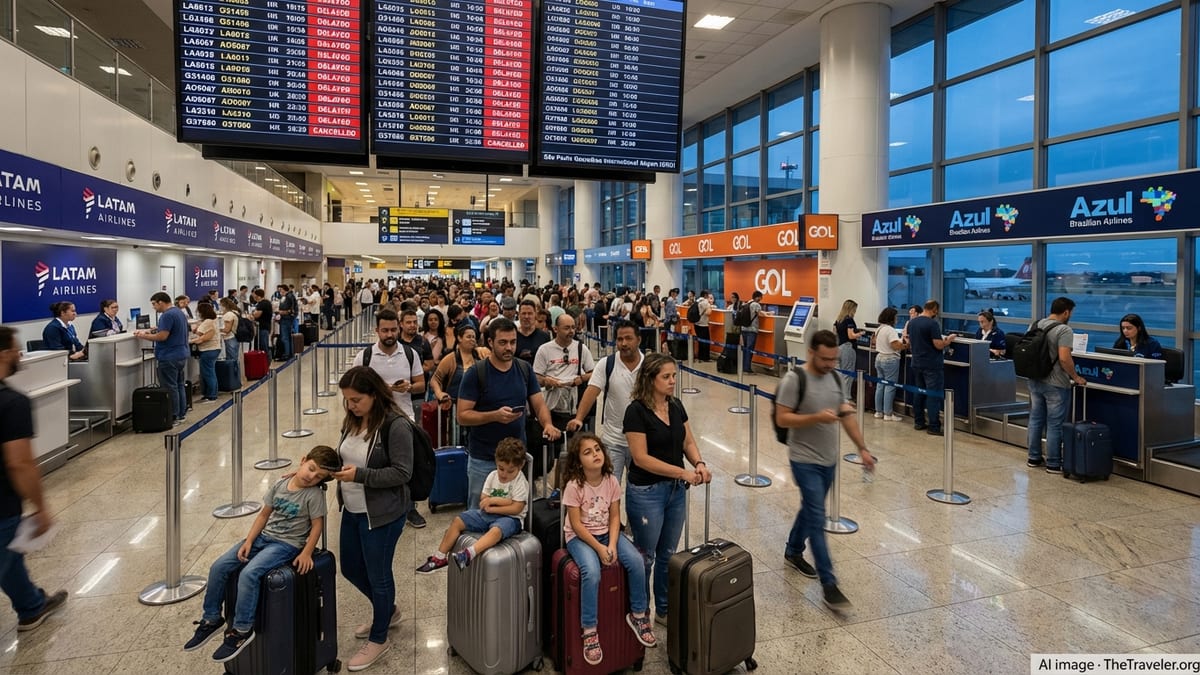
Image by Travel and Tour World – Tourism, Airline, Destination, MICE, Gobal Travel Market, Hotel news that you will find only over here.
Wave of Cancellations Across Brazil’s Busiest Routes
Publicly available data from airport boards and national media reports indicate that cancellations were concentrated on high-demand trunk routes linking São Paulo, Rio de Janeiro, Brasília, Salvador, and Campinas, with knock-on effects at secondary airports across the country. While the total number of cancellations remained a small fraction of the daily schedule, the disruption was significant for affected travelers because many of the impacted flights served already busy time slots.
LATAM, Gol and Azul collectively operate the majority of Brazil’s domestic capacity, and disruptions at any one of the three can quickly cascade through the network. When all three cancel flights on the same day, rebooking options narrow and spare seats on remaining services become harder to find, especially on routes such as São Paulo to Rio de Janeiro or Brasília, which are heavily used by both business and leisure travelers.
Information compiled from airline apps and airport monitors shows that cancellations were spread throughout the day, from early-morning departures out of São Paulo and Campinas to evening returns into Rio de Janeiro and Salvador. This pattern amplified delays as crews and aircraft ended up out of position, forcing further schedule tweaks and occasional additional cancellations.
Travelers caught in the disruption reported longer queues at check-in counters and service desks as they sought rerouting, meal vouchers or overnight accommodation. Some passengers were able to secure same-day alternatives, but others faced multi-hour waits or the prospect of flying the following day, particularly on popular coastal and Northeast routes.
São Paulo and Rio de Janeiro Bear the Brunt
Brazil’s largest aviation markets, São Paulo and Rio de Janeiro, were among the most affected, according to airport information screens monitored throughout the day. Congonhas and Guarulhos in São Paulo, along with Santos Dumont and Galeão in Rio de Janeiro, all recorded cancellations by more than one carrier, constraining capacity on some of the country’s busiest city pairs.
At São Paulo’s Guarulhos, a critical hub for LATAM and an important base for Gol and Azul connections, the cancellation of domestic segments had a ripple effect on onward journeys. Passengers who had planned same-day connections to other Brazilian cities reported being rebooked via alternative airports or shifted to later flights, sometimes involving extra stops through Brasília or Campinas.
In Rio de Janeiro, a mix of cancellations at Santos Dumont and Galeão affected short-haul shuttles to São Paulo and Brasília as well as links to Northeast destinations such as Salvador and Recife. With Santos Dumont typically handling high-frequency shuttle operations and Galeão serving as a growing medium and long-haul hub, disruptions at both airports limited flexibility for re-routing within the same metropolitan area.
Ground operations at both metropolitan areas also came under pressure. Reports from travelers described crowded boarding gates, full customer-service lines and heavier-than-normal demand for ride-hailing and taxi services as some opted to switch airports within the same city to catch alternative flights.
Brasília, Salvador and Campinas See Knock-On Effects
The cancellations also weighed on Brasília, Salvador and Campinas, three airports that play different but complementary roles in Brazil’s domestic network. Brasília, a major connecting hub in the country’s center, relies heavily on flights by LATAM, Gol and Azul to feed traffic north and south, so disruptions on trunk routes into the capital limited available options for travelers making same-day connections.
In Salvador, a key gateway to Bahia and the wider Northeast, cancellations reduced capacity on routes to and from São Paulo, Rio de Janeiro and Brasília. Passengers heading to beach destinations or onward regional airports found fewer same-day alternatives, as aircraft and crews were tied up on revised schedules or positioned elsewhere in the network.
Campinas, Azul’s primary hub, also featured among the affected airports, according to airport-board snapshots. While Azul maintains a dense schedule of flights into Viracopos-Campinas, cancellations on selected departures made it harder to protect all itineraries without resorting to multi-stop routings via São Paulo or Brasília. Travelers using Campinas as an alternative to São Paulo’s main airports reported longer travel times and, in some cases, overnight stays when seats on replacement flights ran out.
Smaller regional airports connected via these hubs were indirectly impacted as well. When feeders from major cities are cancelled, flights onward to secondary destinations can depart with empty seats that were originally reserved for connecting passengers, or in some cases leave with delays while airlines attempt to consolidate disrupted itineraries.
Operational Pressures and Capacity Constraints
Although the precise breakdown of causes for each cancellation was not immediately clear, recent coverage of Brazil’s aviation sector points to a combination of operational pressures and capacity constraints. High aircraft utilization across LATAM, Gol and Azul means that even minor technical issues, crew-availability problems or weather-related delays can trigger a chain reaction, particularly on peak travel days.
Brazil’s leading carriers have been rebuilding networks after the volatility of recent years, carefully balancing aircraft deployment between trunk routes such as São Paulo to Rio de Janeiro and expansion into new or previously underserved markets. This leaves limited slack in the system. When more than 40 flights disappear from the daily schedule, recovery can take several rotations, and the after-effects may be felt for a day or more.
Reports from previous disruption events in Brazil have shown that short-notice operational decisions, such as consolidating lightly booked flights or rotating aircraft to higher-yield routes, can also contribute to timetable changes. For passengers, these internal adjustments often appear simply as cancellations or last-minute schedule changes, regardless of the underlying commercial or operational rationale.
Industry observers note that all three carriers continue to invest in digital tools for customer communication, but gaps remain. During the latest wave of disruptions, some travelers reported receiving app notifications and emails about cancellations in reasonable time, while others said they learned of changes only on arrival at the airport, compounding frustration and uncertainty.
Guidance for Affected Travelers in Brazil
For those currently traveling or planning imminent trips within Brazil, publicly available consumer guidance suggests a few practical steps when faced with cancellations by LATAM, Gol or Azul. Passengers are generally encouraged to monitor airline apps and airport departure boards closely on the day of travel, especially on routes involving São Paulo, Rio de Janeiro, Brasília, Salvador and Campinas, where schedules are dense and subject to rapid adjustment.
Travelers whose flights are cancelled are typically entitled to rebooking options at no additional cost, subject to seat availability. In periods of widespread disruption, however, same-day alternatives may be limited. In such cases, reports indicate that passengers sometimes secure better options by proactively asking about rerouting via alternate hubs or accepting connections rather than waiting for nonstop replacements.
Consumer rights information in Brazil also highlights that significant schedule changes can trigger additional remedies such as refunds or vouchers, depending on the timing of the cancellation and the length of the delay. Passengers are usually advised to retain boarding passes, booking confirmations and written records of any irregular operations issued by the airline, in case they need to file claims with carriers or travel insurers.
With Brazil’s domestic aviation market heavily concentrated among LATAM, Gol and Azul, occasional days of disruption are likely to persist whenever networks are stretched by high demand, adverse weather or operational challenges. For travelers, building extra buffer time into connections and staying flexible about routing can help reduce the impact when cancellations like those seen across São Paulo, Rio de Janeiro, Brasília, Salvador and Campinas abruptly reshape the day’s flight map.