

More news on this day
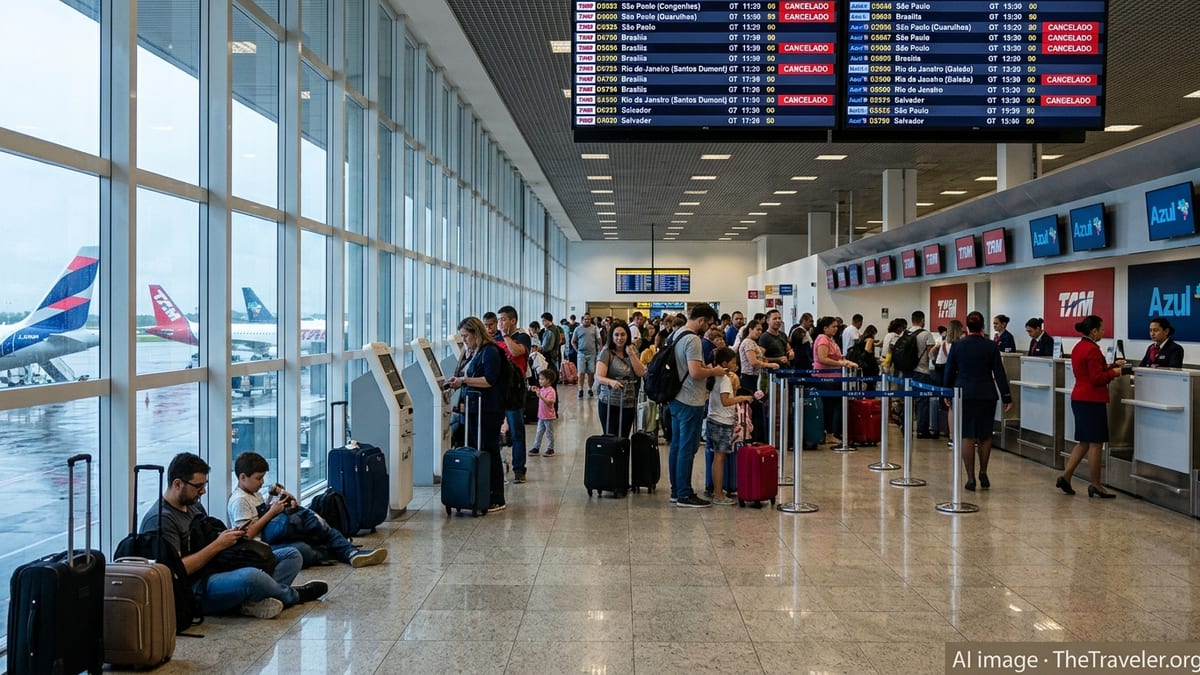
More than 50 flights operated by major Brazilian and regional carriers have been cancelled across the country, disrupting domestic and connecting journeys on busy routes to São Paulo, Brasília, Rio de Janeiro, Salvador and several other key cities, according to early operational data and local media reports.
Get the latest news straight to your inbox!
Major Brazilian Hubs See Wave of Cancellations
Operational data from Brazil’s air traffic and airport monitoring platforms show a concentrated wave of cancellations affecting some of the country’s busiest hubs, including São Paulo’s Guarulhos and Congonhas airports, Brasília International Airport, Rio de Janeiro’s Santos Dumont and Galeão terminals, and Salvador International Airport. Initial tallies indicate that more than 50 scheduled departures and arrivals were withdrawn from service over a short window, creating bottlenecks at check in, security and rebooking desks.
The disruptions are affecting a mix of trunk routes and feeder services, with cancellations particularly evident on high demand corridors linking São Paulo, Brasília, Rio de Janeiro and Salvador. These city pairs account for a substantial share of Brazil’s domestic traffic, and any reduction in frequencies often has a magnified impact on same day connections, especially for travelers relying on tight transfers between regional and long haul services.
Published airport information suggests that knock on effects are also being felt at secondary gateways that depend on these hubs for onward connectivity. Travelers originating in smaller cities and relying on single daily or less frequent services risk losing same day access to Brazil’s main commercial centers when cancellations cluster on the same routes.
Multiple Airlines Affected, From Mainline to Regional Brands
Publicly available airline and regulatory documents indicate that several brands are implicated in the current disruption. Legacy carrier TAM, now part of the LATAM group and still referenced in some regulatory and performance reports, appears among operators adjusting schedules. Azul, one of Brazil’s largest domestic airlines, and its regional affiliate Azul Conecta, identified in aviation statistics under the code ACN, are also involved where smaller aircraft feed traffic into larger hub operations.
Operational metrics published by Brazil’s air navigation authorities and international punctuality analyses show that these airlines typically operate dense schedules at São Paulo, Brasília, Rio de Janeiro and Salvador. When irregular operations occur, even a modest percentage of cancellations can quickly translate into several dozen scrapped flights, particularly on peak travel days and around morning and late afternoon banks of departures.
In addition to direct cancellations, timetable adjustments and equipment changes can complicate the picture for passengers, with some flights being retimed or consolidated rather than outright removed from the schedule. Nonetheless, the aggregate effect for travelers checking live departure boards at the affected airports is a visible reduction in options across multiple carriers serving the same city pairs.
Weather, Congestion and Operational Strain Behind Disruptions
While a single overarching cause has not been formally attributed to the current set of cancellations, recent patterns in Brazil’s aviation sector provide important context. Industry coverage has highlighted how seasonal weather, including localized storms around coastal and inland hubs, frequently constrains operations at short notice. When combined with high traffic density in Brazilian airspace and tight turnarounds on narrow body fleets, these conditions can lead carriers to preemptively cancel a block of flights to restore schedule reliability.
Regulatory performance reports for 2024 and 2025 also point to persistent pressure on on time performance at Brazil’s major airports, with Guarulhos, Congonhas, Santos Dumont, Galeão and Salvador all registering measurable shares of delays and cancellations in recent comparative studies. These documents describe a system operating close to capacity at peak times, where relatively small disruptions can cascade quickly through the day’s operations.
Analysts who follow the Brazilian airline market note that carriers are managing a complex mix of cost controls, post pandemic demand recovery and evolving network strategies, including new long haul launches from São Paulo and regional expansion by feeder operators. The combination of full aircraft, lean staffing and ambitious schedules can leave limited room to absorb unexpected events, increasing the likelihood that airlines will opt to cancel flights outright rather than risk extensive rolling delays.
Passenger Impact on Key Domestic and Connecting Routes
For travelers, the most immediate impact of the latest cancellations is the loss of flexibility on high frequency domestic routes that serve as the backbone of business and leisure travel within Brazil. Flights between São Paulo and Brasília, São Paulo and Rio de Janeiro, and São Paulo and Salvador act as crucial connectors for both point to point journeys and onward international itineraries. When multiple departures on the same route are canceled, options to rebook on the same day become more limited, particularly in peak periods.
Published consumer reports and recent traveler accounts highlight that passengers caught up in cancellations often face long lines at service counters and congested digital channels as they seek rebooking, refunds or alternative accommodations. Those with separate tickets for onward domestic segments are especially exposed, since a missed feeder or trunk flight can invalidate carefully timed connections to secondary cities that may only see one or two flights per day.
Travel planning to and from Salvador and other northeastern destinations may be particularly sensitive to these changes. Routes linking Salvador with São Paulo, Brasília and Rio de Janeiro are key for reaching beach resorts and regional business hubs, and disruptions on these sectors can ripple outward into tourism hotspots along Brazil’s northeastern coastline.
What Travelers Should Watch in the Coming Days
Given the scale of the cancellations already registered, travelers planning to fly within Brazil or connect through São Paulo, Brasília, Rio de Janeiro or Salvador in the coming days are advised, by publicly shared guidance, to monitor their reservations closely and verify flight status repeatedly in the 24 hours before departure. Airline schedules in the region have shown they can evolve rapidly in response to operational pressures, and an initially confirmed booking may still be subject to late adjustment.
Travel industry analyses frequently recommend allowing additional buffer time for connections at major Brazilian hubs, especially when itineraries rely on separate tickets or involve a mix of mainline and regional operators such as TAM branded services within the LATAM group, Azul and Azul Conecta. Building in longer layovers can help reduce the risk that a single cancellation or delay cascades into missed onward flights and overnight disruptions.
Observers of Brazil’s aviation sector suggest that continued monitoring of on time performance statistics and airline schedule updates will be essential to understand whether the current set of cancellations represents a short lived operational shock or the early sign of a more prolonged period of network adjustment. For now, the confirmed loss of more than 50 flights across several key carriers and airports underscores how quickly conditions in Brazil’s busy airspace can change, and why travelers are increasingly encouraged to stay informed right up to the moment of boarding.