

More news on this day
Air travelers across Brazil faced cascading disruption on April 9 after a technical fault in São Paulo’s air traffic control network triggered at least 86 delays and 42 cancellations affecting LATAM, Gol and Azul flights in São Paulo, Rio de Janeiro and Brasília, leaving passengers stranded in major hubs and regional airports.
Get the latest news straight to your inbox!
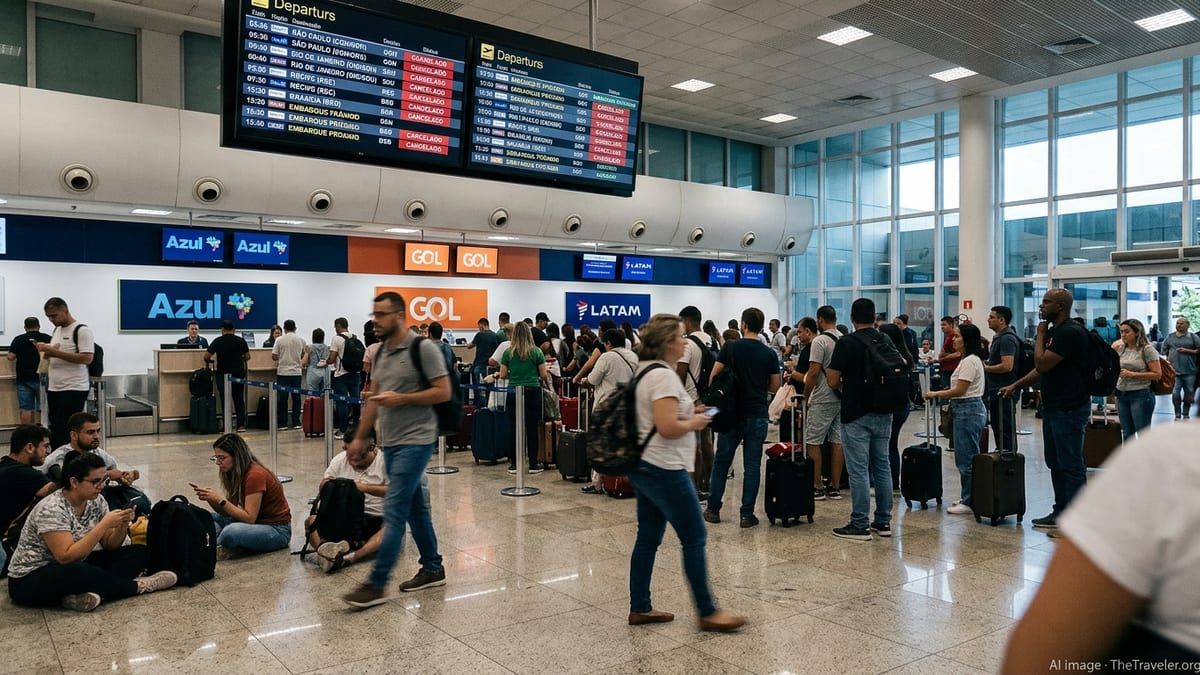
Technical Fault in São Paulo Ripples Across National Network
Publicly available information from Brazil’s civil aviation sector indicates that a power failure at the São Paulo Area Control Center briefly halted takeoffs and landings in one of the country’s busiest air corridors on April 9. Operations around Congonhas and Guarulhos in São Paulo were suspended for a little over an hour while technicians worked to restore the system.
Although the interruption was relatively short, traffic management data and industry reports suggest that the knock-on effects were far more extensive. Flights already in the air were forced to hold or divert, while departures across LATAM, Gol and Azul’s domestic networks were delayed as aircraft and crew fell out of position.
Within hours, updated schedules at airports in São Paulo, Rio de Janeiro and Brasília showed dozens of late departures and arrivals, along with an escalating wave of cancellations. By the end of the afternoon, at least 86 flights operated by the three largest Brazilian carriers were reported delayed, with 42 cancellations concentrated on routes linking the country’s main business and political centers.
Aviation analysts note that the episode underlined the heavy dependence of Brazil’s domestic network on the São Paulo hub, where even brief interruptions can cascade quickly into missed connections and overnight backlogs.
LATAM, Gol and Azul Count Delays and Cancellations
According to press coverage and airline communications reviewed on April 10, Azul reported 12 cancellations and six diversions as a direct result of the temporary shutdown of São Paulo’s airspace, primarily affecting operations at Guarulhos, Congonhas and Viracopos. Gol indicated it had suspended flights to and from key São Paulo airports for around an hour before gradually resuming a reduced schedule.
LATAM, Brazil’s largest carrier by market share, also saw its operations disrupted on trunk routes linking São Paulo to Rio de Janeiro and Brasília. Real-time tracking boards showed mounting delays on LATAM services in and out of Congonhas, Santos Dumont, Galeão and Brasília, with a portion of flights eventually canceled as the day’s rotation became impossible to maintain.
Across all three airlines, the combined tally of disrupted services in São Paulo, Rio de Janeiro and Brasília reached at least 86 delayed flights and 42 cancellations by early evening, based on aggregated airport and schedule data. These figures exclude additional delays and cancellations that appeared later in the night at secondary hubs such as Recife, Salvador and Natal, where aircraft arriving late from the Southeast forced further timetable changes.
Operational bulletins referenced by local media note that carriers attempted to absorb part of the backlog by consolidating lightly booked services and rerouting aircraft. However, with aircraft utilization typically running high across the Brazilian domestic market, the room to recover within the same operating day was limited.
Passengers Face Long Queues, Missed Connections and Overnight Stays
For passengers, the disruption translated into long queues at check-in counters, boarding gates and customer service desks at São Paulo’s Guarulhos and Congonhas airports, Rio de Janeiro’s Santos Dumont and Galeão, and Brasília’s Juscelino Kubitschek International Airport. Social media posts and local news reports described travelers waiting hours for rebooking and information as delay estimates shifted throughout the day.
Travelers with onward domestic connections, especially those booked on tight layovers between São Paulo and Brasília or between Rio and the Northeast, were among the hardest hit. As aircraft left origin airports late or not at all, many passengers missed subsequent flights, forcing rerouting via alternative cities or overnight stays in airport hotels.
The disruption also affected international itineraries. Brazil’s main international gateway at Guarulhos recorded several late departures on long-haul flights after inbound aircraft from Rio de Janeiro and Brasília arrived behind schedule. Some travelers reported having to adjust connecting flights to North America and Europe when feeder services from domestic cities were delayed or canceled.
Consumer advocates and travel specialists cited by local outlets highlighted the importance of keeping receipts for meals, transport and accommodation related to the irregular operations, noting that Brazil’s aviation rules set out specific conditions under which airlines are expected to offer assistance and, in some cases, compensation.
Regulatory Response and Questions About Infrastructure Resilience
Brazil’s national civil aviation regulator activated a pre-crisis protocol in response to the fault at São Paulo’s Area Control Center, according to publicly available regulatory notices. The measure allows closer monitoring of airport operations and coordination among air navigation service providers, airlines and airport operators to stabilize the network.
Regulatory summaries published after the incident indicate that the technical failure was contained and resolved within roughly 70 minutes, after which traffic gradually resumed. However, even a brief loss of capacity in São Paulo’s airspace proved sufficient to create delays stretching across the day, underlining concerns about the resilience of critical aviation infrastructure.
Industry observers note that Brazil has faced episodes of widespread flight disruption in the past linked to infrastructure bottlenecks and air traffic control constraints. While significant investments have been made in recent years to modernize airports and systems, the events of April 9 are being cited in commentary as evidence that key nodes in the network remain vulnerable to single-point failures.
Analysts argue that improving redundancy in air traffic management systems and refining contingency planning for Brazil’s busiest corridors will be essential to mitigate the impact of similar incidents in the future, particularly as domestic travel demand continues to recover and grow.
What Travelers Need to Know for Upcoming Flights
With aircraft and crews still returning to position after the April 9 disruption, schedule data for April 10 showed lingering delays on some LATAM, Gol and Azul routes touching São Paulo, Rio de Janeiro and Brasília. Travel industry monitoring services advised passengers to check the status of their flights repeatedly on the day of travel and to allow extra time for connections, particularly where separate tickets or tight layovers are involved.
Passenger rights information from Brazil’s aviation framework emphasizes that, in cases of significant delay or cancellation, travelers may be entitled to assistance ranging from communication and food vouchers to accommodation and rebooking, depending on the length and cause of the disruption. Publicly available guidance encourages affected passengers to retain documentation of their original booking and any additional expenses incurred.
Travel planners recommend that passengers with nonrefundable hotel reservations, tours or onward transport build flexibility into itineraries over the coming days, especially when itineraries depend on multiple legs within Brazil’s dense Southeast corridor. Booking slightly longer connection times between São Paulo, Rio de Janeiro and Brasília may help reduce the risk of missed flights while the system fully stabilizes.
For now, operational data suggest that airlines are gradually clearing the backlog, but aviation specialists caution that any further shocks, such as adverse weather or localized technical glitches, could temporarily reignite bottlenecks at the country’s busiest hubs while aircraft rotations remain tight.