

More news on this day
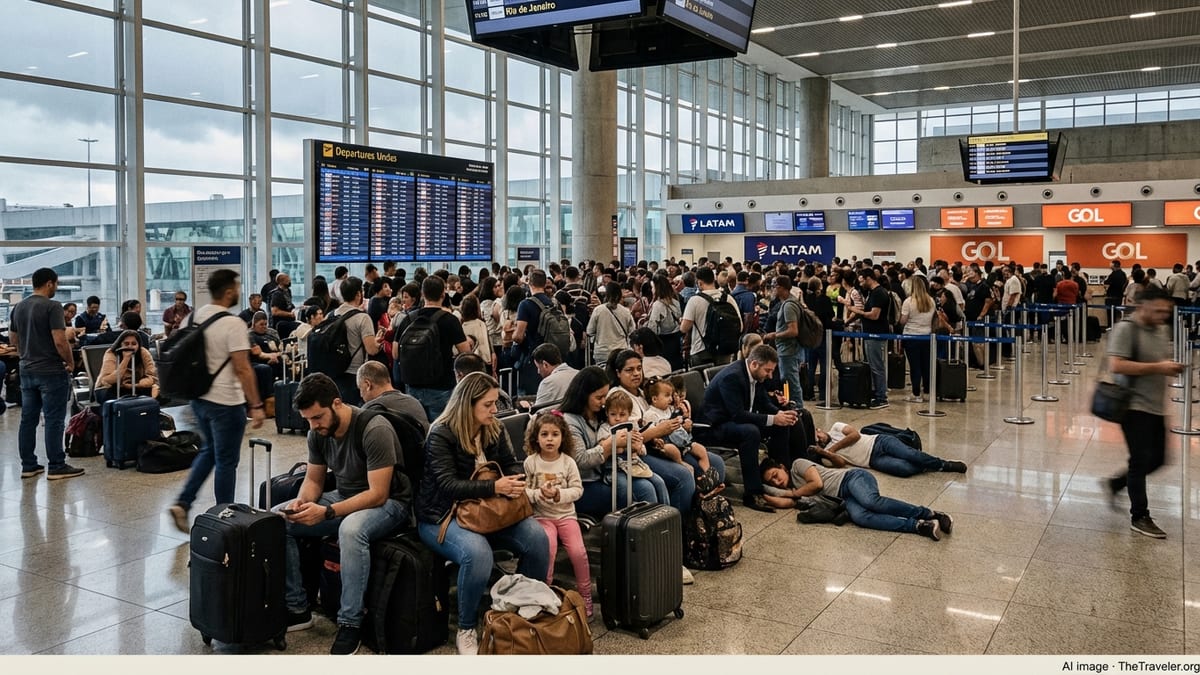
Hundreds of travellers were left stranded in Brazil on Thursday as São Paulo and Rio de Janeiro airports reported at least 32 flight cancellations and 71 delays, snarling connections operated by LATAM, GOL Linhas Aéreas, Aerolíneas Argentinas and other carriers across South America.
Disruptions Hit Key Brazilian Gateways
The latest wave of disruption concentrated on Brazil’s busiest aviation corridor, with flights in and out of São Paulo’s Guarulhos and Congonhas airports and Rio de Janeiro’s Galeão and Santos Dumont terminals suffering cancellations and extended delays. The issues rippled across both domestic and regional routes, stranding passengers in terminal halls and security queues for hours.
According to preliminary operational tallies compiled over the course of the morning and early afternoon, airlines operating at these hubs logged 32 cancelled departures and arrivals alongside 71 delayed services. While the numbers are modest compared with the highest peaks seen during the recent Carnaval rush, the concentration of affected flights at Brazil’s two principal metropolitan areas amplified the impact on connecting traffic across the country.
Airport information boards in São Paulo and Rio de Janeiro showed a patchwork of status updates, with some services pushed back repeatedly in short increments and others scrubbed entirely. Travellers bound for secondary cities such as Porto Alegre, Curitiba, Belo Horizonte and Florianópolis were among those hardest hit, as missed connections forced many to seek scarce rebookings later in the day.
Ground handlers reported unusually long lines at check in and ticket counters as passengers tried to secure new itineraries or request refunds. In several terminals, airport staff handed out water and snack vouchers as waits stretched beyond two hours for those on heavily delayed flights.
LATAM, GOL and Aerolíneas Argentinas Under Pressure
The disruption placed fresh pressure on Latin America’s largest airline groups, which have already been grappling with capacity constraints, high load factors and operational stresses linked to the southern hemisphere summer travel peak. LATAM Brasil and GOL Linhas Aéreas Inteligentes handled a significant share of the affected flights at both São Paulo and Rio de Janeiro airports, reflecting their dominant presence in Brazil’s domestic market.
Regional links involving Argentina also felt the strain. Aerolíneas Argentinas, which is contending with a sweeping 24 hour general strike called by Argentina’s main labor federation, adjusted parts of its Brazil schedule, leading to additional cancellations and delays on routes between Buenos Aires and Brazil’s southeastern cities. As unions representing airport ground staff and service providers in Argentina scaled back operations, carriers were forced to retime or cancel rotations that would usually feed into Brazil’s hubs.
Industry analysts noted that the current situation highlights how tightly interconnected South America’s aviation networks have become. Brazilian carriers such as LATAM and GOL have been expanding regional links, while Aerolíneas Argentinas and Chile based operators have looked to São Paulo and Rio as key entry points for Brazilian tourists and business travellers. When operations falter at just a handful of airports, knock on effects quickly spread across multiple countries.
While Azul Brazilian Airlines was less exposed at the Rio de Janeiro hubs, it also experienced pressure on its São Paulo operations, particularly where aircraft and crew rotations depended on punctual arrivals from other parts of the network. The resulting delays further constrained the ability of airlines to offer immediate rebooking options to disrupted passengers.
Passenger Frustration Builds in Terminals
Inside terminal buildings, the mood among stranded travellers swung between resignation and anger as the scale of the disruption became clear. Families returning from late summer holidays, business travellers on tight schedules and international visitors in transit all faced difficult choices about whether to wait for rebooked flights or abandon plans altogether.
Long queues formed at airline service desks in Guarulhos and Congonhas, where staff were tasked with explaining complex, fast changing operational scenarios. Several passengers reported being offered rebookings more than 24 hours after their original departure times, while others were advised to seek refunds and attempt new bookings themselves when inventory became available.
At Rio’s Galeão airport, where previous operational incidents and weather events have tested the resilience of infrastructure and staffing, airport volunteers and airline employees moved through boarding areas providing information about assistance rights and temporary support. Announcements in Portuguese, Spanish and English reminded affected travellers that, depending on the length of delay, they might be entitled to meals, phone and internet access, or overnight accommodation.
Some international tourists, unfamiliar with Brazil’s consumer protection rules for air travel, expressed confusion about which services airlines were required to provide and which were considered courtesy. Travel agents based in Brazil and abroad reported a spike in calls and messages from clients seeking clarification and urgent help with alternative routes home.
Operational Strain After Carnaval Peak
The latest cancellations and delays come on the heels of several weeks of heightened operational pressure during Brazil’s Carnaval season, when airports across the country handled some of their highest passenger volumes since the pandemic. Earlier in the week, aviation data providers recorded dozens of cancellations and well over a hundred delays concentrated at Guarulhos, Brasília and Galeão, underscoring how fragile on time performance has become during peak periods.
Airlines have cited a combination of factors, including tight fleet utilization, limited spare aircraft, maintenance demands and adverse weather episodes in southeastern Brazil, for the recurring disruption spikes seen in recent weeks. Congonhas airport in São Paulo, in particular, has experienced rolling waves of delays and cancellations linked to strong winds, low visibility and operating hour constraints, leaving regulators to periodically extend opening times in order to clear backlogs.
Carriers have argued that they are working to adjust schedules gradually, adding buffer where possible and optimizing crew rotations, but acknowledge that any unexpected event in one part of the network can cascade rapidly. With aircraft running at very high load factors, especially on trunk routes between São Paulo, Rio de Janeiro, Brasília and the northeast, there is often little spare capacity to absorb last minute rebookings when flights are cancelled.
Airport operators have also faced challenges staffing security, baggage handling and customer service teams at levels that match fluctuating demand. In some terminals, passengers reported waiting more than an hour to retrieve checked luggage from delayed flights, further compounding frustration for those already facing missed connections.
Impact of Argentina’s General Strike on Regional Routes
The turmoil in Brazilian airports coincides with a major general strike in neighboring Argentina, where unions have mounted a 24 hour stoppage against proposed labor reforms. The action prompted Aerolíneas Argentinas to cancel hundreds of flights across its domestic and international network, affecting tens of thousands of passengers and sharply curtailing connectivity through Buenos Aires.
Although the core of the strike related cancellations is centered in Argentina, the effects are being felt in Brazil through disrupted regional services that normally link São Paulo and Rio de Janeiro with Buenos Aires, Córdoba, Mendoza and other Argentine cities. Some of Thursday’s 32 cancellations and 71 delays in Brazil involved flights that either originated in or were bound for airports in Argentina, where ground handling and air traffic services are operating with limited staffing.
LATAM and GOL have also adjusted parts of their regional schedules that touch Argentina, either by retiming flights outside the main strike window, consolidating services or, in some cases, scrubbing rotations altogether. Passengers booked on these routes have been encouraged to accept voluntary changes, travel on alternative dates or request refunds, but space on remaining flights is tight during the busy late summer travel period.
Aviation observers say the twin pressures of domestic peak season in Brazil and widespread labor unrest in Argentina have combined to create one of the most complex operating environments for airlines in the region in recent years. They warn that further schedule volatility is possible if industrial tensions continue or if weather and infrastructure constraints resurface in Brazil’s largest cities.
What Stranded Travellers Are Entitled To
As the disruption unfolded, Brazil’s civil aviation authorities reminded passengers and airlines of their obligations under national consumer protection rules for air transport. Regulations in place since the mid 2010s require carriers to provide a graduated level of assistance whenever a flight is delayed, cancelled or significantly rescheduled, with minimum standards for communication, food and, when necessary, accommodation.
For delays beyond one hour, airlines must offer access to communication channels such as internet or telephone so that passengers can contact family or adjust onward plans. When waiting times exceed two hours, carriers are required to provide meals or vouchers. For severe disruptions beyond four hours, or when overnight stays become unavoidable, travellers may be entitled to hotel accommodation and ground transportation between the airport and their lodging, depending on the cause of the delay and the specific circumstances.
In cases of cancellation or significant change to the itinerary, passengers generally have the right to choose between rebooking on the next available flight, receiving a refund of the unused portion of their ticket or, where feasible, being rerouted by another mode of transport. Consumer advocacy groups have urged travellers to keep all receipts for additional expenses, such as extra meals or transport to alternative airports, which may support later claims or complaints.
Authorities emphasized that travellers should first seek a solution directly with the airline through physical service counters, mobile apps or call centers. If they do not receive a satisfactory response, passengers can then escalate complaints to national consumer platforms or aviation regulators, who track patterns of noncompliance and can impose penalties in cases of systematic breaches.
Airlines’ Response and Efforts to Restore Normality
By early evening, airlines operating at São Paulo and Rio de Janeiro airports said they were working to gradually bring operations back on track, prioritizing flights with high numbers of connecting passengers and services to cities with limited alternative transport options. Additional staff were deployed to customer service counters and boarding gates to assist with rebookings and answer questions about travel waivers.
Some carriers introduced flexible change policies for passengers with tickets issued for the affected dates, allowing them to modify their itineraries within a specified window without penalty fare differences in certain fare classes. Others focused on advancing departures where aircraft and crews were already in position, in order to avoid further build up of delays later in the day.
Nevertheless, network planners acknowledged that residual disruption could linger for at least another 24 hours, particularly on routes that rely on aircraft rotating between multiple cities in quick succession. A single delayed or cancelled flight at the start of the day can set off a chain of knock on effects that persist deep into the evening schedules and spill into the following day.
Airline executives again called for closer coordination between carriers, airport operators and regulators to manage peak travel days, including options such as temporary slot flexibility, extended operating hours where noise rules permit and rapid deployment of additional ground resources when bottlenecks arise.
Outlook for Brazil’s Busy Aviation Market
The current wave of cancellations and delays underscores the growing pains of a Brazilian aviation market that has rebounded strongly from the pandemic and recently set new passenger records. With more than one hundred million domestic travellers in a single year and steadily rising international demand, pressure on infrastructure at São Paulo and Rio de Janeiro airports is expected to persist.
Industry experts argue that investment in runway capacity, terminal expansion, air traffic control modernization and resilience measures against extreme weather will be essential to preventing recurrent operational crises. They point out that as Brazil cements its role as a regional hub, every disruption in São Paulo and Rio has outsize effects on smaller cities and neighboring countries that depend on reliable connections.
For now, passengers are advised to build extra time into their itineraries when traveling through Brazil’s busiest airports, especially during holidays, long weekends and periods of known industrial action in neighboring markets. Monitoring flight status frequently, using airline apps and registering contact details for notifications can help travellers respond more quickly if disruptions arise.
As airlines, regulators and airport operators in Brazil and Argentina navigate this latest episode of turmoil, both countries face the challenge of balancing booming demand for air travel with the need for robust, predictable operations that can withstand weather shocks, labor disputes and infrastructure constraints without leaving hundreds of passengers stranded in terminal halls.