

More news on this day
Brazilian travelers woke to fresh disruption on March 12 as more than 40 international flights operated by Qatar Airways, LATAM, Emirates, United, Azul and other carriers were canceled or heavily rescheduled, severing or thinning critical air links between major Brazilian cities and hubs such as Doha, Dubai, Washington and Buenos Aires.
Get the latest news straight to your inbox!
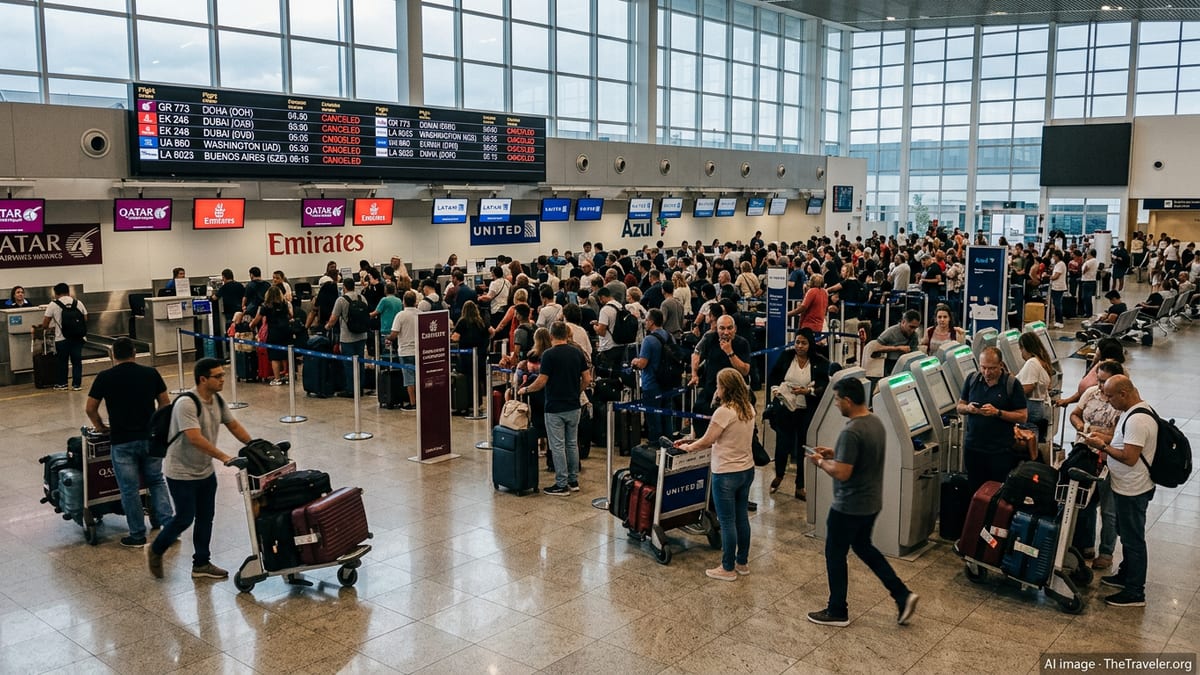
Middle East Tensions Ripple Into Brazilian Skies
The latest wave of cancellations in Brazil is closely tied to continuing airspace restrictions and operational constraints affecting carriers based in or transiting through the Gulf. Since late February, conflict-related closures and reroutes around parts of West Asia have forced airlines including Qatar Airways and Emirates to pare back capacity, extend flight times or suspend certain rotations altogether.
Qatar Airways, which uses Doha as a global connecting hub, has been operating a sharply reduced schedule and selectively restoring routes. Its limited operation into São Paulo’s Guarulhos Airport has left Brazil-bound passengers with fewer options and tighter seat availability, particularly for itineraries linking Brazil with Asia and Africa via Doha.
Emirates is also contending with knock-on effects of regional instability around its Dubai hub. Reduced frequencies and last-minute aircraft swaps are now translating into full cancellations on some long-haul sectors, including Brazil services, as the airline prioritizes operational reliability on its highest-demand routes.
Aviation analysts say Brazil is particularly exposed because most nonstop services to the Gulf are funneled through a small number of daily flights from São Paulo and Rio de Janeiro. When even one of those rotations is pulled from the schedule, thousands of connecting itineraries are affected down the line.
Key Long-Haul Links to Doha, Dubai and Washington Affected
Among the hardest-hit routes on March 12 are flights connecting São Paulo and Rio de Janeiro with Doha and Dubai, along with transcontinental services from Brazil to Washington Dulles. Qatar Airways’ Doha–São Paulo services, which had already been operating under a constrained timetable, saw additional cancellations, catching some travelers mid-journey and forcing complex rebookings via Europe or Africa.
Emirates’ Brazil operations have not escaped the turbulence. While some Dubai–Brazil sectors are still running, at least several rotations were scrubbed or rescheduled, disrupting passengers headed both to the United Arab Emirates and onward to Asia and Europe. Travelers reported receiving late-night notifications of cancellations, with some rebooked on flights days later or rerouted through intermediary hubs.
United Airlines, a key connector between Brazil and the United States, also canceled select services, including flights touching Washington Dulles. The changes are creating bottlenecks for corporate and government travelers who rely on direct links between Brasília, São Paulo and Washington, and for leisure passengers connecting to North American and European destinations via United’s hub network.
Industry observers note that long-haul corridors are especially vulnerable when multiple airlines pull back simultaneously. With aircraft and crew already tightly scheduled following earlier disruptions, carriers have limited slack to absorb additional shocks, making cancellations more likely when fresh constraints arise.
LATAM, Azul and Regional Networks Feel the Strain
The shockwaves are not confined to foreign long-haul operators. Brazilian carriers LATAM and Azul, which provide crucial domestic and regional feed into international gateways, are also adjusting their operations in response to the turbulence on intercontinental routes.
LATAM has been consolidating some departures that connect secondary Brazilian cities to São Paulo and Rio for onward travel to the Middle East, North America and Europe. When partner or codeshare long-haul flights are pulled, associated feeder legs often follow, leaving passengers facing multi-stop domestic re-routings or overnight layovers in the country’s main hubs.
Azul, which has built a substantial network out of cities like Campinas, Recife and Belo Horizonte, has likewise reported selective cancellations and retimings on flights that typically funnel travelers into São Paulo and Rio for onward international travel. For some itineraries to destinations such as Buenos Aires, cancellations by multiple carriers on overlapping corridors have magnified the overall level of disruption.
In practical terms, this means that travelers holding tickets on seemingly short domestic or regional hops may find their flights altered at short notice if the long-haul segment they were feeding is no longer operating. Travel agents in Brazil report spending hours rebuilding complex multi-ticket journeys originally stitched together across Azul, LATAM and foreign partners.
Impact on Major Hubs: São Paulo, Rio, Brasília and Beyond
Brazil’s main international gateways are bearing the brunt of the operational upheaval. São Paulo–Guarulhos, the country’s busiest international airport, has recorded a noticeable uptick in cancellations and retimed services on routes linking it with Doha, Dubai and Washington. Airport officials have urged passengers to arrive early and verify their flight status repeatedly on the day of departure.
In Rio de Janeiro, Galeão International Airport has seen several long-haul departures abruptly pulled from departure boards. While some affected passengers have been shifted to alternative flights through São Paulo or other South American hubs, limited remaining capacity means many are being rebooked days later, particularly on popular transatlantic and Middle Eastern routes.
Brasília and other key cities with direct or one-stop connectivity to Washington and Buenos Aires are also experiencing knock-on effects as airlines consolidate frequencies and seek to keep their most profitable or strategically important routes running. Even where flights are not formally canceled, extended delays and last-minute equipment changes are becoming more common, complicating onward connections inside Brazil.
Regional airports that rely heavily on trunk connections into São Paulo and Rio are indirectly affected as well. With airlines protecting core bank structures at their main hubs, some outstation services are being trimmed around the edges to free up aircraft and crew for more time-sensitive rotations.
What Travelers Can Expect in the Coming Days
Airlines and aviation authorities in Brazil are signaling that the disruption could extend beyond March 12 as carriers continue to recalibrate their schedules around evolving airspace restrictions and security assessments. For passengers with upcoming travel to or from Doha, Dubai, Washington or Buenos Aires, as well as those connecting via São Paulo, Rio or Brasília, the watchword is flexibility.
Carriers including Qatar Airways, Emirates, United, LATAM and Azul are offering a mix of fee-free rebooking, itinerary changes and, in some cases, refunds for affected journeys. However, options may be limited on peak travel days or on routes with already-reduced frequencies, meaning travelers might need to accept alternative routings through less direct hubs or travel on different dates.
Travel experts recommend that passengers avoid relying solely on third-party flight trackers and instead monitor their reservations directly with the operating airline, checking for schedule changes multiple times in the 48 hours before departure. For complex itineraries, especially those involving separate tickets or self-made connections, building in longer layovers and confirming minimum connection times with airlines can reduce the risk of missed onward flights.
With more than 40 cancellations already logged across multiple carriers and further adjustments likely, Brazil’s air travel landscape remains fluid. For now, anyone flying through the country’s main gateways should brace for continued uncertainty, longer travel times and crowded rebooking desks as airlines work to restore stability to their networks.