

More news on this day
Brazil’s federal government is preparing to unlock billions of reais in new financing for airlines, combining fleet expansion with unprecedented sustainability requirements as it seeks to position the country as a global hub for low-carbon aviation and shore up a sector still recovering unevenly from the pandemic.
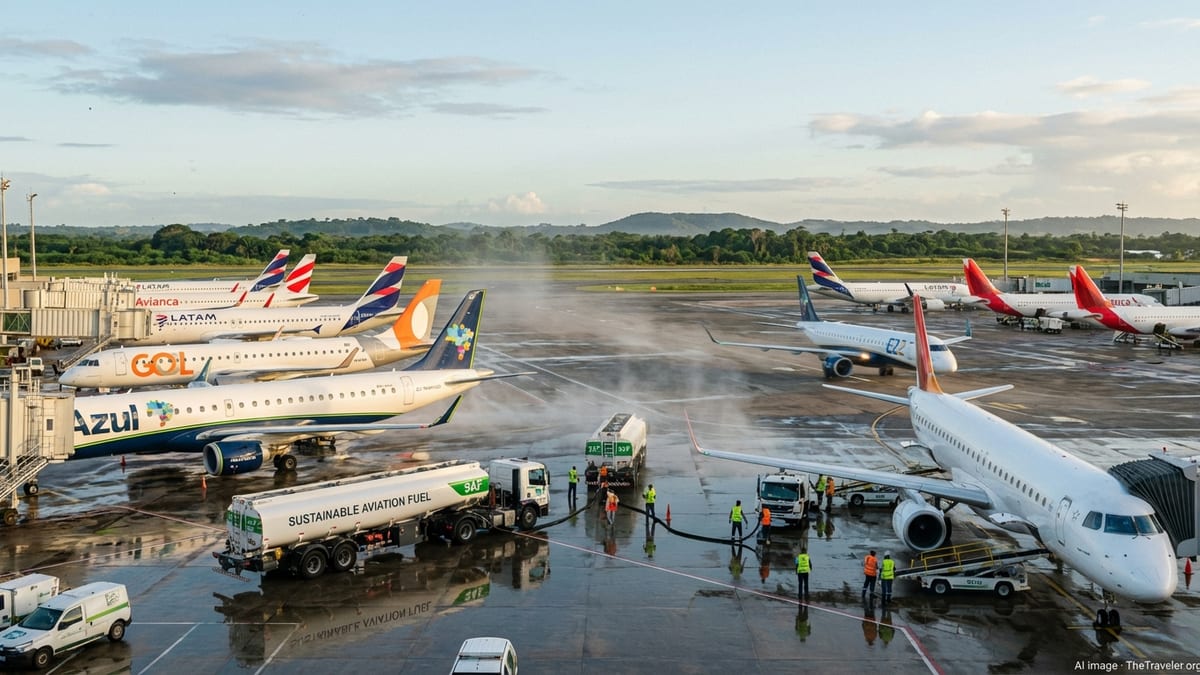
A Strategic Push to Rewire Brazil’s Airline Industry
The planned package, centered on fresh credit lines from the state development bank BNDES and complementary instruments from other public lenders, would inject several billion reais into Brazil’s carriers over the next few years. Officials have signaled that the money is intended not only to help airlines renew and expand their fleets, but also to accelerate the shift toward cleaner fuels and more efficient operations in one of the world’s largest domestic aviation markets.
The initiative comes after a period in which BNDES has already sharply increased support for Embraer and aircraft exports, approving nearly 29 billion reais in financing for the manufacturer and its projects between 2023 and the end of 2025, more than double the volume in the previous four-year period. That ramp-up has laid the groundwork for a broader aviation strategy in which Brazil’s industrial policy, regional development goals and climate commitments are tightly woven together.
While final details of the airline-focused program are still being refined, government sources and sector analysts describe a framework where carriers gain access to below-market funding in exchange for clear commitments on fleet renewal, new routes to underserved regions and tangible steps to cut emissions. The emerging contours suggest a shift away from ad hoc bailouts toward a more structured, conditional support model designed to reshape the industry over the long term.
For travelers, the changes will play out gradually, through newer aircraft, more regional destinations and growing visibility of sustainable aviation fuel on selected routes. For airlines, however, the shift is immediate and strategic, influencing fleet planning decisions that will define their cost base and competitiveness well into the 2030s.
Billions in New Credit, With Strings Attached
At the heart of the government’s plan are new credit facilities expected to total several billion reais, with an initial tranche of about 4 billion reais earmarked specifically for Brazilian airlines in 2026. These lines would be largely channeled through BNDES, long a key backer of the country’s aerospace industry, and designed to be expanded if demand and fiscal space allow.
Draft terms discussed with the market point to interest rates in the high single digits, generally between 6.5 and 7.5 percent per year, significantly below what carriers would face in commercial markets given their debt levels and exposure to currency swings. The loans would feature multi-year grace periods and long maturities, reflecting the life cycle of commercial jets and the time it takes for efficiency gains to materialize in operating results.
In exchange for that relatively cheap capital, airlines would accept a series of conditions. Among them are restrictions on dividend payouts and share buybacks during the grace period, to ensure that resources are channeled into fleet investments and network development rather than shareholder returns. Companies would also be required to present detailed investment plans and meet periodic performance milestones for continued access to the funds.
The package is expected to be structured in tranches tied to specific aircraft acquisitions and sustainability benchmarks, allowing the government to adjust the scale and focus of support as market conditions and climate policies evolve. That design reflects lessons from past rescue programs, which often lacked clear metrics and were criticized for propping up airline balance sheets without driving structural change.
Fleet Renewal: Embraer in Focus, Efficiency as the Watchword
One of the clearest immediate impacts of the financing push is likely to be a fresh wave of orders for Brazilian-made aircraft. Industry officials say the program has been crafted in a way that reinforces domestic supply chains, with a strong emphasis on the latest generation of Embraer regional jets that offer double-digit fuel burn and emissions reductions compared with older models.
Latam Airlines is widely expected to be among the first to tap the new lines, with internal planning pointing to the addition of as many as two dozen Embraer E2-family aircraft to bolster its domestic and short-haul regional network. Azul, already the world’s largest Embraer operator, is seen as another natural beneficiary, potentially using the funds to modernize and expand its large regional fleet while trimming operating costs on thinner routes.
Gol, which currently flies an all-Boeing 737 fleet on its mainline operations, may move more cautiously, but could still leverage the package to accelerate the introduction of newer, more efficient 737 MAX variants and explore regional partnerships or feeder operations using smaller jets. Across the board, the financing is intended to tilt the economics decisively in favor of high-efficiency aircraft with lower per-seat emissions and maintenance costs.
For airlines, the appeal is straightforward: newer jets consume less fuel, require less unscheduled maintenance and offer the kind of passenger comfort and reliability that help sustain yields in a competitive market. For the government, steering capital toward these fleets advances its industrial policy goals by anchoring Embraer’s production pipeline at home, even as the manufacturer continues to grow its export footprint with BNDES-backed deals around the world.
SAF Mandates Put Sustainability at the Center
The financial package does not exist in a vacuum. It coincides with a major regulatory shift: Brazil’s decision to require stepwise reductions in aviation emissions beginning in 2027, implemented through the National Sustainable Aviation Fuel Program, known by its Portuguese acronym ProBioQAV. Rather than mandating a fixed percentage of sustainable aviation fuel in every tank, the program sets emissions reduction targets that airlines can meet using SAF, other efficiencies or offset mechanisms.
Under the plan, airlines operating in Brazil will initially be required to cut emissions by around 1 percent relative to a 2026 baseline, with the target rising each year to reach a 10 percent reduction by 2037. Studies by the state-run Energy Research Company indicate that by 2035, sustainable aviation fuel alone could account for about 12 percent of domestic passenger aviation energy demand, delivering at least an 8 percent reduction in greenhouse gas emissions on domestic flights.
The new financing is explicitly aligned with those goals. Access to the most attractive loan conditions is expected to be linked to concrete SAF usage plans and verified emissions reductions beyond minimum regulatory requirements. Airlines would be asked to demonstrate how their new fleets and fuel procurement strategies position them to comply with ProBioQAV and the global Corsia framework without resorting excessively to carbon offsets.
For a sector historically accustomed to treating fuel as a largely commoditized input, the shift is stark. Contracts now need to take into account the origin, lifecycle emissions and traceability of SAF, while operational planning must consider where the new fuels are actually available. That complexity is precisely why the government is pairing mandates with credit, using financing as both carrot and lever to hasten the transition.
Building a Domestic SAF Ecosystem
To make the climate targets achievable, Brazil is also working to expand the supply of sustainable aviation fuel within its borders. Private and public investment is flowing into a handful of early projects, including a planned biorefinery complex in Bahia designed to produce SAF and renewable diesel from feedstocks such as vegetable oils and waste fats using hydroprocessed esters and fatty acids technology.
Energy analysts note that projects like the Bahia biorefinery, together with initiatives from large fuel distributors that have already begun importing SAF and offering it at major hubs like Rio de Janeiro’s Galeão airport, are critical first steps in creating a viable market. In late 2025, the Salvador airport in Bahia became the first in Brazil to support regular commercial flights using SAF blends, with major carriers operating daily services partly powered by the alternative fuel.
The government’s airline financing package is expected to reinforce this emerging ecosystem by weaving SAF-related conditions into loan covenants. Carriers that commit to long-term offtake agreements with Brazilian SAF producers or participate in pilot programs at designated airports could gain priority access to credit or slightly better terms, while helping to de-risk investments in new refineries and distribution infrastructure.
Sector studies underscore that Brazil’s natural advantages in bioenergy, from abundant arable land to a mature ethanol and biodiesel industry, position it to become a net exporter of sustainable aviation fuels over time. But they also warn that without coordinated policy support, including carbon pricing, tax incentives and guaranteed demand from airlines, SAF production will struggle to compete with conventional jet fuel on cost alone. The latest financing measures are framed as one piece of that broader policy puzzle.
Expanding Connectivity to Brazil’s Interior and Amazon
Beyond climate and industrial policy, the new funding package is explicitly tied to regional development goals. Airlines seeking access to BNDES credit will be encouraged, and in some cases required, to expand service to underserved areas, particularly in the North and Northeast and across the Amazon region, where air links are often the only practical connection to the rest of the country.
This emphasis on connectivity responds to long-standing complaints from state governments and business groups that Brazil’s aviation network is too heavily concentrated in a handful of coastal hubs. By using subsidized financing to nudge airlines toward thinner routes, officials hope to stimulate tourism, trade and investment outside traditional centers while improving mobility for residents of smaller cities.
Modern regional aircraft are central to that strategy. The latest Embraer jets are tailored for operations from shorter runways and secondary airports, with performance characteristics suited to hot and humid conditions and the ability to economically serve routes with fewer passengers. By aligning credit incentives with the introduction of these aircraft on new or upgraded routes, the government aims to make expansion into Brazil’s interior more financially viable for carriers.
For travelers, the impact could translate into more non-stop options between mid-sized cities, better links to ecotourism destinations and more reliable year-round service in regions where flights have historically been sparse or seasonal. Officials stress, however, that expanded connectivity will be accompanied by tighter environmental safeguards, particularly in the Amazon, where increased traffic will be closely monitored for its ecological footprint.
What Travelers and Industry Watchers Should Monitor Next
With regulatory details still being finalized, much of the practical effect of Brazil’s aviation financing push will hinge on how quickly airlines move to sign loan agreements and place aircraft orders. Industry observers are watching closely for announcements of new Embraer deals, revised fleet plans and updated sustainability strategies from the country’s three main carriers over the coming months.
Travelers interested in the environmental impact of their flights will also want to track the rollout of SAF-powered services across Brazil’s network. Pilot programs at hubs in Rio de Janeiro, São Paulo and Salvador are likely to expand as fuel availability increases and airlines seek to showcase their green credentials on high-profile routes, including those serving major business and tourism corridors.
More broadly, the success of the initiative will be measured by whether it delivers on its multiple, interlocking objectives: stabilizing airline finances without open-ended subsidies, boosting domestic aerospace manufacturing and accelerating the decarbonization of a sector that is both economically vital and environmentally challenging. Progress will not be linear, and early bottlenecks in SAF supply, certification and pricing are almost certain.
Yet the direction of travel is now clear. By tying access to billions in public financing to concrete commitments on fleet efficiency, sustainable fuels and regional connectivity, Brazil’s government is signaling that the era of unconstrained, carbon-intensive aviation growth is ending. The next few years will show whether this blend of incentives and mandates can chart a new course for flying in Latin America’s largest country.