

More news on this day
Canada is aligning with a growing bloc of major outbound travel markets in responding to Brazil’s latest tightening of electronic visa rules, a shift that will reshape how North Americans and Europeans plan trips to South America’s largest country from 2026 onward.
With new e‑Visa obligations coming into force for citizens of Canada, the United States, Mexico, France and more than two dozen other nationalities, Brazil is accelerating a regional drive toward fully digital borders while triggering concern among airlines, tour operators and frequent travelers who had grown used to visa‑free entry.
More News
- Caribbean Travel to U.S. Upended by New Visa Freezes and Expanded Bans
- Mexico Restores E-Visas for Brazilians, Paving the Way for Borderless Tourism
- Philippine Airlines Joins Regional Carriers Powering Southeast Asia’s Tourism Boom
Brazil Locks In a Permanent E‑Visa Era From 2026
After several years of postponements and piecemeal changes, Brazilian authorities have now confirmed that, from 1 January 2026, a permanent and wide‑ranging e‑Visa regime will apply to short‑term visitors from a list of more than 30 countries. That list includes Canada, the United States, Mexico, France, Australia, Japan and key markets across Europe and Latin America. Many of these nationals either enjoyed unilateral visa waivers in the pre‑pandemic era or benefited from temporary suspensions of visa rules while Brazil sought to revive inbound tourism.
The new framework builds on a system that was reinstated in April 2025 for travelers from the United States, Canada and Australia, who were again required to obtain an online visitor visa for tourism, business, sports or cultural activities. Under the 2025 rules, applicants must use a dedicated electronic platform, upload documents and pay a fee that typically runs close to 80 US dollars per person. In most cases, visas are issued for multiple years and allow a stay of up to 90 days per year, but the process introduces both cost and administrative friction for trips that were previously spontaneous.
Brazil is now extending that concept in two directions. First, it is embedding the e‑Visa requirement in legislation that makes it a standing feature of its border policy for many high‑income source markets, rather than a temporary, reversible measure. Second, it is broadening the scope of affected nationalities to include regional neighbors and European states that previously relied on traditional visa‑exemption agreements. Officials in Brasília argue that this will bring greater consistency to who needs a visa and how it is obtained, replacing a patchwork of waivers, consular practices and paper stamps.
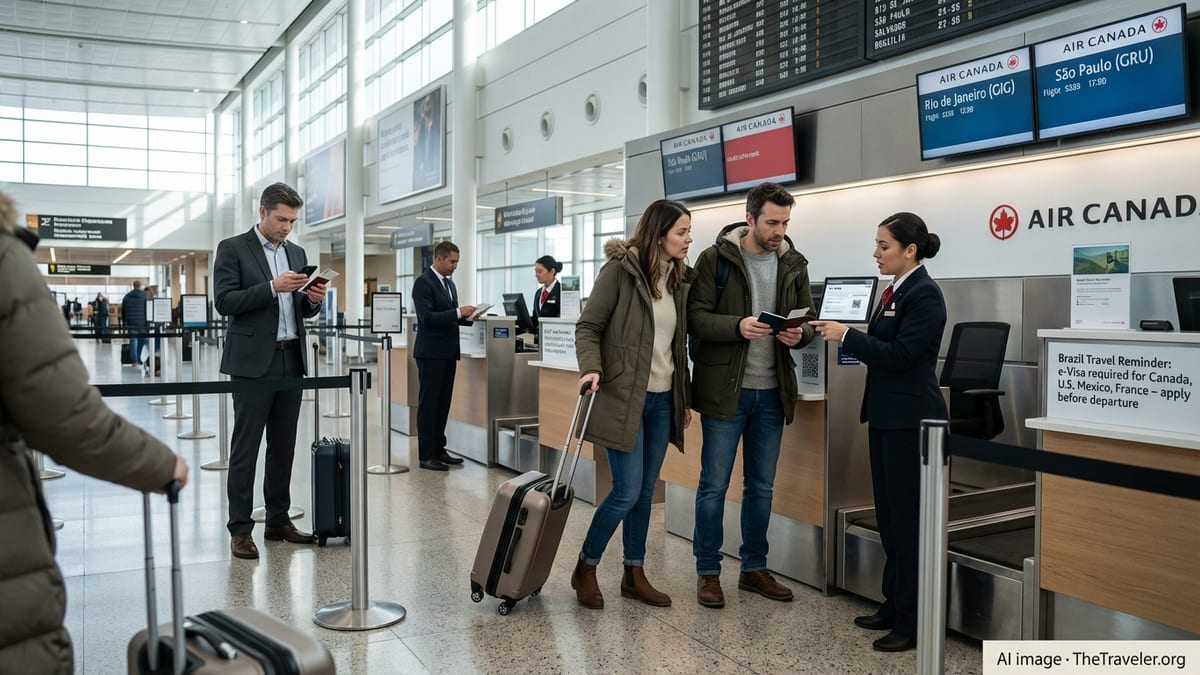
For travelers, the most immediate change will be psychological. The days when a Canadian or American visitor could simply book a last‑minute flight to Rio de Janeiro or São Paulo without thinking about formalities are effectively ending. From 2026, any national on the affected lists will be expected to secure an electronic authorization before boarding, with carriers instructed to deny boarding to passengers who cannot show a valid approval.
Canada Joins a Growing Bloc of Countries Pushing Back
Canada’s inclusion in the 2026 e‑Visa expansion has sharpened political and industry debate in Ottawa, where officials and tourism leaders have watched Brazil’s policy zigzags with unease. For several years, Canadian nationals benefited from a unilateral visa waiver introduced by a previous Brazilian administration that hoped easier entry would attract more long‑haul visitors. That waiver was rolled back under President Luiz Inácio Lula da Silva, who campaigned on restoring the traditional diplomatic principle of reciprocity in visa policy.
Once Brazil confirmed that Canadians would need an e‑Visa from April 2025, Canadian airlines, tour operators and business associations warned that demand for Brazilian destinations could soften, especially among winter vacationers accustomed to hopping south without paperwork. Those concerns have been amplified by the broader 2026 package, which not only cements the requirement but also ties it to a larger system of digital border controls, taxes and potential biometric checks at entry points.
In response, Canadian officials have signaled that they will review Brazil’s status under Canada’s own entry rules. While Canada maintains long‑standing visa requirements for many Brazilian travelers, Ottawa has shown a willingness in recent years to ease some restrictions via its electronic travel authorization program for certain low‑risk profiles. The new developments in Brazil have reopened debate over whether Canada should calibrate its own policy to encourage reciprocity or adopt a firmer stance if Canadian tourism and business travel are materially disrupted.
Behind the scenes, diplomats from Canada, the United States, Mexico, France and other affected countries are understood to be coordinating their messaging toward Brasília. Their shared objective is to push for more flexible implementation, clearer communication of technical requirements and, in some cases, carve‑outs or simplified procedures for frequent travelers, airline crew and participants in major events. Whether Brazil will adjust its course remains uncertain, but the fact that Canada is now acting in concert with multiple major partners elevates the issue on the international agenda.
How the New E‑Visa Rules Will Work for Travelers
By 2026, Brazil’s e‑Visa will be the default gateway for short‑term stays by most Canadian, American, Mexican, French and other designated nationals. The system, already live for some countries, requires applicants to complete a digital form, upload a passport scan, a face photo and sometimes proof of travel arrangements or accommodation. Payment is made online in advance, and decisions are typically delivered by email within several working days, although processing times can vary during peak periods.
Fees are expected to remain broadly in line with the schedule introduced for the 2025 reinstatement, where visitors from the United States, Canada and Australia faced charges a little under 100 US dollars per person. For families and group trips, these costs quickly add up, raising the overall price of a Brazilian holiday compared with destinations in the Caribbean or Central America that still welcome many North American travelers visa‑free. While the Brazilian government argues that multi‑year validity and multiple entries help offset the cost, first‑time visitors may see it as one more barrier.
Airlines and travel agents will play a crucial role in educating customers. Under international carrier liability rules, airlines are responsible for checking that passengers hold the required documentation before boarding flights to Brazil. In practice, this means that check‑in staff will be trained to verify electronic approvals, and boarding passes may be withheld if systems cannot confirm that a traveler’s passport number is linked to a valid e‑Visa. Travelers who assume they can apply at the airport or on arrival will risk being turned away long before they reach Brazilian immigration.
Travelers are being advised to apply at least two weeks before departure and to keep both a digital and printed copy of their approval, even if border posts eventually adopt fully automated verification. Those with complex itineraries involving connections or cruises touching Brazilian ports should pay close attention to whether every leg of their journey is covered by the same visa category and validity period, especially if they are combining tourism with business meetings or events.
Economic Stakes for Brazil’s Tourism Industry
Brazil’s decision to harden its entry rules just as global travel is normalizing carries significant economic implications. Canada and the United States together represent one of Brazil’s most valuable long‑haul tourism markets, not only in absolute visitor numbers but also in average per‑capita spending. Mexican travelers are an increasingly important segment on regional routes, while French tourists have long been prominent in destinations like Rio de Janeiro, Bahia and the Amazon region.
Tourism associations inside Brazil have expressed mixed feelings about the 2026 framework. On one hand, many accept the argument that digital visas modernize border management, offer better data for security and public health purposes, and put Brazil in line with practices used by the European Union and other blocs. On the other hand, they worry that stricter requirements will deter price‑sensitive travelers and shift holidaymakers toward countries that offer equivalent sun‑and‑sea experiences with fewer formalities.
The timing is sensitive. Brazilian tourism receipts are still rebuilding after the pandemic and subsequent economic volatility, and domestic operators have only recently benefited from strong demand tied to events, festivals and sporting fixtures. For airlines, especially carriers operating long‑haul routes from North America and Europe, any drop in bookings linked to visa friction can quickly undermine route profitability. Several have already indicated that they will monitor demand closely in late 2025 and early 2026 as the new rules bed in.
For Brazil’s federal government, the calculus is more complex than simple visitor counts. Officials argue that e‑Visas will enable better targeting of security resources, more accurate forecasting of tourist flows and more efficient tax collection related to the new tourist levies scheduled to be rolled out alongside the visa reforms. If the system works smoothly, they contend, the net effect could be neutral or even positive for tourism, especially if travelers view the process as comparable to digital authorizations now required for many destinations worldwide.
Diplomatic Ripples and the Reciprocity Debate
Central to Brazil’s justification is the concept of reciprocity. Brazilian citizens generally need to obtain visas or electronic travel authorizations for Canada, the United States and, in many cases, Schengen‑area countries like France. The Lula administration has repeatedly stressed that it is simply aligning its own practices with those imposed on Brazilians abroad, after what it views as a unilateral and unreciprocated experiment in visa liberalization between 2019 and 2022.
This stance has not gone unchallenged. Critics in Brazil note that outbound Brazilian tourism has long been constrained by foreign visa requirements and argue that replicating those hurdles for inbound guests may do more harm than good. From this perspective, unilateral openness could have been a competitive advantage in attracting high‑spending visitors from wealthy countries that face extensive paperwork when traveling elsewhere. Supporters of the reforms counter that reciprocity is a basic expectation in international relations and that Brazil risks sending the wrong message if it appears more permissive than its partners.
Canada, the United States, Mexico and France are using diplomatic channels to emphasize the potential downsides of the new regime. While none is expected to retaliate with new barriers aimed specifically at Brazilian citizens in the immediate term, they are likely to factor Brazil’s position into future discussions about easing their own entry rules for Brazilians. In this sense, Brasília’s choice to harden its border may slow or complicate efforts to secure visa‑free or low‑friction travel for its own citizens in key destination markets.
The broader regional dynamics are also at play. Brazil is taking a leadership role in a Latin American move toward digital border controls, forming working groups with neighbors to share data and harmonize systems. For countries like Canada and France, which already participate in multiple digital travel schemes, this presents both an opportunity for cooperation and a challenge to ensure that privacy, security and due process standards remain high in cross‑border data exchanges.
What Travelers From Canada, the U.S., Mexico and France Should Do Now
For individual travelers, the policy debates are secondary to practical questions. Canadians and other affected nationals planning a trip to Brazil in 2025 or 2026 should first verify whether their planned travel dates fall under the currently active e‑Visa rules or the expanded 2026 scheme. For the United States, Canada and Australia, the obligation has already been in force since April 2025 for most short‑term visits. Mexico, France and several additional markets will come under the broader umbrella when the 2026 ordinance takes effect.
Booking timelines will need to adjust accordingly. Industry advisors recommend treating the e‑Visa as a core part of trip planning, on the same level as purchasing tickets or confirming accommodation. Travelers should avoid non‑refundable expenditures until they receive their visa approval and should double‑check that passport details in airline reservations match those used in the e‑Visa application. Even minor discrepancies can trigger last‑minute stress at check‑in or immigration counters.
Travel insurers are already updating their policies to interpret visa denials or delays in light of the new Brazilian framework. Many now specify whether they will cover non‑refundable costs if a traveler fails to obtain a visa in time because of incomplete documentation or technical issues. Frequent travelers from Canada and other countries may wish to review policy terms carefully, especially if they plan multiple trips to Brazil within the multi‑year validity of a single e‑Visa.
Ultimately, Brazil will remain a compelling destination for long‑haul travelers seeking culture, nature and major events. The challenge for Canada, the United States, Mexico, France and other partners will be to balance their policy responses with the desire to keep people‑to‑people ties strong. For now, the safest course for would‑be visitors is to stay informed about the evolving rules and build extra lead time into every journey.
FAQ
Q1. When will Canada’s travelers be fully affected by Brazil’s new e‑Visa rules?
Canadian citizens have already needed an e‑Visa for most short‑term trips to Brazil since April 10, 2025, and from January 1, 2026 that requirement will be folded into a broader permanent digital border scheme that also covers Mexico, France and other markets.
Q2. Which nationalities are included alongside Canada in Brazil’s 2026 e‑Visa expansion?
The 2026 framework applies to citizens of the United States, Mexico, France and a wider group of more than 30 countries, including Australia, Japan and several European and Latin American states that had previously benefited from visa‑free stays.
Q3. What types of trips will require an e‑Visa for Canadians and other affected travelers?
The e‑Visa will be mandatory for short‑term tourism, business visits, participation in sports or artistic events and most airport transit scenarios, even when travelers do not plan to leave the international area of a Brazilian airport.
Q4. How far in advance should travelers apply for Brazil’s e‑Visa?
Processing times are typically around five working days, but authorities and travel advisors recommend applying at least two weeks before departure to avoid disruption during busy seasons or if additional documents are requested.
Q5. Will the e‑Visa be valid for multiple trips to Brazil?
In most cases, e‑Visas issued to Canadians, Americans and other nationals are expected to be multiple‑entry documents valid for several years, with each stay capped at around 90 days per year, although exact validity can vary by nationality.
Q6. How are Canada, the United States, Mexico and France responding diplomatically?
These countries are coordinating messages to Brazil, raising concerns about the impact on tourism and business travel and pushing for clear communication, technical reliability and possible flexibilities for frequent travelers and specific categories like airline crew.
Q7. Could Brazil’s decision lead to new restrictions on Brazilian travelers visiting Canada or other countries?
There is no immediate sign of direct retaliation, but Brazil’s tougher stance is likely to influence future talks on easing entry rules for Brazilians, with some partners signaling that reciprocity will remain an important benchmark.
Q8. What are the main economic risks of the 2026 e‑Visa regime for Brazil?
The biggest risks lie in potential declines in visitor numbers or trip frequency from high‑spending markets such as Canada, the United States and France, which could affect airlines, hotels, tour operators and local businesses that depend on international tourism.
Q9. How will airlines handle passengers who arrive at the airport without a valid Brazilian e‑Visa?
Airlines are responsible for verifying travel documents and are expected to deny boarding to passengers who cannot show a valid e‑Visa linked to their passport, so travelers should not assume they can resolve issues on arrival in Brazil.
Q10. Where can travelers from Canada and other countries get the most reliable updates on Brazil’s evolving visa policy?
The most reliable information will come from official government channels, such as Brazil’s foreign ministry and consular services, as well as from national foreign affairs departments and reputable travel advisories in the traveler’s home country.