

More news on this day
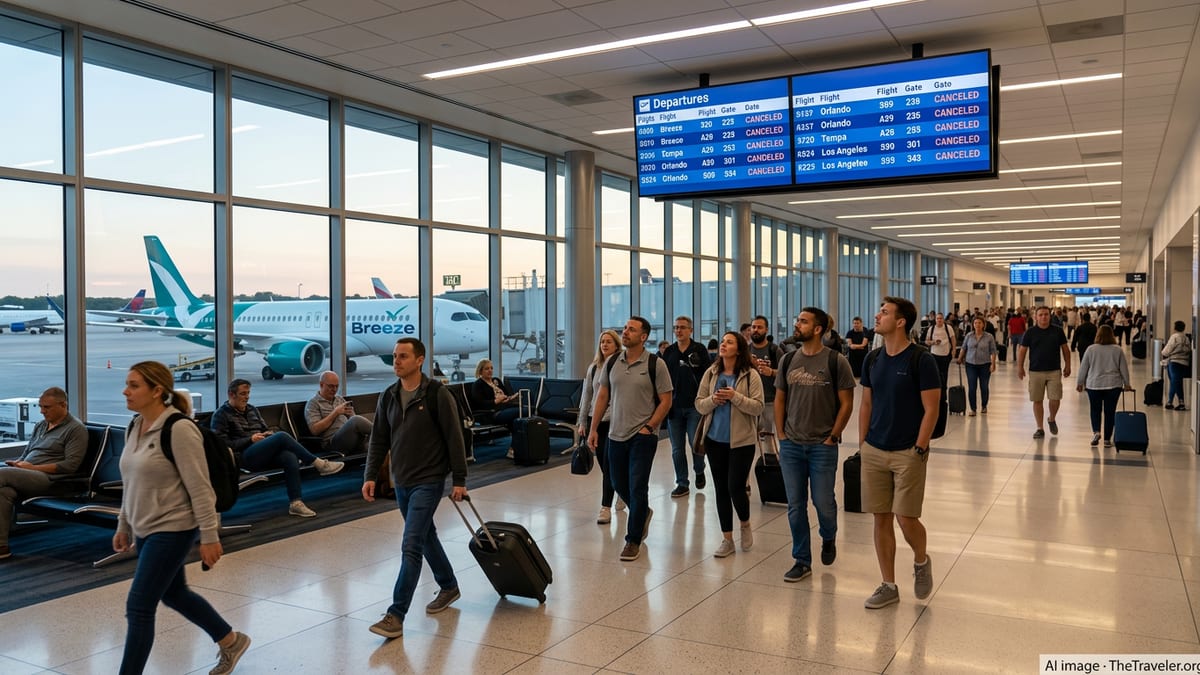
Fast-growing low cost carrier Breeze Airways is pulling back from parts of its domestic network, dropping service in nine U.S. markets and erasing multiple routes touching Orlando, Tampa and Los Angeles as the airline pivots toward stronger performing leisure and visiting-friends-and-relatives corridors.
Get the latest news straight to your inbox!
Network Retrenchment Hits Sun Belt Gateways
The latest schedule changes, reflected in reservation systems in mid March, show Breeze withdrawing from a cluster of smaller and mid sized airports while trimming frequencies or discontinuing certain links at major leisure gateways. Routes touching Orlando International, Tampa and the greater Los Angeles area are among the highest profile cuts, removing options that had been marketed heavily to budget conscious travelers.
Breeze has not publicly detailed each exit market in a single announcement, but airport notices and timetable updates indicate the carrier is stepping back from underperforming routes where load factors and yields lagged expectations. The strategy mirrors moves by other low cost competitors that have recently cut capacity in marginal cities while concentrating aircraft in markets with more proven demand.
For Orlando and Tampa, the retrenchment marks a shift from the growth narrative of the past two years, when both airports touted new nonstop links by Breeze to secondary and tertiary cities across the Southeast and Midwest. Several of those thinner routes, especially those operating only a few times a week, are now disappearing from schedules beyond the spring shoulder period.
On the West Coast, Breeze is also rebalancing its presence in the Los Angeles basin, where it has experimented with both Los Angeles International and secondary airports such as Burbank for point to point flights into the interior United States. A combination of higher operating costs, intense competition and seasonality has left some of those services vulnerable during the slower travel months.
Seasonal Bets Give Way to Data Driven Cuts
Breeze built much of its early network around highly seasonal, low frequency routes designed to connect smaller cities directly to sun destinations such as Florida and Southern California without requiring a hub connection. That model provided good headlines and short term wins when demand was strong, but also left the airline exposed when off peak bookings did not keep aircraft sufficiently full.
In recent months, travelers and airport officials have noted a pattern of Breeze suspending or dropping flights that were initially touted as year round but behaved more like seasonal charters. In some cases, fares climbed sharply for remaining departure dates before service disappeared from the schedule, a sign that inventory was being pulled rather than sold out.
Executives have framed the changes as part of a normal maturation process in which route performance data informs a more disciplined approach to aircraft deployment. In practice, that has meant walking away from new or marginal routes in favor of concentrating around a smaller set of city pairs where the carrier believes it can sustain low fares while still earning a profit.
The decision to trim Orlando, Tampa and Los Angeles services fits this pattern. All three airports remain in the network, and each continues to gain new flights to other destinations. However, experimental links that failed to generate consistent year round demand are being quietly removed, often months before they were originally scheduled to operate.
Impact on Travelers and Secondary Airports
The pullback poses immediate challenges for travelers in affected cities who had grown accustomed to Breeze’s nonstop options to Florida and Southern California. In some markets, the airline was the only carrier offering a direct link to Orlando or Tampa, forcing passengers back onto one stop itineraries on larger network airlines or into their cars for longer drives to larger airports.
Smaller airports that had promoted Breeze’s arrival as a milestone in their air service development now face the task of filling lost capacity. Local tourism officials, in particular, worry that the loss of low fare nonstop flights will make it harder to attract budget minded visitors during key travel seasons.
For Orlando, Tampa and Los Angeles, the effect is more nuanced. These large, competitive markets still enjoy extensive service from multiple airlines, so the disappearance of a handful of Breeze routes will not materially reduce overall connectivity. Instead, the impact is felt most acutely in specific origin cities that lose a direct link, and among price sensitive travelers who had relied on Breeze’s promotional fares.
Consumer advocates note that sudden schedule changes can create frustration and added costs for passengers whose trips are disrupted. While Breeze offers refunds or rebooking on its own network when flights are canceled, customers are often left to sort out new arrangements on competing carriers, sometimes at higher last minute prices.
Competitive Pressures and Fleet Priorities
Breeze’s retrenchment comes as competition intensifies in many of the leisure markets the airline targets. Larger low cost competitors have bulked up in Florida and the West Coast, while legacy carriers continue to defend their hubs with aggressive pricing and loyalty incentives. That dynamic makes it more difficult for a relatively small player to sustain lightly used routes at attractive fares.
At the same time, Breeze is still in the process of taking delivery of additional Airbus A220 aircraft, which are central to its long term strategy of operating longer, thinner routes with a premium leisure product. Each new aircraft gives the airline more flexibility to redeploy capacity away from underperforming markets and into city pairs where it sees better prospects.
Industry analysts say the recent route cuts should be viewed in the context of that broader fleet and network strategy. Rather than signaling a retreat from Orlando, Tampa or Los Angeles altogether, the carrier appears to be pruning weaker routes so that aircraft time can be shifted to markets with stronger demand or less direct competition.
For travelers watching Breeze’s evolution, the message is that the network will remain fluid, particularly on newer or more experimental routes. Flights that appear one season may not return the next if performance falls short, even as the airline launches new services elsewhere that fit its evolving model.
What Comes Next for Breeze’s Route Map
Despite the pullback from nine markets, Breeze continues to add routes in other parts of the country, including new links from secondary cities to Florida and fresh service from select West Coast airports. The airline’s pattern of rapid experimentation, followed by equally rapid pruning, suggests its route map will continue to shift in the near term.
Airports hoping to secure or retain Breeze service are responding by offering marketing support and incentives, while emphasizing traffic data that demonstrates sustainable demand. Some have already signaled that they are in talks with alternative carriers to backfill routes that Breeze is abandoning.
For now, passengers who value Breeze’s no change fee policy and onboard product will still find the airline in major leisure markets like Orlando, Tampa and Los Angeles, but they may need to be more flexible on departure airports and travel dates. As the carrier chases profitability and scale, its presence in individual city pairs is likely to ebb and flow with each schedule update.
The latest cuts underline a reality of the post pandemic domestic aviation market: even as demand for travel remains robust, airlines are under pressure to deploy aircraft only where they can consistently earn a return. For Breeze, that means some high profile routes to Orlando, Tampa and Los Angeles will quietly disappear, even as the airline bets on new city pairs elsewhere in its still evolving network.