

More news on this day
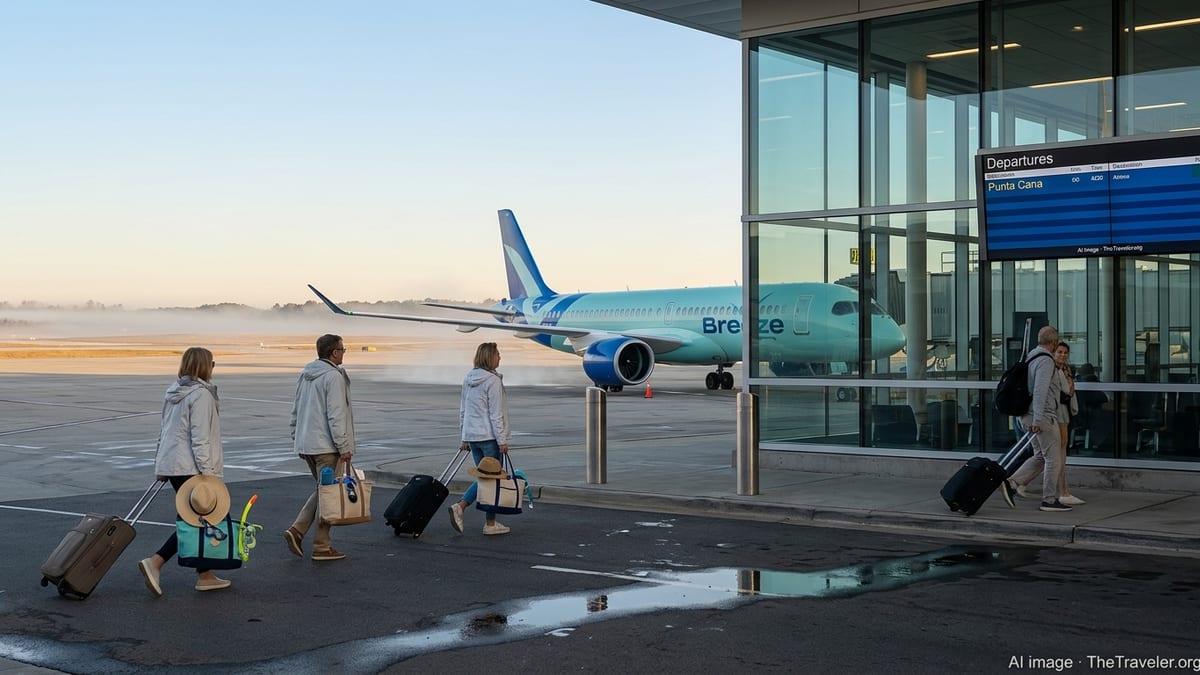
Breeze Airways is adding Raleigh–Durham to its growing network of flights to Punta Cana in the Dominican Republic, positioning North Carolina’s capital region alongside major U.S. gateways such as New York, Newark, Boston, Philadelphia, Miami, Atlanta and Fort Lauderdale in the race to capture Caribbean-bound leisure travelers with ultra-low fares and nonstop convenience.
Get the latest news straight to your inbox!
Raleigh Becomes Newest Gateway in Breeze’s Caribbean Push
Publicly available schedules indicate that Breeze Airways will begin seasonal nonstop service between Raleigh–Durham International Airport and Punta Cana International Airport on March 4, 2026, using Airbus A220 aircraft. The launch places Raleigh among a widening list of U.S. cities gaining direct links to the popular Dominican resort hub as the carrier rolls out its first wave of international operations.
Industry data and airport disclosures show that Punta Cana is being positioned as one of Breeze’s early international focal points, with service linked to a mix of East Coast and Sun Belt cities. These include large metropolitan areas such as New York and Newark, major Northeast markets like Boston and Philadelphia, and key Florida and Southeastern gateways including Miami, Fort Lauderdale and Atlanta, where demand for beach and resort travel remains strong year-round.
The Raleigh addition marks a strategic expansion beyond traditional coastal hubs, bringing nonstop Caribbean access to a fast-growing tech and life-sciences region that historically has had limited direct links to island destinations. The move reflects a broader trend among low-cost and hybrid carriers targeting midsize metropolitan areas that can sustain leisure-focused routes previously considered viable only from larger hub airports.
Ultra-Low Fares Heat Up Competition on RDU–Punta Cana
Online fare listings for upcoming dates show Breeze Airways selling one-way Raleigh–Punta Cana tickets in the low- to mid-100-dollar range during select travel periods, undercutting or closely matching existing competitors on the route. Travel platforms and price trackers consistently display Breeze among the lowest available nonstop options, reinforcing the airline’s positioning as a value-focused challenger on Caribbean leisure corridors.
The new service arrives in a market that has already seen recent growth. American Airlines and Avelo Airlines have each introduced Raleigh–Punta Cana flights over the past two years, turning what was once a niche, seasonal offering into a three-carrier contest for vacation traffic. With Breeze entering as an additional nonstop option, travelers now face a more competitive environment likely to keep pressure on fares, particularly during shoulder seasons.
Industry analysts note that the combination of low base fares, unbundled add-ons and vacation-package tie-ins is reshaping how travelers from secondary U.S. markets access Caribbean resorts. Breeze’s entry further disrupts legacy pricing structures by marketing Punta Cana trips in a style similar to domestic leisure routes, with promotional sales, simplified fare families and a heavy emphasis on nonstop convenience from cities that previously required connections.
Raleigh’s International Profile Rises With New Leisure Links
The addition of Breeze’s Punta Cana flights is part of a broader international build-out at Raleigh–Durham International Airport. Over the past two years, the airport has seen new or expanded service to destinations including Montego Bay, Cancún, Toronto and Vancouver, highlighting a shift from primarily domestic connectivity toward a more diversified route map that includes both business and leisure-focused international links.
Local economic development reports describe Breeze as a major new player at Raleigh–Durham, citing the establishment of a crew base and the creation of hundreds of aviation jobs to support its growing schedule. The airline’s move into international flying from the airport, alongside other carriers’ Caribbean expansions, underscores the region’s emergence as a significant origin market for sun-and-sand vacations.
For travelers, the growing slate of nonstop options reduces the need for connections through traditional hubs such as Charlotte, Miami or New York when heading to Caribbean resorts. The ability to reach Punta Cana directly from Raleigh is expected to appeal to families, groups and all-inclusive vacation travelers who historically relied on charter-style offerings or multi-stop itineraries to reach the Dominican Republic.
Punta Cana Demand Surges Across East Coast and Sun Belt
Punta Cana has evolved into one of the Caribbean’s busiest leisure gateways, supported by a dense cluster of all-inclusive resorts, golf courses and beach communities clustered along the eastern coast of the Dominican Republic. Airline schedules and tourism statistics point to steady growth in U.S. arrivals in recent years, driven by a combination of competitive room pricing, large-scale resort developments and favorable air-service economics for narrowbody aircraft.
Breeze’s move to tie Raleigh into a larger Punta Cana network that includes New York, Newark, Boston, Philadelphia, Miami, Atlanta and Fort Lauderdale mirrors a wider industry pattern. Multiple carriers are now treating Punta Cana as a core beach destination on par with Cancún or Montego Bay, building seasonal and year-round capacity from a range of mainland cities that can feed hotel partners and tour operators throughout the peak winter and spring break periods.
With more U.S. airlines adding or expanding Punta Cana operations, the airport increasingly functions as a regional distribution point for Caribbean tourism, offering onward ground transportation to a variety of coastal communities. The resulting scale helps support frequent flights and fare promotions, creating a feedback loop that encourages still more travelers from secondary U.S. cities to consider the Dominican Republic for their next beach vacation.
What Breeze’s Entry Means for Travelers and the Market
For consumers in the Raleigh–Durham area, Breeze’s new Punta Cana route brings an additional layer of flexibility on dates, schedules and price points. The airline’s model, which typically offers a basic fare with optional extras for bags, seats and priority services, allows travelers to tailor their spending more precisely than with bundled legacy offerings. This structure often resonates with cost-conscious families and younger travelers seeking value without sacrificing nonstop convenience.
From a market perspective, the route underscores how competitive dynamics in the U.S. airline industry are shifting as newer carriers receive regulatory approval to operate internationally. Breeze’s certification as a U.S. flag carrier opened the door to Caribbean and Mexican destinations, and its choice to include Raleigh among the early set of international gateways illustrates the importance of high-growth, midsize regions in the next phase of leisure network development.
As additional schedules are loaded and more seasons of data accumulate, aviation analysts will be watching booking patterns, average fares and load factors on the Raleigh–Punta Cana corridor to gauge the durability of demand. For now, the entry of Breeze Airways into the market signals that carriers see significant long-term potential in connecting inland U.S. cities directly to Caribbean resort destinations at ultra-low price points.