

More news on this day
A renewed focus on river crossings inside Tanzania’s Tarangire National Park is quietly reshaping how safari vehicles move through one of East Africa’s most wildlife-rich landscapes, with the Matete Bridge at the center of a new chapter for the park’s famed elephant country.
Get the latest news straight to your inbox!
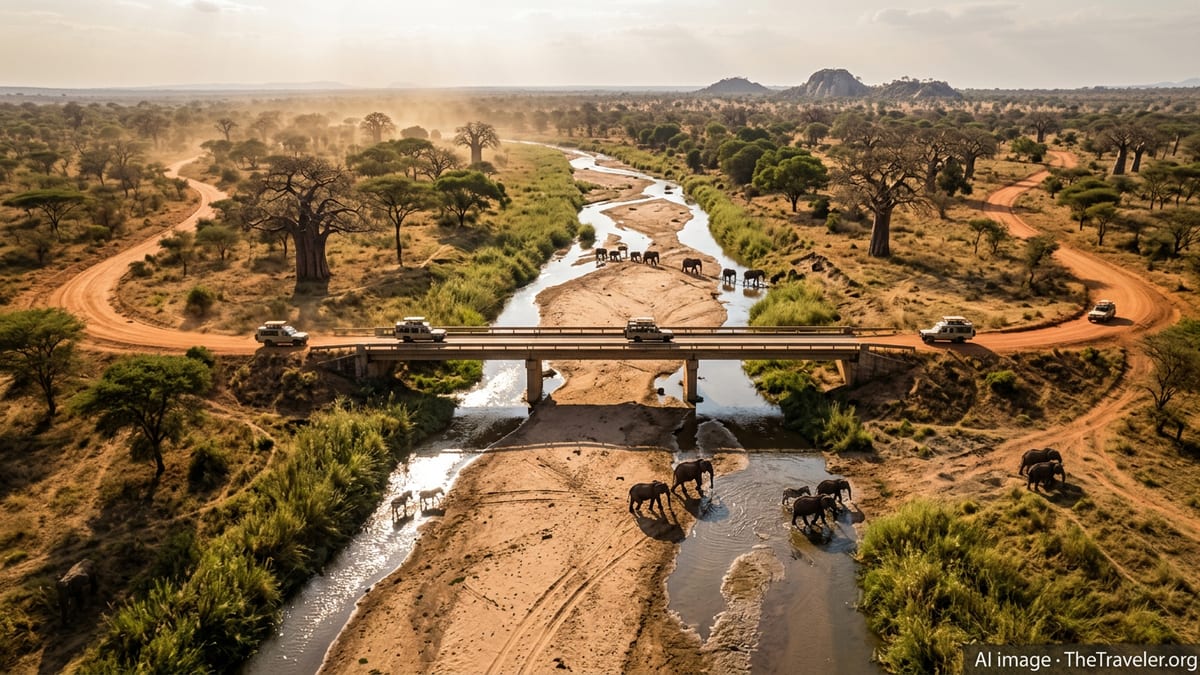
A Strategic Crossing in a Critical River System
The Matete Bridge, also known in some safari literature as the Engelhard Bridge, spans the Tarangire River in the northeastern section of Tarangire National Park. The crossing links the Matete woodlands on the river’s northern bank with central areas of the park, where the river forms the main dry-season lifeline for wildlife. Publicly available safari guides describe the bridge as a gateway into a mosaic of riverine forest, tall grass and acacia woodland that holds some of Tarangire’s highest densities of elephants, big cats and plains game.
The Tarangire River itself is one of northern Tanzania’s defining ecological features. Hydrological studies and park information materials note that it is the only permanent water source over a broad swath of surrounding rangelands, drawing migratory herds back into the park from June to October when seasonal pans and streams elsewhere have dried. By straddling this artery, the Matete Bridge effectively connects habitats on both sides of the river that might otherwise be difficult to reach for much of the year.
Infrastructure planning documents from Tanzanian authorities list a proposed construction and rehabilitation program for the Matete Bridge within a broader package of works in and around Tarangire, including access roads and airstrips. Those reports indicate that the crossing is treated not simply as a convenience for visitors, but as a strategic asset for managing traffic, enabling rangers to patrol more efficiently and supporting tourism, which finances much of the park’s conservation budget.
Safari operators now highlight the Matete crossing as part of detailed route descriptions that weave through the park’s northern and central circuits. As a result, what was once seen mainly as a technical river crossing is increasingly framed as a pivotal element in how guides design game drives and how travelers experience Tarangire’s distinctive mix of river valley, granite outcrops and open woodland.
Shorter Drives, Smarter Routes for Safari Travelers
For visitors on the classic northern Tanzania safari circuit, small changes in road access can translate into significant shifts in how a day in the bush feels. Trip notes from tour companies and traveler reports show that the Matete Bridge has allowed guides to link the Matete woodlands with central hotspots like the Tarangire River corridors and nearby picnic sites without long detours to alternative fords or tracks.
Driving times between camps on the north and east sides of the park and the core river loops can be reduced when the bridge is fully operational and connected to graded access roads. Planning documents for road repair programs in the wider Tarangire area reference work on links around Matete and adjacent sectors, suggesting an intention to keep these routes usable even during challenging wet seasons. For guests, that can mean less time spent on repetitive access runs from the main gate and more time in productive game-viewing zones.
Safari specialists also point out that a functioning bridge gives them more flexibility to adapt to daily conditions. If a section of track along one bank of the river becomes crowded or muddy, vehicles can cross at Matete and work quieter loops on the opposite side, or head toward other features such as the Silale Swamp or Burungi circuit. This capacity to improvise routes on the fly is increasingly cited in marketing material as a way to deliver a less congested, more responsive safari experience.
Overland itineraries that combine Tarangire with Lake Manyara National Park and the Ngorongoro Conservation Area also benefit. Operators based in Arusha describe using internal crossings to design one-way routes through Tarangire rather than simple out-and-back drives from the main gate, a shift that is made practical when a dependable crossing such as Matete is available within the park road network.
Relieving Pressure on Wildlife and Spreading Visitor Impact
Conservation groups working in the broader Tarangire ecosystem have long warned about the risks of both habitat fragmentation and localized crowding around key wildlife concentrations. Tarangire’s elephants, lions and giraffes are often found clustered along the river during the dry season, and bottlenecks at a few popular loops or gate-adjacent tracks can lead to vehicle build-ups at sightings.
By giving guides an additional way to cross the Tarangire River inside the park, the Matete Bridge helps disperse that pressure. Public-facing information from safari outfits notes that the Matete woodlands are less frequently visited than some of the central river bends, even though they offer similarly rich game viewing and notable leopard and elephant activity. With improved connectivity, vehicles can spread out across a wider grid of tracks rather than converging on the same handful of loops.
This redistribution is significant for wildlife. Fewer vehicles stacked at a single lion sighting or elephant herd reduce disturbance, particularly in peak dry months. It also supports more varied experiences for visitors, who are more likely to encounter animals behaving naturally when there are fewer vehicles present. Guides increasingly promote quiet corners accessed via Matete as a selling point, particularly for repeat safari-goers seeking less crowded encounters.
At a broader scale, the bridge forms part of a network of roads and crossings that help rangers monitor sensitive zones along the river. Public reports on infrastructure programs in the Tarangire area suggest that this connectivity is viewed as complementary to anti-poaching patrols and rapid responses to human-wildlife conflict issues on the park’s fringes, underscoring the dual role of tourism infrastructure in both access and protection.
Gateway to the Matete Woodlands and Their Wildlife Riches
Beyond its logistical function, the Matete Bridge is increasingly portrayed as an entry point to one of Tarangire’s signature habitats. The surrounding Matete woodlands, named for the tall reed-like matete grass that lines parts of the river, appear in online safari briefings as a highlight of the park’s northern sector, known for high elephant densities, notable birdlife and a strong chance of spotting leopards draped in the branches of sausage trees.
Travel features and lodge descriptions emphasize that the area’s mix of tall grass, scattered baobabs and riverine forest contrasts with the more open plains found in other northern circuit parks. From the bridge, guides can work slow loops along the river, scan sandbanks for elephant crossings and follow game trails that lead toward the wider woodlands. The ability to move easily between banks encourages varied circuits that take in both close river views and elevated vantage points on nearby ridges.
For photographers, the crossing offers changing perspectives on the same stretch of river throughout the day. Morning light on the eastern bank can illuminate herds descending to drink, while afternoon drives from the opposite side can capture backlit dust clouds and silhouettes of giraffes and baobabs. Safari operators note that this flexibility is particularly valuable on shorter itineraries, where maximizing different angles and habitats in just one or two days in Tarangire can make the experience feel more expansive.
The bridge’s role as a symbolic link between riverine strongholds and more remote woodland tracks also aligns with wider efforts in the Tarangire ecosystem to maintain functional corridors for migratory wildlife. Regional conservation initiatives that reference the Tarangire–Manyara corridor highlight the importance of keeping movement routes open across the landscape, and while the Matete crossing is internal to the park, it reflects a broader emphasis on connectivity rather than isolation.
What the New Connectivity Means for Future Safaris
Looking ahead, the inclusion of the Matete Bridge in public infrastructure plans and safari marketing suggests that it will remain a central feature of Tarangire itineraries. As paved approaches from Arusha maintain relatively short transfer times to the park, the internal road and bridge network will play a growing role in determining how visitor numbers are absorbed without undermining the sense of wilderness that draws travelers in the first place.
Some tour companies are already positioning Tarangire as a destination where one or two extra nights can reward those willing to explore beyond the main river loops. Easy access across the Matete Bridge helps make that case. Packages now commonly mention walking safaris, night drives and extended circuits into quieter sectors that hinge on being able to move smoothly across the river at more than one point.
For local communities around Tarangire, improved tourism flows inside the park have indirect but important implications. Increased time in the park core can translate into higher demand for guiding, vehicle services, supplies and accommodation in nearby gateway towns. National planning documents that reference Matete as part of a larger program of works hint at an expectation that better-managed, higher-value tourism will reinforce the park’s role as a source of jobs and foreign exchange.
As visitor interest in less crowded, conservation-minded safaris continues to rise, Tarangire’s evolving network of roads and bridges is likely to receive more attention from both operators and travelers. In that context, the Matete Bridge is emerging as more than a piece of concrete and steel over a river. It is a functional symbol of how thoughtful infrastructure can help align wildlife protection, visitor experience and local economic benefit in one of Tanzania’s most compelling wild landscapes.