

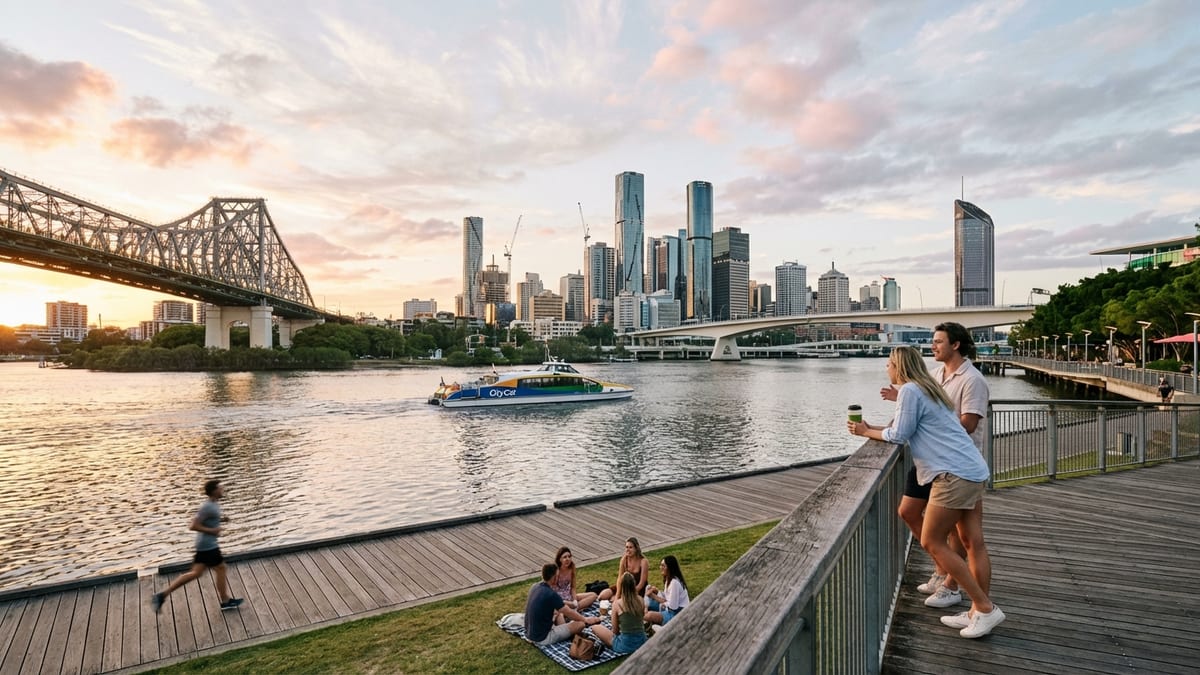
Brisbane has long traded on its reputation as Australia’s relaxed river city, but in recent years it has quietly transformed into one of the country’s most interesting urban destinations.
With new precincts along the river, a revamped dining scene, major cultural institutions and a subtropical climate that invites you outdoors year-round, Brisbane rewards both first-time visitors and repeat travelers. This guide walks you through what to see, how to get around, where to stay and what to know before you go, so you can make the most of your time in Queensland’s capital.
Orientation: Getting to Know Brisbane
Brisbane is the capital of Queensland, located on Australia’s east coast about halfway between Sydney and Cairns. The city curls around the Brisbane River rather than the ocean, with the central business district on a tight loop of riverbank and a string of inner suburbs spreading out in all directions. To the east lie the bayside suburbs and ferries to Moreton Bay, while to the south and north you will find the highways leading to the Gold Coast and Sunshine Coast. Brisbane itself is compact enough that most visitors focus on a corridor stretching from Newstead and Fortitude Valley down through the CBD to South Bank and West End.
For visitors from North America or Europe, Brisbane Airport is the primary gateway, with direct long-haul flights from major hubs in Asia, the Middle East and increasingly the United States. The airport sits around 20 to 25 minutes by train or taxi from the city center. Once in town, the Brisbane River is a constant reference point; locals will often give directions based on whether somewhere is on the “city side” or the “South Bank side” of the water. Unlike some larger capitals, Brisbane feels approachable, with a walkable center and distinct neighborhoods that you can easily string together in a single day of exploring.
The climate is humid subtropical, meaning hot, often stormy summers and mild, dry winters. Summer runs from December to February, with daytime temperatures frequently above 86 degrees Fahrenheit and high humidity. Winter, from June to August, is generally sunny and pleasant, with daytime highs around the mid-60s. The shoulder seasons of spring and autumn are ideal for sightseeing, outdoor dining and riverfront walks, although Brisbane’s packed events calendar means there is rarely a quiet time on weekends.
Top Sights You Should Not Miss
Brisbane’s must-see attractions cluster around the central river loop. On the south side, the South Bank Parklands combine leafy riverside promenades, restaurants, public art and the city’s signature cultural institutions. The Queensland Art Gallery and Gallery of Modern Art form a major complex with rotating international exhibitions and a strong focus on contemporary Asia-Pacific art. Nearby, the Queensland Museum and the Queensland Performing Arts Centre round out a dense cultural hub that can easily occupy a full day.
Across the river in the CBD, the historic City Hall and King George Square sit at the symbolic heart of Brisbane. City Hall’s clock tower tours offer elevated views over the city’s evolving skyline. From here it is a short walk to the City Botanic Gardens, an oasis of tropical trees, bamboo groves and riverside lawns that date back to the 19th century. The gardens are especially atmospheric early in the morning or around sunset, when joggers, commuters and ibises share the paths.
One of the most significant additions to the cityscape is the Queen’s Wharf Brisbane precinct, which began opening in stages from August 2024. Built along a historic stretch of riverfront on the CBD side, the development combines a resort-style casino complex, hotels, a rooftop Sky Deck with panoramic views, pedestrian promenades and a large-scale public art trail featuring works by local and First Nations artists. It is connected to South Bank via the Neville Bonner Bridge, a striking pedestrian bridge that opened in 2024 and has quickly become a landmark in its own right.
For a complete change of perspective, head to the cliffs of Kangaroo Point, just downstream from the CBD. The clifftop park and the riverside boardwalk below offer classic skyline views, particularly at dusk. Adventurous visitors can join guided rock climbing or abseiling sessions on the cliffs, while those looking for a gentler outing can simply bring a picnic and watch ferries glide past as the city lights flicker on.
Exploring Brisbane’s Neighborhoods and Riverfront
Part of Brisbane’s appeal lies in its distinct inner-city neighborhoods, many of which are linked by the river and an ever-growing network of walkways and bridges. Fortitude Valley, north of the CBD, is the city’s nightlife and live music hub, with a mix of heritage shopfronts and glass towers housing bars, nightclubs and rooftop venues. By day, “The Valley” has evolved into a creative district, with galleries, design studios and some of Brisbane’s more cutting-edge dining rooms.
Downriver from the Valley, Newstead and Teneriffe showcase Brisbane’s warehouse conversions and new residential developments along the river. The former wool stores of Teneriffe now house loft apartments, cafes and craft breweries, while the riverfront path offers a scenic walk or bike ride. Continuing along the waterfront leads to Newstead Park and Gasworks, where restaurants and bars cluster around an illuminated former gas ring that has become a popular evening gathering spot.
Across the river on the south side, South Bank and nearby West End show two different faces of the city. South Bank is polished and planned, with landscaped gardens, a city-beach style lagoon, playgrounds and family-friendly eateries spread along the water. Street performers and weekend markets add a festive atmosphere. By contrast, West End retains a more bohemian feel, with older Queenslander houses, leafy backstreets, independent cafes, vintage shops and a growing crop of small bars. The two neighborhoods sit adjacent, making it easy to experience both in a single outing.
Further afield but still within easy reach, the inner western suburbs of Paddington and Rosalie wind over steep hills lined with timber-and-tin houses and leafy verandas. Antique shops, boutiques and neighborhood restaurants cluster along Given Terrace and Latrobe Terrace, creating a village feel just a short bus ride from the city. For travelers wanting a break from the high-rises, these hilly streets provide some of the best opportunities to see classic Brisbane architecture and views back towards the skyline.
Getting Around: Transport, Tickets and Practical Tips
Brisbane is straightforward to navigate, with a mix of trains, buses, ferries and pedestrian infrastructure. From Brisbane Airport, the Airtrain runs directly to central stations such as Fortitude Valley, Central and Roma Street. As of early 2026, typical adult fares for the city leg are in the high teens in Australian dollars when booked online in advance, with discounts often available if you pre-purchase or travel off-peak. Taxis and rideshare services operate from dedicated ranks at both terminals, and the drive into the city generally takes around 20 to 30 minutes depending on traffic.
Once you are in the city, public transport across South East Queensland operates on a unified Translink system. The state government introduced a flat 50 cent fare for all Translink services in August 2024, and in early 2025 confirmed that this ultra-low fare structure would become permanent. That means any bus, suburban train, tram or Brisbane City ferry trip within the network costs 50 cents per journey, regardless of distance. The Airtrain, which connects the airport to the city, operates under its own pricing but has periodically participated in government-backed discount schemes, so it is worth checking current offers when you plan your trip.
Brisbane has also completed a rollout of smart ticketing that allows you to tap on and off with contactless credit or debit cards, smartphones, smart watches and traditional go card smartcards. All these options are charged at the same 50 cent fare on regular Translink services, and you can generally transfer between modes within set time limits without paying an additional fare. For short-term visitors, this system eliminates the need to buy a dedicated transport card, although go cards remain available at stations and selected retailers for those who prefer them.
On the river itself, high-speed CityCat ferries and local cross-river services are both useful and scenic. Services have faced occasional temporary suspensions during severe weather events such as floods or cyclones, so it is wise to check live updates close to your travel dates. When they are running normally, CityCats connect suburbs such as New Farm, Bulimba, Toowong and St Lucia with the central city, effectively turning the river into a moving viewpoint. Walking and cycling are also pleasant options, with riverside paths linking Kangaroo Point, South Bank, the CBD and New Farm into a mostly continuous loop.
Where to Stay and What It Will Cost
Brisbane’s hotel scene has expanded significantly, moving beyond traditional business hotels to include design-led boutique properties, new international brands and apartment-style stays. The CBD remains the most convenient base if you are focused on sightseeing, with easy access to Queen Street Mall shopping, the Botanic Gardens, the river ferries and the bridges to South Bank. Many of the city’s newest high-rise hotels occupy former commercial towers, bringing rooftop pools, sky bars and river views into the mix.
The opening of The Star Brisbane within the Queen’s Wharf precinct has introduced a large integrated resort with multiple hotel offerings, a rooftop Sky Deck, infinity-style pools and a dense cluster of bars and restaurants. While this complex caters strongly to the gaming market, non-gaming visitors can still enjoy the elevated views and public spaces. Room rates here typically skew toward the upper end of the market, particularly around major events and weekends, but the development adds an unmistakably resort-like layer to the inner city.
Travelers seeking a more local neighborhood feel often choose to stay in South Bank, West End or Fortitude Valley. South Bank offers river views, family-friendly hotels and proximity to the cultural precinct, while West End and Fortitude Valley have more compact boutique properties above or near bars and cafes. Apartment hotels are common across the inner city, giving longer-stay visitors kitchen and laundry facilities along with hotel-style services. As in most Australian capitals, prices fluctuate with demand, with winter and midweek stays often cheaper than peak summer weekends.
For budget-conscious travelers, hostels and guesthouses are scattered around the CBD fringe, particularly in the Valley, Kangaroo Point and the inner west. While dorm beds and basic private rooms remain available, many of Brisbane’s newer hostels have moved toward a “poshtel” model with improved design, social spaces and private pod-style bunks. If you are visiting in conjunction with a major festival or a big sporting event, booking well in advance is essential, as room rates can spike and reasonably priced options close to the center may sell out.
Food, Drink and Brisbane’s Evolving Nightlife
Brisbane’s dining scene has matured rapidly, moving beyond its former reputation for pub grub and casual riverside cafes. Today you will find serious restaurants drawing on local produce from Queensland’s farms, reefs and rainforests, alongside inventive small-plate bars and a strong cafe culture built around specialty coffee and brunch. Given the warm climate, many venues spill out into courtyards, decks and waterfront terraces, allowing you to dine outdoors for much of the year.
Howard Smith Wharves, tucked under the Story Bridge on the city side of the river, is one of the most atmospheric places to eat and drink. This heritage-listed former wharf complex has been transformed into a waterfront precinct with breweries, wine bars, restaurants and an upscale hotel. Views stretch across the river to the Kangaroo Point cliffs and back toward the CBD skyline, making it a popular spot for sunset drinks and long dinners. On weekends, the area hums with a mix of locals and visitors, so consider booking ahead for popular venues.
Fortitude Valley remains the heart of Brisbane’s nightlife, offering everything from intimate wine bars to live music venues and late-night clubs. Recent years have seen more focus on rooftop spaces and small bars along laneways, diversifying the scene beyond big-room nightclubs. Elsewhere, inner suburbs such as Newstead, New Farm and West End have built strong reputations for neighborhood dining, with casual eateries, craft breweries and cocktail bars packed into compact, walkable clusters.
For a taste of Queensland’s multicultural flavors, seek out Vietnamese eateries in Inala, Chinese and Korean restaurants in Sunnybank, and Greek and Middle Eastern venues dotted around the inner south and west. While these areas sit a short train or bus ride from the CBD, they reward visitors with food and atmospheres that feel a world away from the polished riverfront. As always in Brisbane, outdoor seating is prized, and many suburban venues make the most of leafy backstreets and subtropical gardens.
Day Trips, Nature and Seasonal Events
One of Brisbane’s biggest advantages is its access to nature and coastal escapes. To the east, ferries from suburbs such as Cleveland and Manly connect to the islands of Moreton Bay, including North Stradbroke Island and Moreton Island. These sandy islands offer clear waters, wild beaches and opportunities for snorkeling, sandboarding and, in winter, whale watching. Even a short excursion out to the bay gives a sense of how close the city sits to a very different coastal landscape.
To the south and north, the Gold Coast and Sunshine Coast are both roughly an hour to 90 minutes away by car or coach, depending on traffic and your exact destination. The Gold Coast combines surf beaches with high-rise resorts and major theme parks, while the Sunshine Coast leans more toward relaxed coastal towns and hinterland villages. Many visitors to Brisbane build a few days on one or both coasts into a longer itinerary, using the city as a base for urban culture and dining before heading out for beach time.
Closer to town, the forested hills and national parks around Mount Coot-tha and the Scenic Rim provide accessible hiking and lookouts. The Mount Coot-tha Lookout is a classic vantage point over Brisbane and a popular spot for sunrise and sunset. Walking trails in the surrounding bushland range from short loops to longer hikes. To the south-west, the Scenic Rim region offers more serious mountain scenery, vineyards and small-town hospitality, typically reached by car or organized tours.
Brisbane’s events calendar runs throughout the year, with major drawcards including the Brisbane Festival in September, featuring large-scale public art, music and the popular riverfire fireworks display. Other highlights include summer cricket and winter rugby matches at The Gabba and Suncorp Stadium, as well as touring exhibitions at the city’s galleries and performances at the Queensland Performing Arts Centre. Event schedules and venues can change, so it is wise to check what is on during your planned travel dates and to book tickets early for headline shows or big matches.
Safety, Culture and Practical Essentials
Brisbane is generally considered a safe city by international standards, with low rates of violent crime in tourist areas. Common-sense precautions still apply, particularly late at night around nightlife districts where alcohol can occasionally fuel antisocial behavior. Keep valuables out of sight, use licensed taxis or rideshare services after dark if you feel uncomfortable walking, and stay aware of your surroundings in crowded areas. Around the river and coastal areas, pay attention to safety signage, especially regarding flooding, strong currents or swimming conditions.
The city’s subtropical climate means sun protection and hydration are critical. Even in winter, ultraviolet levels can be high, so sunscreen, a hat and sunglasses are essential if you are spending extended time outdoors. In summer, brief but intense afternoon thunderstorms are common, and heavy rain can cause localised flooding along low-lying paths and roads. When planning riverfront walks or ferry rides during the wet season, keep an eye on local forecasts and any alerts about high river levels or temporary closures.
Culturally, Brisbane balances a relaxed, informal vibe with growing cosmopolitan confidence. Dress codes are generally casual, especially during the day, although upscale restaurants and nightlife venues may expect smart-casual attire. Tipping is not compulsory in Australia, but rounding up small bills or leaving around 10 percent in restaurants for good service is appreciated rather than expected. English is the main language, and most services, signage and public announcements are straightforward for international visitors.
For connectivity, free public Wi-Fi is available in parts of the CBD, South Bank and some transport hubs, while Australian prepaid SIM cards are easy to buy at the airport, supermarkets and convenience stores. Electrical outlets use the Australian three-prong plug, and the standard voltage is 230V, so visitors from North America and parts of Asia will need an appropriate adapter and should ensure their devices support the higher voltage. Healthcare facilities are modern and widely available, but travel insurance is strongly recommended to cover any unexpected medical needs.
The Takeaway
Brisbane in 2026 is a city in full stride, blending new riverfront developments and skyline-changing projects with older neighborhoods rich in character. The permanent introduction of ultra-cheap public transport fares, the rise of integrated precincts like Queen’s Wharf and the ongoing evolution of dining and cultural offerings have collectively reshaped how both locals and visitors experience the city. Yet Brisbane has retained its easygoing personality, where shorts and sandals are as common as suits and where a world-class gallery might sit just a short stroll from a shaded riverside picnic spot.
For travelers, this means a visit to Brisbane can be as laid-back or as curated as you choose. You can spend days hopping between museums, rooftop bars and design hotels, or simply wander riverside paths, ride ferries and explore village-like suburbs. With island getaways, national parks and two major coastal regions within easy reach, Brisbane also serves as a versatile base for a wider Queensland adventure. Arrive ready for warmth, both in the weather and in the welcome, and you will find a city that continues to surprise long after you first glimpse its river bends from the air.
FAQ
Q1. When is the best time of year to visit Brisbane?
For comfortable temperatures and lower humidity, the best times to visit Brisbane are typically from April to early June and from September to early November. Winter months from June to August are sunny and mild, ideal for outdoor activities, while summer from December to February can be hot, humid and stormy, though it suits travelers who enjoy warm evenings and poolside time.
Q2. How many days do I need to see the main sights?
A stay of three to four full days is enough to cover Brisbane’s main attractions, including South Bank’s cultural precinct, the CBD, a couple of inner suburbs and some time on the river. If you plan to include a Moreton Bay island excursion or day trips to the Gold Coast or Sunshine Coast, consider extending your stay to five to seven days.
Q3. What is the easiest way to get from Brisbane Airport to the city?
The Airtrain is usually the most convenient and predictable option, running regularly between the domestic and international terminals and central stations such as Fortitude Valley, Central and Roma Street in around 20 to 25 minutes. Taxis and rideshare services are also widely available and can be cost-effective for small groups or if you are staying in areas not directly served by the train.
Q4. Do I need a transport card, or can I just tap with my bank card?
You no longer need a dedicated transport card to use Brisbane’s public transport network. The city’s smart ticketing system allows you to tap on and off with contactless credit or debit cards, smartphones and smart watches, with the same low 50 cent fare applying on Translink buses, trains, ferries and trams. Traditional go cards are still available, but for short-term visitors they are optional rather than essential.
Q5. Is Brisbane a walkable city?
The central areas of Brisbane, including the CBD, South Bank and nearby neighborhoods such as Fortitude Valley and West End, are walkable, with riverfront promenades and multiple pedestrian bridges. However, the city spreads over a large area, and some attractions and suburbs are best reached by public transport or rideshare. In summer, the heat and humidity can make long walks uncomfortable in the middle of the day, so plan to walk more in the mornings and evenings.
Q6. What should I pack for a trip to Brisbane?
Lightweight, breathable clothing, comfortable walking shoes, a hat, sunglasses and high-SPF sunscreen are essentials for Brisbane’s subtropical climate. A compact umbrella or light rain jacket is useful in the summer wet season when thunderstorms can move through quickly. In winter, a light jacket or sweater is usually sufficient for cooler evenings, as daytime temperatures remain mild.
Q7. Are there beaches in Brisbane itself?
Brisbane is built along the river rather than directly on the ocean, so it does not have surf beaches in the city center. However, the South Bank Parklands feature a man-made lagoon and sandy “city beach” that provide a place to swim and relax by the water. For natural beaches, you can take ferries to the Moreton Bay islands or drive to the Gold Coast or Sunshine Coast, both within easy day-trip distance.
Q8. How expensive is Brisbane compared with other Australian cities?
Brisbane is generally a little more affordable than Sydney or Melbourne when it comes to hotel rates and some dining costs, although prices are still in line with those of a major developed city. The introduction of flat 50 cent public transport fares has significantly reduced the cost of getting around. As always, costs vary depending on travel style, choice of accommodation and how often you dine at high-end restaurants.
Q9. Are there any safety concerns I should be aware of?
Brisbane is widely regarded as safe for visitors, and violent crime is rare in tourist areas. Main concerns are petty theft, especially in crowded places, and the usual risks associated with nightlife districts late at night. Weather-related issues such as strong sun, high heat and occasional flooding along the river during heavy rain also deserve attention. Following basic precautions and staying informed about local conditions will address most potential problems.
Q10. Can I use Brisbane as a base for exploring the rest of Queensland?
Yes, Brisbane works well as a hub for exploring South East Queensland. From the city, you can make day trips or short overnight excursions to the Gold Coast, Sunshine Coast, Scenic Rim and Moreton Bay islands, as well as connect by air or rail to farther-flung destinations such as the Whitsundays and Tropical North Queensland. Many travelers spend several nights in Brisbane at the start or end of broader Queensland itineraries to enjoy the city’s culture and dining before or after beach and reef adventures.