

More news on this day
British Airways is preparing to add Melbourne to its long-haul network in 2026, aligning the Australian city with a wave of recent and emerging services to Colombo, Cape Town, Tokyo and Barbados that signal a renewed focus on leisure-led, globally dispersed routes.
Get the latest news straight to your inbox!
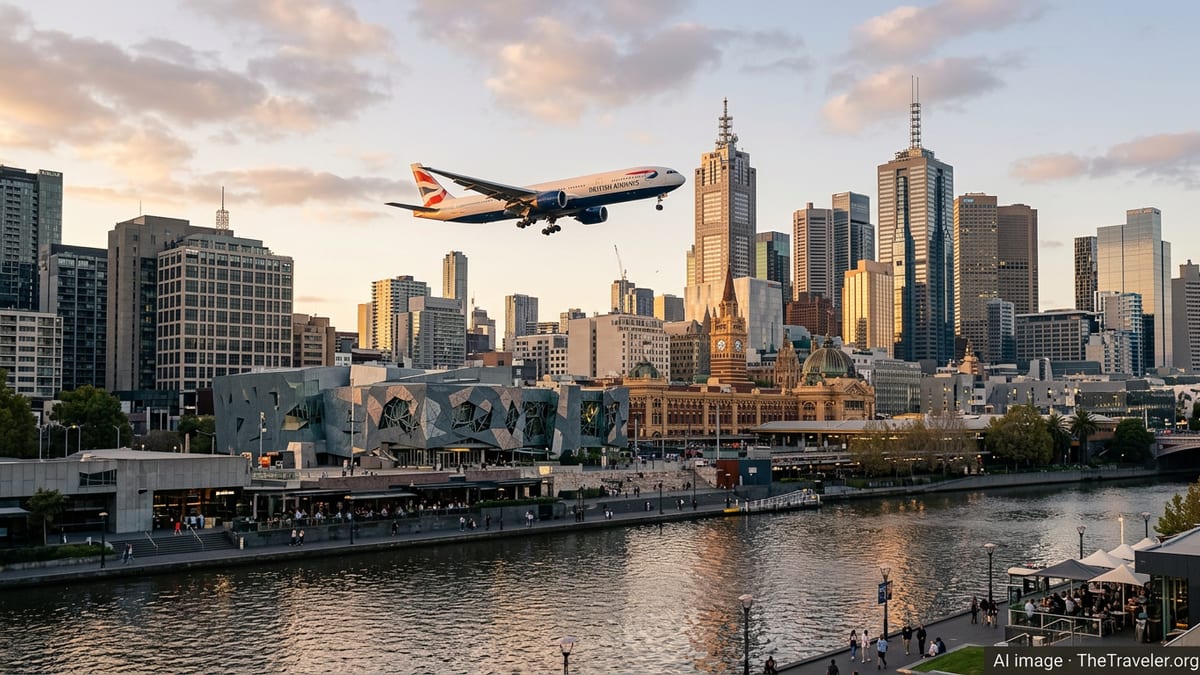
Melbourne Emerges as a Strategic Long-Haul Anchor
Publicly available timetable and product information for 2026 indicates that Melbourne is being positioned as a key addition to British Airways’ long-haul portfolio, complementing the carrier’s existing one-stop links to Australia and reinforcing London’s role as a gateway between Europe and the Asia-Pacific region. The development follows a broader industry trend of European airlines deepening their presence in Australia, with carriers such as Finnair planning new Melbourne services from late 2026 and Turkish Airlines continuing to grow its footprint in the market.
For British Airways, adding Melbourne to a lineup that already includes high-demand destinations in Asia, Africa and the Caribbean reflects a focus on travelers seeking long-haul holidays and family visits, as well as corporate links between financial and cultural hubs. Melbourne’s status as a major business city and gateway to Victoria’s leisure attractions gives it a dual appeal that fits the airline’s current emphasis on both premium and volume-driven markets.
Network references for 2026 suggest that Melbourne flights will be integrated into British Airways’ broader schedule improvements, which include additional seats to Bangkok and new connectivity options across Southeast Asia. This approach is designed to create more one-stop choices for travelers heading to or from Australia via London, using partnerships and connecting banks at Heathrow to build a more resilient, diversified long-haul network.
Industry commentary notes that Melbourne’s addition could help distribute demand that is currently funneled through Sydney and other hubs, providing alternative routings for passengers affected by periodic disruptions in Gulf airspace or by capacity constraints on existing kangaroo routes. The move also underlines the strategic value of Australia as a high-yield but capacity-limited market where even incremental additions can shift competitive dynamics.
Colombo and South Asia Strengthen the Network Spine
Alongside Melbourne, Colombo is part of a wider South Asian emphasis that has become increasingly visible in British Airways’ schedules and fleet plans. The airline already offers a dense operation into India’s largest cities, and references to continued growth in the region through 2025 and 2026 suggest that Colombo is being woven into a spine of South Asian destinations feeding into London Heathrow.
According to published coverage of British Airways’ transformation programme, the carrier has been investing in upgraded cabins and more consistent long-haul products, with new First and refreshed premium cabins due to roll out progressively through 2026. This product push is particularly relevant for South Asian routes, where demand from visiting friends and relatives overlaps with premium corporate traffic, and where London’s role as a financial and cultural hub continues to generate high year-round loads.
Colombo’s inclusion in this framework gives travelers in Sri Lanka an additional full-service link to Europe and North America via Heathrow, while also offering UK and European travelers a gateway to the Indian Ocean region. Industry analysis indicates that such routes are often supported by strong leisure demand, especially during peak Northern Hemisphere winter months, making Colombo an important counter-seasonal component of the network.
By treating Colombo as part of an integrated South Asian cluster rather than a standalone outpost, British Airways appears to be aiming for more efficient aircraft utilization and stronger connecting flows. This helps to underwrite capacity on longer sectors such as Melbourne, where reliable feed from multiple regions is key to sustaining year-round operations.
Cape Town and Barbados Capitalise on Leisure Demand
Cape Town and Barbados continue to feature prominently in British Airways’ long-haul strategy as classic leisure destinations with strong repeat visitation and robust premium demand. Seasonal schedule information and recent route maps show that both destinations have benefitted from additional capacity and frequency adjustments in recent years, particularly during the Northern Hemisphere winter when sun-seeking traffic from the United Kingdom and Europe peaks.
Reports indicate that British Airways has used widebody aircraft with its latest cabins on many Cape Town services, matching the route’s mix of holidaymakers, second-home owners and business travelers tied to South Africa’s tourism and resource sectors. The city’s scenic appeal and diverse attractions make it a staple of long-haul leisure portfolios, and its overnight flight patterns to and from London fit neatly into fleet rotation plans.
Barbados, meanwhile, occupies a central role in the airline’s Caribbean offering. Recent promotional materials have highlighted Bridgetown alongside destinations such as Miami and Jamaica in the context of broader 2026 holiday planning, underscoring the island’s importance as both a cruise gateway and a stand-alone beach destination. The combination of package holidays, cruise connections and increasingly upscale resort developments has helped sustain strong premium-cabin demand even outside traditional peak weeks.
By continuing to emphasise Cape Town and Barbados while adding Melbourne and solidifying Colombo, British Airways appears to be pursuing a balanced portfolio of long-haul leisure routes across different hemispheres. This diversified seasonality can help the airline smooth demand across the calendar year, mitigating peaks and troughs and supporting more stable aircraft utilization.
Tokyo and Asia-Pacific Connectivity Remain Central
Tokyo has long been a cornerstone of British Airways’ Asia-Pacific network, providing direct access to one of the world’s most important aviation and business markets. Publicly available schedule discussions and traveler reports show strong demand for London to Tokyo services into 2026, with both leisure and corporate segments contributing to high load factors and robust yield.
In parallel, British Airways has been increasing its capacity to Bangkok for the 2026 summer season, according to recent network updates. That growth, combined with codeshare partnerships in the region, is relevant for travelers headed to Tokyo, Melbourne and other Asia-Pacific destinations, as it creates additional one-stop possibilities and alternative routings where direct capacity is constrained.
The choice to maintain and in some cases enhance Asia services, even as Gulf-region routings face temporary disruption, speaks to the strategic importance of the broader region in British Airways’ long-term plans. Japan’s enduring appeal for inbound tourism, along with its extensive onward connectivity across East Asia, makes Tokyo a vital pillar supporting the expansion into Melbourne and reinforcing the carrier’s presence in the Pacific basin.
As travel demand continues to recover and evolve, analysts expect British Airways to keep refining schedules into Tokyo and other Asian gateways, adjusting aircraft types and frequencies to match shifting patterns. The linkage between Tokyo, Bangkok and emerging routes such as Melbourne indicates a network design that increasingly treats Asia-Pacific as an integrated system rather than a set of isolated endpoints.
Implications for Travelers Planning 2026 Journeys
For travelers planning long-haul trips in 2026, the combination of Melbourne, Colombo, Cape Town, Tokyo and Barbados in the British Airways portfolio points to a more globally distributed set of options from London Heathrow. This evolution offers greater choice to those seeking complex itineraries, such as multi-stop journeys that might combine Asia, Africa and the Caribbean around a central European hub.
Public information from airlines and travel advisers suggests that demand for premium leisure travel remains strong into 2026, with customers increasingly willing to pay for upgraded cabins and more flexible booking conditions. British Airways’ ongoing product investments, including refreshed long-haul interiors, are likely to be a factor in destination choice for high-spend travelers evaluating different routings to Australia, South Asia or the Caribbean.
At the same time, network adjustments across the industry, including temporary suspensions of some Gulf routes and the arrival of new competitors on corridors such as Europe to Australia, are creating a more fluid environment for fare levels and seat availability. For those targeting Melbourne, Colombo, Cape Town, Tokyo or Barbados, monitoring schedules and inventory well in advance of departure will remain important, particularly around peak holiday periods.
Overall, the addition of Melbourne alongside established destinations such as Colombo, Cape Town, Tokyo and Barbados illustrates how British Airways is reshaping its long-haul network for 2026 around a mix of resilient leisure markets and strategic business hubs. The result is a broader set of long-range options from London that reflects both changing passenger preferences and the shifting geography of global air travel.