

More news on this day
British Airways is widening its network retrenchment across the Middle East and key long-haul corridors, as fresh schedule updates show UK travellers now face reduced or suspended services to Dubai, Qatar, the UAE, Jordan, Bahrain, Oman, Thailand, Singapore and other destinations well into the spring travel period.
Get the latest news straight to your inbox!
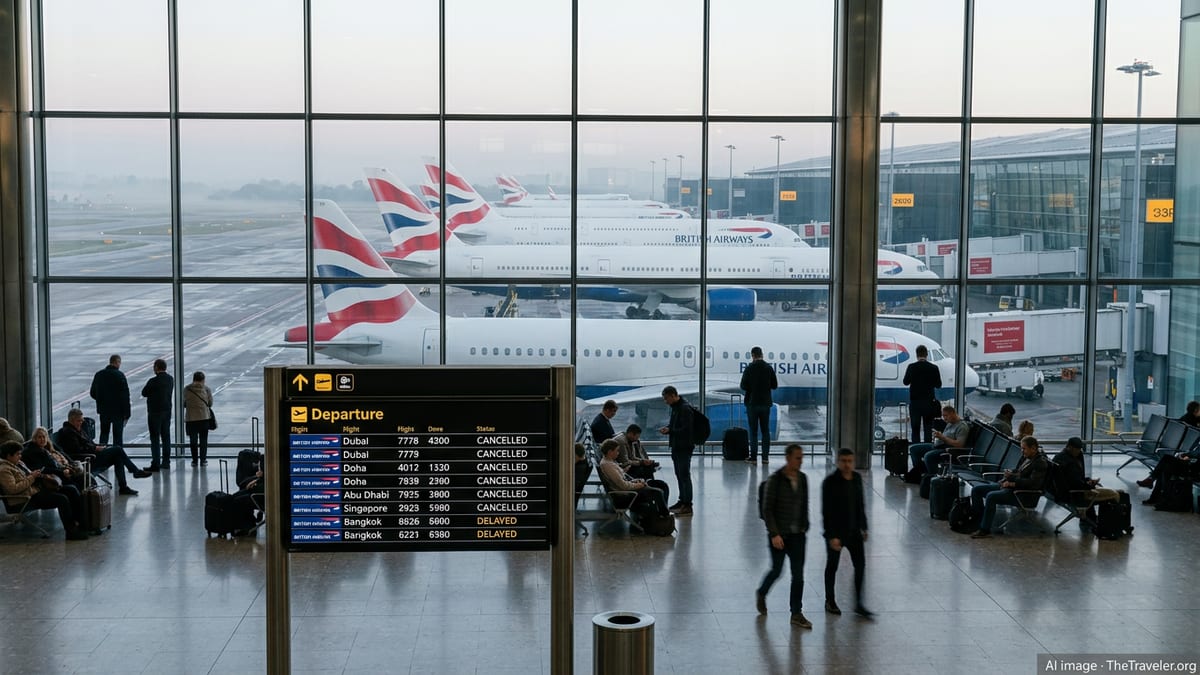
UK Routes Pulled as Gulf Airspace Turmoil Continues
Recent schedule changes and published coverage indicate that British Airways has sharply scaled back its presence across the Gulf, with flights to Dubai, Doha, Amman and Bahrain cancelled for much of March and some services to Abu Dhabi suspended until later in the year. The cuts follow weeks of severe disruption linked to airspace closures and security concerns affecting multiple states in the region, including the UAE, Qatar, Jordan and Bahrain.
Reports from regional outlets describe thousands of flights cancelled or rerouted after restrictions over parts of Iran and surrounding airspace forced airlines to abandon some of the most heavily used Europe–Asia corridors. Dubai International and Abu Dhabi, normally among the world’s busiest hubs, have seen waves of cancellations as carriers struggled to navigate changing restrictions and congestion on alternative routings.
While British Airways initially framed the moves as temporary, network data and travel-industry reporting suggest that reductions on some routes have now been embedded into the carrier’s forward schedules. Travellers holding tickets from UK airports to key Middle Eastern hubs through late March and into April are seeing itineraries cancelled outright or shifted onto different dates and routings.
The widening disruption places the UK firmly among a growing list of countries where passengers are facing prolonged uncertainty over flights that rely on Gulf and Levant airspace, including journeys to Qatar, the UAE, Jordan, Bahrain and onward connections to Asia.
Dubai, Doha and Abu Dhabi Absorbing the Hardest Hit
Dubai remains at the centre of the upheaval. Coverage from Gulf-based media notes that British Airways has halted its normal London–Dubai operation for an extended period, after earlier rounds of day-by-day cancellations. Other European airlines have also withdrawn or reduced Dubai services this month, underscoring the scale of the operational challenge for flights transiting the region.
Doha and Abu Dhabi have been similarly affected. A travel industry report summarising British Airways’ policies shows all Heathrow services to Doha and Amman cancelled through at least mid-March, while flights to Abu Dhabi have been removed from the schedule until later in 2026. That effectively erases one of the few non-Gulf-carrier options for UK passengers seeking one-stop connections to South and Southeast Asia without transiting Dubai or Doha.
The retreat leaves Gulf-based airlines such as Emirates, Etihad Airways and Qatar Airways carrying a disproportionate share of the traffic load between Europe and Asia. Even these carriers have been forced to adjust, with reports of capacity cuts, extended routings around closed airspace and limited “relief flights” designed primarily to repatriate stranded travellers rather than to offer normal commercial schedules.
For UK residents booked to or through these hubs, the immediate effect is fewer seats, longer journey times and an increased likelihood of last-minute changes, particularly on itineraries involving Dubai, Doha and Abu Dhabi.
Knock-On Effects for Thailand, Singapore and Wider Asia
The turbulence in Middle Eastern skies is now rippling across Asia-facing routes from the UK. According to aviation data cited by specialist travel outlets, tens of thousands of flights have been cancelled across the wider region since late February, including services touching Thailand and Singapore that depend on Gulf connections for feeder traffic.
Bangkok and Singapore, long-established transit points between Europe and Australasia, are feeling the strain as airlines attempt to reconfigure routings to avoid closed airspace. Reports indicate that British Airways and other European carriers have pushed additional capacity into Southeast Asia in the short term, using aircraft that would otherwise operate Gulf services. That shift is creating pockets of relief for travellers able to secure seats on nonstop or non-Middle East itineraries, while intensifying competition for limited capacity.
At the same time, Asia-Pacific hubs such as Singapore Changi and Bangkok Suvarnabhumi are dealing with their own cascade of delays and cancellations on services to Middle Eastern cities. Travel-analytics firms tracking disruption report hundreds of affected flights across major Asian airports since the start of March, highlighting how deeply interconnected Europe–Asia traffic flows have become.
For UK holidaymakers bound for Thailand or Singapore via British Airways’ traditional partnerships and multi-stop itineraries, the result is a more complex patchwork of options, often involving rebooking via alternative hubs or switching to carriers that can still operate viable routings.
UK Travellers Face Prolonged Uncertainty Into May
Although some restrictions have eased in recent days, schedule updates and airline advisories suggest that disruption is likely to persist well beyond the immediate crisis window. British Airways’ flexible travel policies, which initially covered departures to Dubai, Abu Dhabi, Doha, Bahrain and Amman through mid-March, have already been extended once and may need to be revised again if airspace and security conditions remain volatile.
UK-based passengers with bookings through April and May are reporting received notifications of “significant changes” to itineraries involving Gulf hubs, including cancellations of May departures routed via Doha or Dubai. In some cases, travellers have been invited to choose alternative dates, reroute via other cities such as Singapore or Bangkok, or request refunds. The pattern points to a deeper recalibration of the airline’s schedule, rather than a short-lived blip.
Travel commentators note that even if core routes to Dubai and Doha are restored on a limited basis over the coming weeks, operational knock-on effects such as aircraft and crew repositioning, slot constraints at congested hubs and ongoing safety assessments could hamper a swift return to pre-crisis frequencies. That means UK travellers planning Easter and early summer trips that rely on Middle Eastern connections may continue to face curtailed options, higher fares and longer circuitous journeys.
Industry analysts also warn that further adjustments remain possible if geopolitical tensions escalate or if regional authorities introduce new restrictions on overflights or airport capacity, factors largely outside the control of individual carriers.
What the Disruptions Mean for Bookings and Passenger Rights
With British Airways continuing to trim or suspend key services to Dubai and other Gulf destinations, travel experts are urging UK passengers to scrutinise their bookings, particularly those involving connections through Qatar, the UAE, Jordan, Bahrain or Oman. Publicly available guidance from consumer-rights organisations reminds passengers that, where flights are cancelled by an airline, customers are typically entitled to a choice between a refund and alternative transport to their final destination, subject to prevailing regulations.
In practice, rerouting has become more complicated. Reports indicate that, on some itineraries, British Airways is rebooking affected travellers on partner airlines where seats exist, or proposing new routings via Asian hubs that avoid the most constrained airspace. However, pressure on capacity means that finding comparable travel dates, cabin classes or connection times can be challenging, especially for peak travel periods stretching into May.
Travel advisers recommend that passengers monitor their reservations regularly via airline and travel agency channels, rather than waiting for notification, as last-minute cancellations and schedule changes remain common. They also point to the value of comprehensive travel insurance policies that specifically cover disruption due to airspace closures or geopolitical events, though coverage terms vary widely.
For now, British Airways’ extended cuts place the UK squarely among the countries most exposed to the ongoing reshaping of Middle East and Asia flight links. Until regional skies stabilise, travellers can expect a landscape of reduced direct options to Dubai and neighbouring hubs, longer journeys via alternative gateways such as Singapore and Bangkok, and a booking environment where flexibility is at a premium.