

More news on this day
British Airways and a growing list of major international airlines have suspended or sharply reduced flights across the Middle East as escalating conflict, airspace closures and missile strikes upend one of the world’s busiest aviation corridors and leave travelers stranded from Europe to Asia.
Get the latest news straight to your inbox!
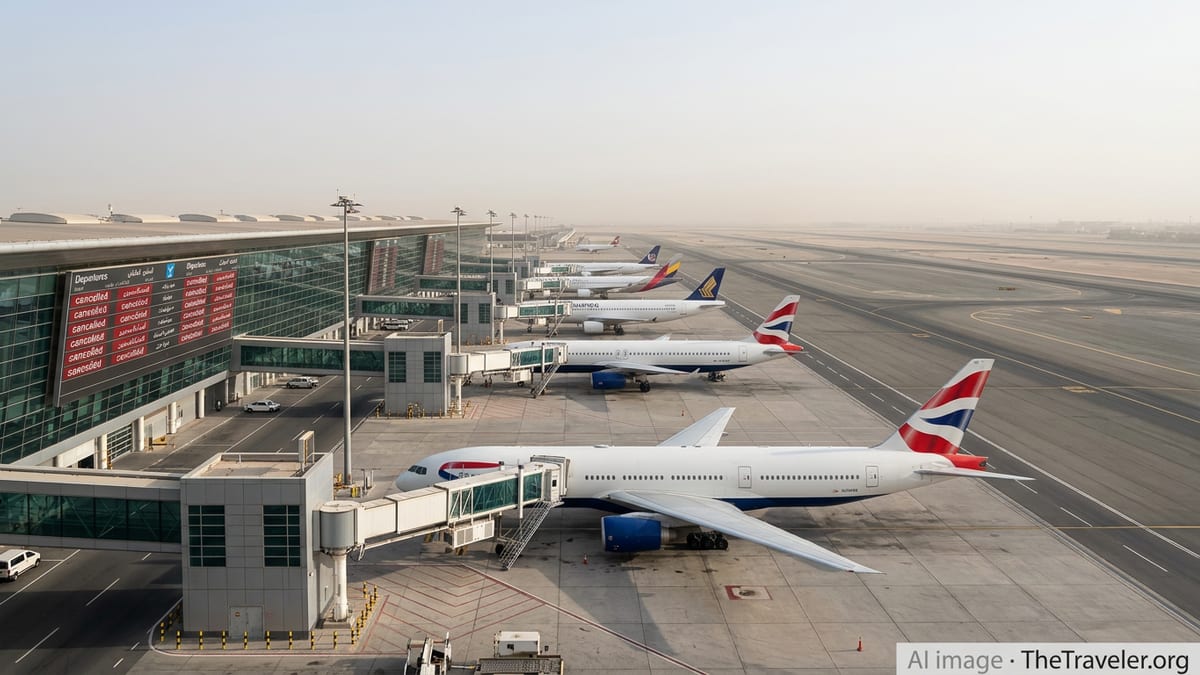
British Airways Halts Gulf Network as Conflict Deepens
British Airways has cancelled all flights to and from several key Middle Eastern cities, including Amman, Bahrain, Doha, Dubai and Tel Aviv, for the remainder of March, responding to rapidly deteriorating security conditions and widespread airspace restrictions across the region. The carrier has also suspended its Abu Dhabi route until later in the year, signalling that it does not expect a swift resolution to the crisis.
The moves follow a series of ballistic missile and drone attacks tied to the expanding conflict involving Iran, the United States and Israel, which began in late February and has triggered successive rounds of airspace closures over Iran, Iraq and parts of the Gulf. British Airways said it is reviewing operations day by day, but current schedules indicate no regular passenger services on its Gulf network until at least mid March, with some city pairs frozen for significantly longer.
The abrupt cancellations have stranded thousands of British and European travellers who had been relying on direct links between London and Middle Eastern hubs for business and leisure trips, as well as onward journeys to Asia and Africa. Passenger advocacy groups in the United Kingdom report surging complaints from customers struggling to secure alternative routes or refunds in time to make essential connections.
Operationally, the airline has been forced to divert or turn back multiple flights midair as the situation has evolved, contributing to fresh disruption at European airports. Aviation analysts note that British Airways, which had rebuilt much of its long haul network after the pandemic, now faces a complex and costly rerouting puzzle, with crews, aircraft and passengers out of position across three continents.
Global Carriers Slash Routes to Tel Aviv, Beirut and Gulf Hubs
British Airways’ decision is part of a broader retrenchment by global airlines, many of which have suspended flights to Tel Aviv, Beirut and primary Gulf gateways amid ongoing missile and drone threats and conflicting guidance from regional authorities. Air France has prolonged the suspension of services to Dubai and Riyadh, as well as routes into Tel Aviv and Beirut, citing continued security risks and closed airspace over multiple conflict zones.
American Airlines has extended the suspension of its Philadelphia to Doha service until at least early May and delayed the relaunch of its New York to Tel Aviv route, which had already seen multiple interruptions during earlier flare ups. U.S. regulators have prohibited carriers from flying within large portions of Iranian and Iraqi airspace and warned of threats from long range missiles and air defense systems in surrounding skies.
European, Asian and Middle Eastern airlines have also taken sweeping action, with Lufthansa, Virgin Atlantic, Air India and several Gulf-based carriers temporarily halting or severely curtailing services into the region. Industry assessments suggest that thousands of flights have been cancelled since the end of February as airspace closures expanded to cover much of Iran, Iraq, Israel, Jordan, Lebanon, Kuwait, Qatar, Bahrain and the United Arab Emirates.
The knock on effects are being felt well beyond the conflict zone. Flights connecting secondary European cities such as Bucharest to destinations including Dubai, Doha, Amman, Cairo, Beirut and Sharm el Sheikh have been suspended, cutting off popular winter sun and religious tourism routes. For many travellers, indirect routings via third country hubs have become the only remaining option, often at sharply higher prices.
Airspace Closures Force Lengthy Detours and Rising Fares
The closure or partial closure of Middle Eastern airspace has reshaped global flight paths almost overnight. Before the conflict, routes over Iran and the Gulf served as vital bridges between Europe and Asia, enabling fast, fuel efficient connections through mega hubs in Dubai, Doha and other Gulf cities. With those corridors now heavily restricted, airlines are diverting long haul services either far north via the Caucasus or far south over the Arabian Sea and Indian Ocean.
These detours can add from one and a half to six hours to typical flight times, pushing aircraft close to their fuel and crew duty limits and leading some operators to cancel routes that are no longer commercially or operationally viable. Aviation tracking data shows traditional highways of air traffic over Iran and Iraq largely empty of civilian aircraft, while surrounding corridors have become congested bottlenecks.
For passengers, the impact is being felt most immediately in soaring ticket prices and dwindling seat availability, particularly on Asia to Europe journeys that once relied on Gulf stopovers. Travel data firms report economy fares on some key city pairs more than tripling compared with early February, as airlines slash capacity and demand shifts to a shrinking number of safe, usable routes.
Insurers and corporate travel managers are also revising risk assessments, with many multinational companies temporarily halting nonessential trips to the broader region. In parallel, several governments have advised citizens to leave affected countries on the first available commercial flights, further intensifying demand for a limited pool of outbound seats.
Stranded Travelers Face Uncertain Timelines and Patchwork Support
With schedules changing by the hour, stranded travellers across the Middle East are relying on a patchwork of emergency repatriation flights, limited commercial services and overland routes to exit the region. European governments, including France, have chartered aircraft and negotiated fixed price seats with remaining Gulf carriers to bring citizens home from conflict affected areas as regular airline capacity has evaporated.
For those booked on suspended flights, rebooking options are often constrained. British Airways and other major airlines are offering refunds or alternative itineraries where seats exist, but many passengers report long call centre wait times and difficulty securing comparable routes without paying substantial fare differences. In some cases, travellers have been urged not to go to airports unless they already hold confirmed tickets on operating flights.
Airport terminals in partially reopened hubs remain crowded with transit passengers whose original connections have vanished, many sleeping in departures halls while they wait for news of new flights. Local hotels in gateway cities such as Dubai and Doha report a spike in one way bookings from travellers seeking a place to stay while they monitor updates from airlines and embassies.
Travel advisers emphasize that conditions remain highly fluid and recommend that passengers check their flight status repeatedly on the day of travel, register with consular services and keep flexible plans in case additional airspace closures are announced with little warning.
Uncertain Outlook for Tourism and Aviation Recovery
The latest wave of suspensions comes just as the Middle East was consolidating its position as a global travel crossroads after the pandemic. Gulf carriers had restored much of their pre crisis capacity, and regional destinations from the United Arab Emirates to Jordan and Egypt were marketing heavily to long haul tourists. The abrupt collapse in connectivity has thrown those recovery plans into doubt.
Industry analysts warn that even if active hostilities ease in the coming weeks, it could take significantly longer for airlines and regulators to restore confidence in the safety of overflying affected territories. Carriers will need clarity on missile risks, air defense activity and the reliability of early warning systems before resuming dense traffic flows through reopened airspace.
In the meantime, tourism boards and airport operators across the region are bracing for a sharp drop in arrivals and transit passengers, particularly from high spending markets in Europe and Asia. Hotels, tour operators and ground handling companies that depend on Gulf hub traffic are preparing for cancellations and reduced bookings well into the spring season.
For travellers, the message from airlines and governments is that disruption could persist for weeks or months rather than days. With British Airways and other major carriers signalling extended suspensions on some routes, anyone planning journeys that traverse the Middle East is being urged to build in extra time, consider alternative routings and closely monitor fast changing travel advisories.