

More news on this day
British Airways closed 2025 with record profitability and its strongest operational performance in more than a decade, as heavy investment in technology, customer experience and fleet modernisation translated into higher margins, rising satisfaction scores and a leading contribution to parent group IAG’s best-ever results.
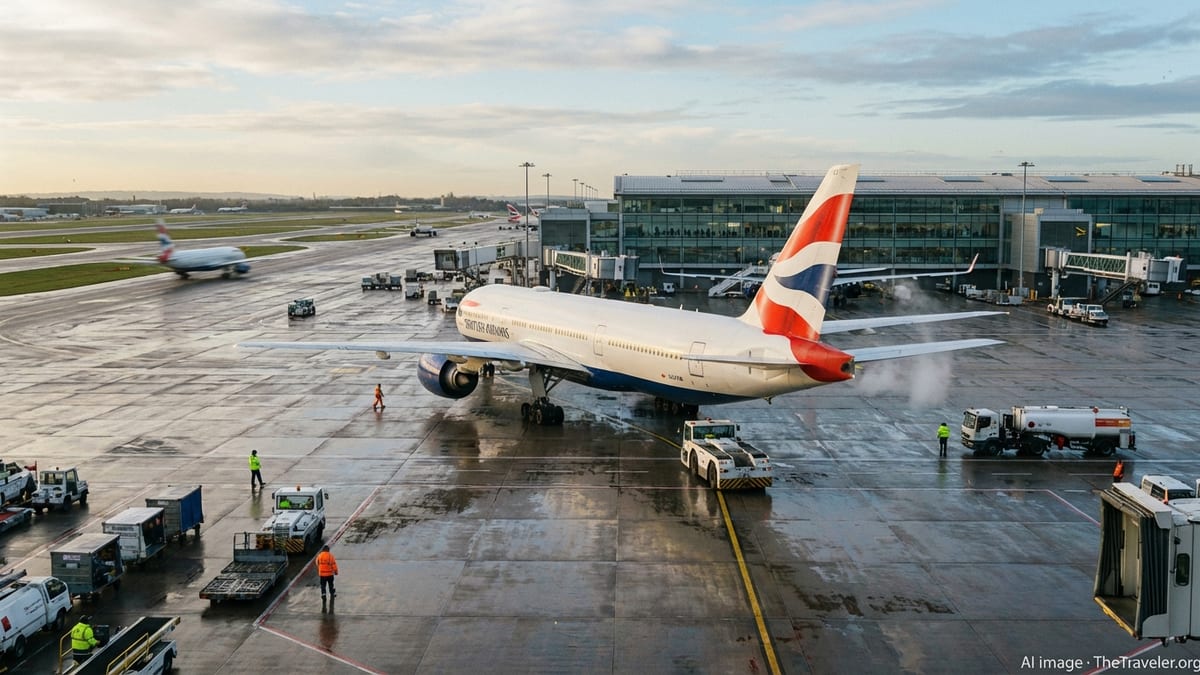
Record Profits and Margin Strength for 2025
Parent company International Airlines Group reported its strongest financial year on record for 2025, and British Airways sat at the heart of that performance. The UK flag carrier delivered an operating profit of £2.23 billion, an increase of £182 million on 2024, and an operating margin of 15.2 percent, at the top end of the group’s mid-term targets. Capacity at British Airways rose by 1.7 percent year on year, showing that the airline converted modest growth into disproportionately higher earnings.
Across the group, operating profit before exceptional items climbed to around €5 billion on revenue of €33.2 billion, while net profit reached approximately €3.34 billion, up more than 20 percent compared with the previous year. Lower fuel costs, disciplined capacity deployment and robust demand for long-haul premium travel all supported the result. Executives highlighted British Airways and Iberia as the standout contributors, both posting margins above 15 percent and helping to push group returns on invested capital to the high teens.
Stronger cash generation allowed IAG to reduce net debt to below €6 billion and keep leverage comfortably under one times earnings. That balance-sheet improvement, combined with the record profit, underpinned plans for a €1.5 billion share buyback and a higher dividend in respect of 2025. Analysts noted that the scale of the shareholder returns underscored management’s confidence that the group’s current level of profitability, to which British Airways is central, is sustainable even as traffic growth moderates.
For British Airways, the figures mark a decisive break from the heavy losses endured during the pandemic and the subsequent period of operational disruption. Chief executive Sean Doyle told staff the airline was now operating with significantly greater resilience, having completed more than 1,200 transformation projects across the business since launching a multiyear, £7 billion investment programme.
Operational Excellence Driven by AI and Resilience Investments
Operational performance was a core driver of British Airways’ improved financial results in 2025. The carrier reported its best punctuality since 2011, with 82 percent of flights departing within 15 minutes of schedule across its mainline network, compared with 73 percent in 2024. At London Heathrow, first-quarter on-time departures reached 86 percent, a record for the airline, while peak days in February and April saw punctuality approach or exceed 90 percent.
Those gains reflect a focused £100 million investment in operational resilience and new technology. British Airways has deployed artificial intelligence and machine learning tools across its operation, using advanced forecasting and optimisation systems to anticipate disruption, reroute aircraft around adverse weather and re-plan schedules more rapidly when problems arise. Company data indicate that these tools helped avoid hundreds of thousands of minutes of delay during the year, sharply reducing knock-on cancellations and missed connections.
Despite facing external shocks, including infrastructure failures at Heathrow and ongoing airspace restrictions linked to geopolitical tensions, the airline was able to recover its schedule quickly. Across 2025, British Airways flew around 46.7 million customers on close to 308,000 flights, and kept more than 95 percent of its schedule operating on the days following major disruption events. Management credited new decision-support technology and cross-functional control centres with shortening recovery times and improving communication with customers.
The push for operational excellence extended to maintenance and engineering. During 2025, British Airways expanded its technical capabilities at London Gatwick by acquiring a major hangar and maintenance operation, a move aimed at increasing in-house control over aircraft availability. The airline has also been working closely with engine suppliers to mitigate the impact of ongoing supply-chain constraints affecting parts of the long-haul fleet, adjusting schedules in advance where necessary to preserve reliability.
Customer Experience, Digital Upgrades and Premium Demand
Improved operations fed directly into better customer sentiment. British Airways reported a double-digit increase in its Net Promoter Score in 2025 compared with the previous year, taking the measure of customer satisfaction to its highest level since 2019 and above internal targets. Management linked the improvement not only to better punctuality but also to a raft of customer-facing upgrades funded through the wider investment programme.
The airline has continued to refresh cabins, lounges and catering across its network, with particular emphasis on long-haul premium cabins that remain a key profit engine. Strong demand for business and first class, especially on transatlantic routes, helped offset the fact that overall business travel volumes have not fully returned to pre-pandemic levels. Industry analysts note that premium leisure travellers, willing to pay higher fares for comfort and flexibility, are increasingly underpinning revenue on core North Atlantic routes for British Airways and its alliance partners.
Digital improvements form another pillar of the airline’s strategy. British Airways has begun rolling out a redesigned mobile app intended to give customers more real-time control over their journeys, from seat selection and rebooking to baggage tracking. The carrier is also preparing to introduce free, high-speed Wi-Fi provided through a partnership with satellite operator Starlink, initially on selected aircraft from 2026. Executives say the connectivity upgrade will support new in-flight services and improve the ability to communicate with passengers during irregular operations.
Looking ahead, British Airways plans to introduce a new First class seat and to continue the phased renewal of long-haul cabins, aiming to align the product more closely with leading competitors on key routes from London. The airline is also investing in its brand presence beyond the airport, including a new live music venue concept in London that is designed to reinforce its identity as a global British cultural ambassador while creating new engagement touchpoints with frequent flyers.
Fleet, Sustainability and Strategic Positioning
Behind the numbers, British Airways’ 2025 performance was supported by targeted fleet investment and a sharpening focus on sustainability. IAG invested heavily in new aircraft during the year, adding dozens of jets across its airlines and placing further orders for long-haul types from Airbus and Boeing. British Airways continues to take delivery of fuel-efficient aircraft, including the latest-generation widebodies, which help cut emissions per seat and reduce operating costs on long-haul routes.
The carrier stepped up its use of sustainable aviation fuel in 2025, with such fuels accounting for a growing share of total consumption. British Airways remains the largest user of sustainable aviation fuel within the IAG group and is working with suppliers and policymakers to scale up production. Alongside fleet renewal and fuel initiatives, the airline has pursued a series of onboard and ground-based efficiency measures, from weight-saving programmes to more efficient ground handling, to progress towards medium-term emissions reduction goals.
On the strategic front, British Airways is benefiting from strong demand in core long-haul markets while continuing to navigate competitive and regulatory pressures in short-haul Europe. Transatlantic traffic, particularly on London to North America routes, stayed robust through 2025, with high load factors and solid pricing in premium cabins. At the same time, rising costs and softer demand on some intra-European routes have led the group to focus capacity where returns are strongest, a trend likely to continue into 2026.
As IAG explores potential acquisitions and partnerships elsewhere in Europe, British Airways’ role as the group’s largest and most globally recognised brand remains central. The airline’s record 2025 results, underpinned by operational gains and a clearer strategic focus, position it as a key platform for future growth while giving management more room to invest in product, sustainability and digital innovation.
Outlook: Building on 2025’s High-Water Mark
With 2025 setting new records for profit and operating margins, British Airways enters 2026 from a position of unusual strength, though not without challenges. IAG expects capacity to grow only modestly this year, by around 3 percent across the group, constrained by aircraft delivery delays and supply-chain bottlenecks. That limited capacity growth, set against still-firm demand on many long-haul routes, should help support yields but leaves less room for error if macroeconomic conditions weaken.
Management is signalling that the focus will remain on execution rather than aggressive expansion. For British Airways, that means consolidating the punctuality gains of 2025 through further refinement of AI tools and operational processes, while continuing to tackle persistent pressure points such as airport congestion and infrastructure constraints around London. The airline will also need to manage cost inflation, including labour and airport charges, without eroding the revenue gains achieved through product and pricing initiatives.
Analysts caution that geopolitical risks, volatile fuel prices and increased scrutiny of aviation’s environmental footprint could all test the resilience British Airways has built. However, the airline’s recent track record of converting operational improvements into stronger financial results has given investors and corporate customers renewed confidence in its trajectory. For travellers, the combination of more reliable schedules, enhanced onboard offerings and improved digital services suggests that the carrier’s transformation is increasingly visible on the front line.
As 2026 unfolds, British Airways’ challenge will be to prove that 2025 was not just a bounce-back year but the foundation of a new era of consistent, high-quality performance. If it can sustain its current level of operational discipline while continuing to modernise its fleet and customer experience, the airline is well placed to remain one of Europe’s most profitable and influential network carriers.