

More news on this day
British Airways is sharpening its long-haul focus on Australia, Sri Lanka, South Africa and Japan, with new schedules and capacity upgrades that collectively signal a renewed push for British and European travelers chasing ambitious long‑haul escapes.
Get the latest news straight to your inbox!
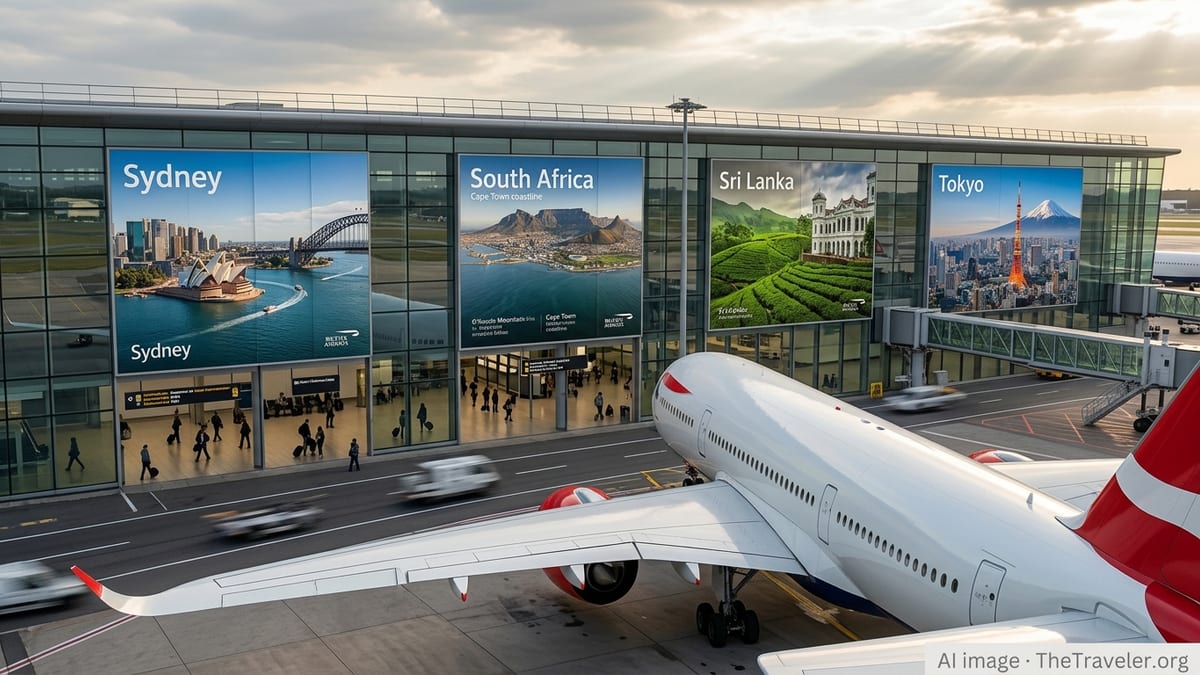
Targeted Capacity Gains on the Kangaroo Route and Beyond
Publicly available schedule data and airline disclosures show that British Airways is leaning into destinations that blend strong leisure appeal with resilient premium demand. On the so‑called Kangaroo Route between London and Australia, the carrier continues to operate its London to Sydney service via Singapore, while fine‑tuning aircraft deployment and timings to capture both UK point‑to‑point traffic and connecting flows from Europe and North America.
Industry sources tracking long‑haul networks indicate that the airline’s broader 2025 and 2026 schedules put particular emphasis on long‑range widebodies out of London Heathrow. This allows British Airways to thicken services to key Asian and Indian Ocean gateways that feed Australia and Sri Lanka, and to adjust capacity seasonally without withdrawing from marquee markets.
For passengers, the outcome is a more robust year‑round offer to Australia, even though the route remains among the most operationally complex on the network. Additional seats and improved connectivity on adjacent Asian sectors effectively boost options for travelers piecing together multi‑stop itineraries that combine Australia with Japan or Sri Lanka in one extended trip.
Japan Flights Climb as Demand Roars Back
Japan has re‑emerged as one of the standout winners in British Airways’ Asia portfolio. The carrier is increasing London Heathrow to Tokyo Haneda frequencies to twice daily for the northern summer 2025 season, with a mix of Boeing 787‑9 and Airbus A350‑1000 aircraft scheduled on the route. The shift restores a level of capacity that more closely resembles pre‑pandemic patterns, while also injecting newer cabins into one of the airline’s longest Asian markets.
Haneda’s closer proximity to central Tokyo makes it particularly attractive for time‑sensitive business travelers and high‑spending leisure visitors. With Japan tourism volumes from Europe showing strong recovery, the added British Airways services are timed to capture both cherry‑blossom season demand in spring and late‑year peak travel around autumn foliage and year‑end holidays.
Travel analysts note that this uplift to Japan has knock‑on effects across the network. By anchoring more long‑haul flying at Heathrow, British Airways can funnel connecting passengers from regional UK cities and major European markets into its Tokyo flights, reinforcing London’s role as a key Europe–Japan bridge and enabling more complex itineraries that link Tokyo with onward destinations such as Sydney or Cape Town.
South Africa Capacity Responds to Cape Town’s Tourism Surge
South Africa, and Cape Town in particular, is seeing sustained strength in international arrivals, with British Airways among the carriers expanding long‑haul connectivity into the Western Cape. Reports from regional tourism bodies and aviation trackers highlight that British Airways continues to operate daily long‑haul services between London and Cape Town, supported by larger aircraft types such as the Boeing 777‑300ER and Airbus A350 on selected rotations.
This capacity is feeding into a broader surge that has seen multiple global airlines add seats into Cape Town over the past two years. British and European holidaymakers, incentivized by favorable exchange rates and strong sun‑seeking demand during the northern winter, are increasingly pairing Cape Town with safaris and wine‑country stays, driving high load factors across the season.
Johannesburg remains the primary commercial gateway, but the elevated focus on Cape Town highlights how leisure‑led O&D demand is reshaping British Airways’ South African strategy. Industry coverage suggests that the airline is carefully balancing aircraft deployment between the two cities, maximizing premium‑cabin revenue while maintaining enough economy‑class capacity to keep fares competitive in a crowded long‑haul leisure market.
Sri Lanka’s Resilience Puts Colombo Back on the Map
Sri Lanka’s tourism recovery has accelerated since borders fully reopened, with Colombo once again positioned as a strategic Indian Ocean stopover for multi‑centre breaks. While British Airways does not match the scale of regional Gulf super‑connectors on this corridor, schedule filings and route‑mapping data indicate that London–Colombo capacity has been steadily rebuilt through direct services and coordinated connections that route passengers via partner hubs.
For British travelers, Sri Lanka offers a compelling mix of beach resorts, cultural heritage, and wildlife tourism, often combined with onward hops to the Maldives or Southeast Asia. As confidence returns, British Airways’ presence in the market, even at modest frequencies, becomes a catalyst for tour operators and dynamic packaging platforms to reintroduce Sri Lanka into winter‑sun brochures.
Analysts observing the region note that consistent, year‑round service is key to sustaining demand. By aligning Colombo schedules with peak weekend departure times out of London and ensuring onward connectivity at Heathrow, British Airways is positioning Sri Lanka as a flexible bolt‑on to longer Asia–Pacific trips, rather than a standalone niche destination.
What the Long‑Haul Push Means for Travellers
Collectively, the capacity boosts and schedule refinements across Australia, Sri Lanka, South Africa and Japan point to a clear strategy: target long‑haul markets where British travelers are willing to book bigger, more experiential trips and pay for comfort in premium cabins. The airline’s network adjustments for 2025 and 2026 align with broader trends showing robust demand for long‑haul leisure travel, even as short‑haul growth moderates.
For passengers planning complex holidays, the practical impact is more choice on dates, aircraft type and cabin product, along with tighter connection windows at Heathrow on both outbound and inbound legs. Higher frequencies to Tokyo and stable daily coverage to Cape Town and Sydney, supported by year‑round access to Colombo, create new possibilities for multi‑country escape itineraries that were harder to piece together during the immediate post‑pandemic rebuild.
At the same time, greater capacity does not automatically translate to lower fares. Travel agencies and fare trackers expect pricing to remain dynamic, particularly around school holidays and major events, with business‑class and premium‑economy cabins showing the strongest resilience. For now, British Airways’ renewed emphasis on these four long‑haul pillars signals that the airline is betting on an enduring appetite for far‑flung adventures, even as global economic signals remain mixed.