

More news on this day
British Airways has halted flights to Dubai, Doha, Tel Aviv, Amman, Bahrain and Abu Dhabi as sweeping airspace closures linked to the escalating Iran conflict send shockwaves through global aviation networks and leave tens of thousands of travelers scrambling to rebook journeys.
Get the latest news straight to your inbox!
Safety Concerns Trigger Sweeping Route Suspensions
The decision by British Airways to suspend services to several of its key Middle East destinations follows the rapid closure of airspace across parts of the Gulf and Levant after recent US and Israeli strikes on Iran and retaliatory attacks in the region. Authorities in Iran, Iraq, Israel, Jordan, Kuwait, Bahrain, Syria and the United Arab Emirates have all imposed varying levels of restrictions, effectively severing some of the busiest east west corridors in global aviation.
In a statement carried by industry outlets, the airline said it remained unable to operate flights from Abu Dhabi, Amman, Bahrain, Doha, Dubai and Tel Aviv and was closely monitoring the situation. The suspensions cover both point to point traffic and onward connections through London Heathrow, one of Europe’s main hubs for travel between North America and Asia, amplifying the disruption far beyond the Middle East.
British Airways has operated a series of limited rescue and repatriation flights in recent days but has paused regular commercial services into the affected cities until at least later in March, according to airline and government advisories. Routes to Abu Dhabi are expected to remain off the schedule for longer, reflecting a combination of safety assessments and earlier fleet planning cuts on that corridor.
The carrier has emphasized that passenger and crew safety remains its overriding priority, aligning its risk assessments with guidance from UK and international aviation regulators. With missile and drone activity reported across parts of the Gulf and documented damage at airports in the United Arab Emirates, commercial overflights have become increasingly difficult to operate safely and reliably.
Ripple Effects Across Global Flight Networks
The shutdown of British Airways services is part of a much wider pattern of disruption as airlines around the world reroute or cancel flights to avoid closed or high risk airspace. Consultancy and corporate travel bulletins estimate that thousands of flights have been cancelled or diverted each day since the latest escalation, with Dubai, Abu Dhabi and Doha among the hardest hit hubs.
Carriers including Lufthansa, Air France, KLM, IndiGo, Cathay Pacific and Wizz Air have all announced extended suspensions or sharply reduced schedules to Gulf and Levant destinations, while Gulf based airlines such as Emirates, Etihad and Qatar Airways have been forced into rolling cancellations and complex rerouting. Many long haul flights between Europe and Asia are now being sent north over the Caucasus or south over the Arabian Sea, adding hours of flying time and significantly increasing fuel burn.
For global travelers, the impact is immediate and far reaching. Passengers booked on British Airways services to Dubai or Doha are being rebooked where possible on alternative routings, often via remaining open hubs such as Riyadh or Jeddah, or offered refunds and flexible vouchers. Those in the region face longer waits to secure seats on limited rescue flights, particularly from airports where local authorities are tightly controlling terminal access to avoid overcrowding.
Air cargo flows have also been caught up in the turmoil, with freight forwarders warning of rising rates and longer transit times as high value shipments are pushed onto constrained routes. Corporate travel managers are advising companies to postpone non essential trips to the region and to build in substantial buffers for any required travel involving connections through Europe or Asia.
Stranded Passengers Grapple With Uncertainty
For many travelers, the abrupt grounding of flights has translated into days of uncertainty in airport terminals and hotels. British nationals in Bahrain, Israel, Kuwait, Qatar and the United Arab Emirates have been urged by the UK government to register their presence and await information on repatriation options, amid estimates that more than 100,000 people from the United Kingdom alone may ultimately need assistance to leave the region.
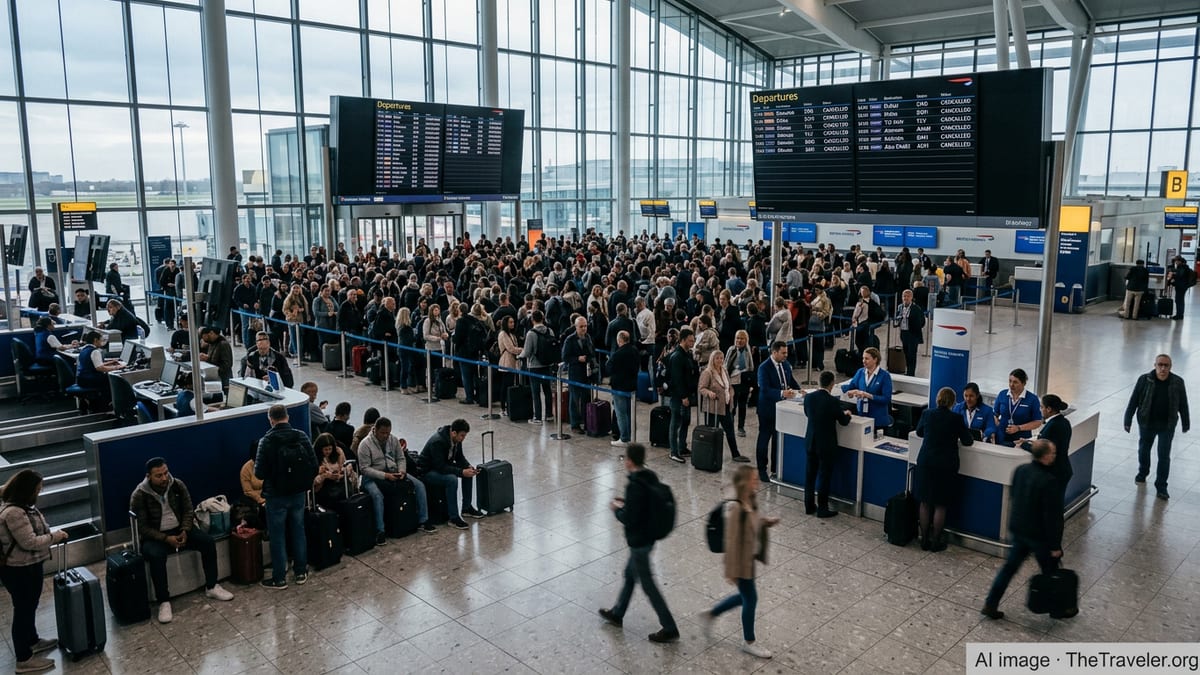
On the ground, scenes at major airports have ranged from relatively orderly queues at rebooking desks to crowded departure halls as passengers try to secure scarce seats on any departing aircraft. With British Airways and other European carriers suspending direct services to Tel Aviv, Amman, Dubai and other key cities, travelers attempting to reach Europe have often been forced into complex multi stop journeys or to shelter in place until rescue flights can be arranged.
Consumer advocates note that under UK and European passenger rights rules, travelers whose British Airways flights are cancelled are entitled to refunds or alternative transport where available, though the extraordinary airspace closures may limit compensation for knock on costs. The airline has urged customers not to travel to the airport unless their flight status is showing as operating and confirmed, and to ensure contact details are up to date in their bookings so that short notice changes can be communicated.
Travel agents report that some holidaymakers have opted to reroute their trips entirely, substituting Gulf stopovers with itineraries via Istanbul, Cairo or European hubs that can still connect to Indian Ocean and Southeast Asian destinations. Others have postponed departures to later in the year, amid uncertainty over how long restrictions on flights into the Gulf and Israel will remain in place.
Economic Stakes High for Gulf Hubs and Airlines
The grounding of flights into Dubai, Doha, Abu Dhabi and Bahrain carries significant economic implications for the region’s aviation heavy economies. Dubai International Airport is one of the world’s busiest hubs for international passengers, while Doha’s Hamad International Airport and Abu Dhabi’s Zayed International Airport play central roles in connecting Europe, Asia, Africa and Australasia.
With large numbers of transit passengers no longer able to route through the Gulf, regional carriers are losing lucrative long haul connecting traffic and premium cabin demand. Analysts tracking the fallout from the conflict estimate that combined airline and airport losses across the Gulf could run into the billions of dollars if airspace closures are prolonged, compounding the knock on effects on tourism, hospitality and related sectors.
For British Airways, the suspended routes represent a mix of high yielding business traffic and important leisure flows that feed its broader network. The Dubai and Doha corridors in particular have been strong performers in recent years, linking London to two of the region’s fastest growing hubs. The loss of these flights narrows options for passengers and heightens competition on remaining open routes operated by other European and Asian carriers.
Industry observers say the latest crisis underscores the vulnerability of globally integrated airline networks to regional conflicts, particularly in choke point regions such as the Gulf where a relatively small volume of airspace carries a disproportionate share of east west traffic. Insurance costs, fuel bills and crew rostering complexity are all rising as airlines adjust to longer routes and extended layovers away from traditional hubs.
What Travelers Should Do Now
With the situation evolving by the day, travel experts are urging passengers booked on British Airways services to or through the Middle East in the coming weeks to stay flexible and informed. The most immediate advice is to check flight status frequently and to avoid starting a journey unless each segment is clearly confirmed as operating, given the potential for last minute cancellations if airspace restrictions are tightened again.
Those with imminent departures to Dubai, Doha, Tel Aviv, Amman, Bahrain or Abu Dhabi are being encouraged to contact British Airways or their travel agent to explore rebooking options on alternative routings, or to move travel dates into late spring or summer when airlines hope for more stable operations. Travelers who no longer wish to travel to the region can typically request refunds or vouchers, depending on fare rules and the extent of the disruption to their itineraries.
Seasoned travel planners also recommend allowing much longer connection times on any itineraries that might overfly the wider region, in case of diversions or extended routing around closed airspace. Business travelers, in particular, are being advised to build contingency plans that include remote participation at meetings or hybrid travel arrangements routed via more northerly or southerly hubs.
For now, there is no clear timeline for the full restoration of British Airways flights to Dubai, Doha, Tel Aviv, Amman, Bahrain and Abu Dhabi. The carrier has signalled that it will only resume services when it is confident that routes can be safely and reliably operated. Until then, the suspension of these links stands as one of the starkest signs yet of how deeply the latest Middle East crisis is reshaping global travel patterns.