

More news on this day
British holidaymakers are being urged to carry out urgent checks on passport validity, condition and visa requirements well before booking or boarding this summer, as new UK and EU border systems tighten documentation rules and increase the risk of being turned away at the airport.
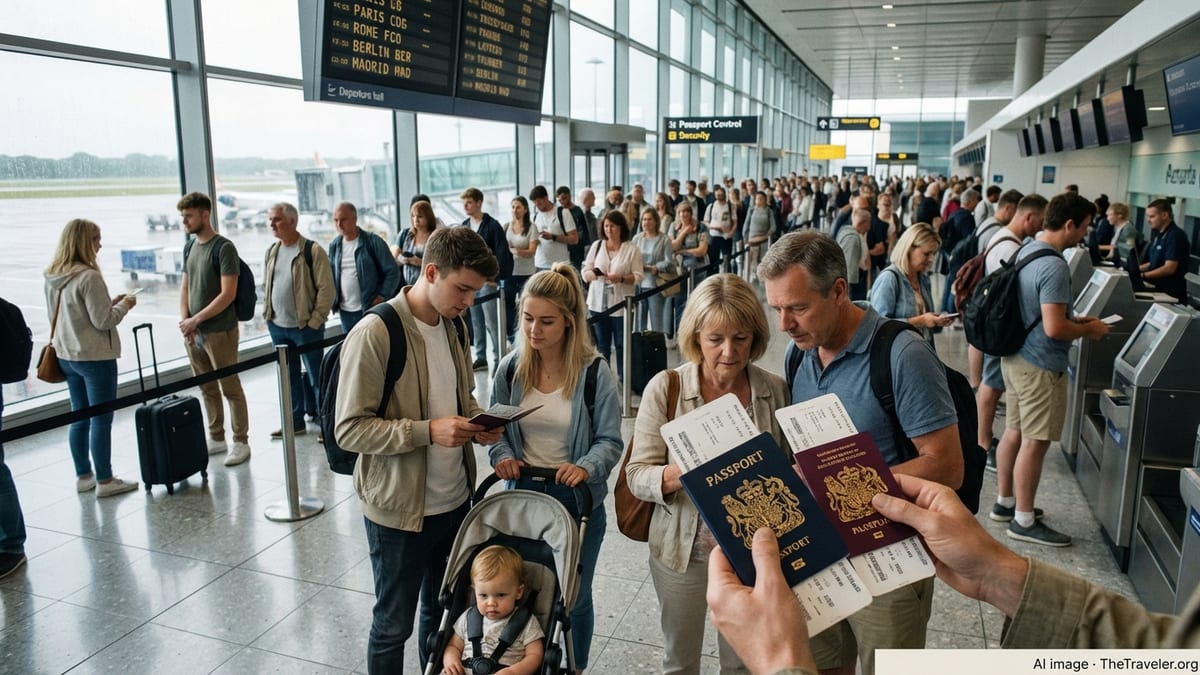
Passport Validity Rules Under Fresh Scrutiny
Travel industry bodies and consumer groups are warning that confusion over post-Brexit passport rules is still catching out British travellers, even as further changes to border controls approach. Under current Schengen rules, UK passports must generally be less than 10 years old on the day of entry and have at least three months’ validity remaining on the intended date of departure from the EU, in addition to airline requirements.
The UK government has repeatedly highlighted that the old habit of travelling “up to the expiry date” is no longer safe for most European trips. Carriers have been told they must refuse boarding if a passport fails destination checks, meaning a small miscalculation on dates can result in a ruined family holiday at the departure gate. With school breaks and peak summer departures weeks away, airlines say they are already seeing a spike in last-minute panic renewals.
Experts also note that some long-haul destinations operate their own six-month validity rules, adding another layer of complexity for multi-stop itineraries. Holidaymakers are being advised to check both the issue and expiry dates of every family member’s passport against official Foreign Office travel advice, and to allow extra time for renewals as the summer rush builds.
Damaged Passports Increasingly Likely to Be Rejected
Alongside expiry dates, the physical condition of passports is emerging as a significant risk factor. Border officials and airlines have wide discretion to refuse travel if a document is considered damaged, and reports of Britons being stopped because of torn pages, peeling laminate or extensive water damage have risen in recent seasons.
Guidance from the UK authorities makes clear that passports must be machine-readable and that personal details and the photograph must be fully visible and securely attached. Even seemingly minor issues, such as ink spills, heavy creasing around the chip or separated covers, can trigger additional scrutiny, particularly where automated e-gates are being used.
With more checks now digital and biometric, any damage that affects the chip or data page can cause delays or outright refusal. Travel agents are urging customers to inspect passports well ahead of summer trips and to replace any document that looks worn, rather than gamble on the discretion of a check-in agent on the day of travel. Families with young children, whose passports often suffer more wear and tear, are seen as especially vulnerable.
EU Entry/Exit System Brings Biometric Border Checks
From 12 October 2025, the European Union’s new Entry/Exit System began rolling out across external Schengen borders, introducing biometric checks for non-EU visitors, including British tourists. The scheme is being phased in over six months and is due to be fully operational by April 2026, affecting travel to popular destinations such as France, Spain, Italy and Greece.
Under the system, UK travellers on short stays will have their passport details, fingerprints and a facial image recorded electronically on first entry, replacing manual passport stamping. Once registered, their biometric record will be reused for future crossings until either the passport expires or the three-year record lapses. The EU and UK governments have both warned that the new procedures may lengthen queues during the early months of operation, especially at busy airports, land crossings and ports serving ferries and Eurotunnel services.
Officials stress that the Entry/Exit System itself does not introduce a new visa, and there is no fee for the registration. However, it will strictly monitor the existing rule that limits most British visitors to 90 days in any 180-day period within the Schengen area. Frequent travellers who have previously relied on passport stamps to calculate stays will now have their movements logged digitally, leaving far less room for error or discretion if they exceed the permitted limit.
ETIAS Visa Waiver and UK ETA Tighten the Net
Layered on top of the Entry/Exit System will be the European Travel Information and Authorisation System, a new electronic visa-waiver for non-EU nationals. Brussels has confirmed that ETIAS is now expected to launch in late 2026, following the completion of the Entry/Exit rollout, with a phased and then mandatory introduction likely stretching into 2027.
Once in force, most British tourists will need to obtain ETIAS approval online before travelling to the Schengen zone, providing personal and travel details and paying a fee of around 20 euros. The authorisation, valid for multiple short trips over several years, will be checked by carriers before boarding in a similar way to the United States ESTA system. Travel lawyers say that forgetting to secure ETIAS is likely to result in denied boarding at UK ports and airports rather than detention on arrival in Europe.
At the same time, the UK is tightening its own Electronic Travel Authorisation programme for visitors who do not need a full visa to enter Britain. The scheme, which has been gradually introduced since 2023, became fully enforceable for a wide group of non-visa nationals in February 2026. Airlines and ferry operators are now under instructions to refuse passengers who require an ETA but have not obtained one in advance, increasing the focus on correct paperwork in both directions.
Dual Nationals and Visa Rules Face Added Complexity
British citizens who hold another nationality are being urged to pay particular attention to the documents they travel on this year. New rules tied to the UK’s immigration digitisation drive mean many dual British nationals now need to present a valid British passport or a certificate of entitlement in order to re-enter the UK, and they are not eligible to use the UK ETA as a workaround.
The changes have already led to instances of dual nationals being refused boarding abroad when attempting to travel on a non-British passport alone, despite having an automatic right of abode in the UK. While temporary concessions allow some expired British passports to be accepted as proof of nationality in limited circumstances, carriers retain discretion and are wary of fines for transporting passengers without the correct documentation.
For outbound travel from the UK, dual nationals must also consider which passport they use to enter their destination country. A traveller entering the EU on an EU passport, for example, will generally be exempt from the new Entry/Exit and ETIAS rules for non-EU visitors, but must still ensure they can meet UK requirements when returning home. Travel advisers are recommending that dual citizens check carrier and government guidance for both nationalities and carry all relevant documents, particularly when travelling with children who may have different passports.
Industry Urges Early Checks Before Summer Peak
With several systems changing in quick succession, British travel firms say the 2026 summer season could be one of the most complex yet for documentation. Airports, ferry ports and tour operators are stepping up communication campaigns, advising customers to check passport dates, condition, visa policies and, where applicable, ETA or future ETIAS requirements as soon as they start planning a trip rather than waiting until check-in.
Consumer advocates are also reminding travellers to factor paperwork into their budgeting and timelines. Standard passport renewals, emergency travel documents, and future ETIAS fees can all add to costs, while delays in processing during peak periods may force travellers to change dates or downgrade plans if documents do not arrive in time. Insurers, meanwhile, warn that policies may not pay out where a trip is missed solely because required documents were invalid, damaged or never obtained.
For now, officials’ central message is simple: do not assume what was acceptable before Brexit, or even last summer, will still work this year. Meticulous checks of passport validity, condition and visa status months ahead of departure, they say, remain the best safeguard against being turned away long before the holiday has even begun.