

More news on this day
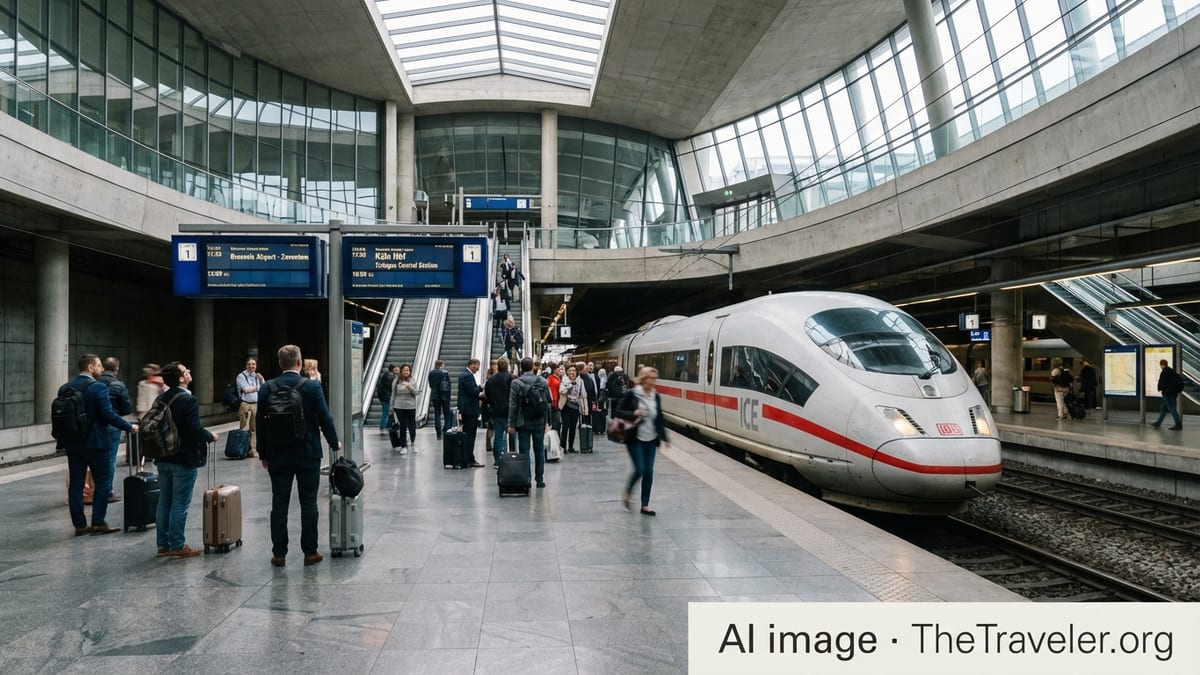
Brussels Airport and the German city of Cologne are set to be linked by a new direct ICE high-speed train from September 7, 2026, a two-hour rail connection that industry leaders say could quietly redefine how travelers move across one of Europe’s busiest air corridors.
A New High-Speed Spine Between Belgium and Germany
Germany’s Deutsche Bahn will introduce the direct high-speed service between Cologne and Brussels Airport using its latest-generation ICE trains, creating the airport’s first true plug-in to the continental high-speed network. For years, air passengers arriving in or departing from Brussels had to route via Brussels Midi station to access German high-speed services, adding time and complexity to already tight connections.
From September 7, 2026, trains are scheduled to run twice daily in each direction between Cologne and Antwerp, calling at Aachen, Liège, Leuven and Brussels Airport. The end-to-end journey time between Cologne and the airport is expected to be around two hours, with the morning service due to arrive at the terminal station beneath the airport at 8:29. Tickets are already on sale through Deutsche Bahn’s usual channels, signaling strong confidence that the route will be fully integrated into Europe’s late-summer timetable change.
Rail planners describe the Antwerp–Brussels Airport–Cologne axis as a new north–south spine that knits together key Belgian and German cities with a single high-speed corridor. For travelers, the most visible change will be fewer changes of trains and shorter overall door-to-door journeys, particularly for trips that previously involved a mix of regional trains and airport buses.
The link coincides with ongoing infrastructure upgrades around Brussels Airport, including renewal works on the tunnel connection to the Brussels–Leuven line and preparations for a new light rail line from Brussels North to the terminal by 2030. Together, these projects are turning the airport into a multi-modal hub rather than a purely aviation-focused node.
Air–Rail Codeshare Turns Trains Into “Flight Numbers”
In parallel with Deutsche Bahn’s operational launch, Brussels Airlines is entering into a codeshare agreement that will see the ICE trains carry a Brussels Airlines flight number. For passengers, that means the high-speed service will effectively function as an extension of the airline’s route network, bundled in a single booking that combines rail segments with onward flights from Brussels Airport.
The air–rail product, marketed as Brussels Airlines Express Rail, promises guaranteed connections in case of delays, through check-in for the full itinerary and the ability to earn Miles and More loyalty points on the rail leg. That approach mirrors similar partnerships already in place at other European hubs such as Frankfurt and Zurich, but it is a first for Brussels Airport, which has long campaigned to be placed on the high-speed map.
Lufthansa Group executives have framed the deal as a core element of a broader intermodal strategy that brings air and rail much closer together. By shifting some short-haul feeder traffic from regional jets to high-speed trains, the group aims to free up runway and slot capacity at Brussels for long-haul services, especially to Africa and North America, where aircraft remain hard to substitute.
For German and Belgian corporate clients, the bundled ticketing and guaranteed connection conditions are likely to be as significant as the raw journey time. Companies that once booked separate rail and air tickets, assuming the risk of missed connections, will now be able to consolidate trips into a single contract, with clearer rules on delays, rebooking and care obligations.
What the New Route Means for Travelers
For leisure travelers in the Rhine-Ruhr region, the prospect of boarding an early-morning ICE in Cologne and stepping out directly beneath the departure hall at Brussels Airport in time for a long-haul flight is a tangible upgrade. The scheduled two-hour journey to the airport station makes it realistic for passengers to arrive from Cologne in the morning, connect onto transatlantic or African departures and still keep total travel time competitive with flying via other hubs.
On the Belgian side, Antwerp and Leuven gain a new direct high-speed link to western Germany, with the same trains continuing beyond Brussels Airport to Cologne. That opens up weekend city-break options that avoid airports entirely, while also giving residents of Flanders a smoother way to reach flights from Brussels without passing through central Brussels rail stations.
Travel industry analysts note that the twice-daily frequency is modest compared with some of Europe’s busiest high-speed corridors. Yet they argue that the quality of the connection, its timing relative to peak departure waves at Brussels Airport and its tight integration with airline booking systems make it disproportionately important. If early trains prove popular, Deutsche Bahn has left the door open to adding more services during future timetable revisions.
The new ICE link may also shift perceptions among travelers who have long seen Brussels Airport as less conveniently connected by rail than rivals like Amsterdam Schiphol or Paris Charles de Gaulle. By adding a branded, high-speed product with clear schedules and through-ticketing, Brussels is making a bid to be considered in the same bracket of easily reachable European hubs.
A Greener Alternative to Short-Haul Flights
The launch of the Brussels Airport–Cologne high-speed service comes as the European Union pushes for faster, more extensive cross-border rail connections to reduce aviation emissions on short and medium-haul routes. While today’s rail network still falls short of political ambitions for a truly continent-wide high-speed grid, targeted links such as this one are seen as pragmatic steps that can deliver immediate benefits.
By offering a two-hour, city-to-airport rail option, the new route is expected to capture travelers who might once have chosen short-haul feeder flights or long car journeys. For many passengers in Cologne, Bonn and the wider Rhine region, taking the train directly to Brussels Airport could cut their overall carbon footprint while keeping journey times competitive, especially once time spent in security lines and at departure gates for short flights is factored in.
Environmental groups have long argued that robust high-speed rail alternatives are a prerequisite for any credible European strategy to shift demand away from short-haul flying. Although the Brussels Airport–Cologne route alone cannot transform the continent’s transport emissions profile, it provides a concrete example of how air and rail can be joined up in practice, rather than merely in policy papers.
For Brussels Airport, the environmental angle is not just about public image. As regulators increasingly scrutinize airport expansion plans and flight volumes, being able to demonstrate that a growing share of passengers arrive and depart using rail, rather than domestic or regional flights, could prove decisive in future debates over capacity and sustainability targets.
Fitting Into Europe’s Emerging High-Speed Map
The new ICE link also illustrates how Europe’s fragmented high-speed network is slowly knitting together through a patchwork of bilateral and regional projects. Cologne is already a major node in the German high-speed system, with frequent connections to Frankfurt, Berlin, Hamburg and southern Germany. By tying Brussels Airport directly into Cologne’s rail hub, the 2026 launch effectively plugs the Belgian gateway into a much larger grid.
That could eventually mean faster, simpler rail itineraries from Brussels Airport to cities far beyond Cologne via same-platform transfers at Cologne Messe/Deutz, where Deutsche Bahn plans to coordinate timetables with its ICE Sprinter services. For travelers, the impact may become most evident not in the headline Brussels–Cologne journey time, but in how easily they can string together multi-leg rail trips across borders without backtracking through city-center stations.
Policy makers in Brussels and Berlin have presented the project as a practical demonstration of how cross-border services can be scaled up even as larger, long-term visions for a pan-European high-speed grid progress slowly. With infrastructure investments already under way around Brussels Airport and regulatory approvals granted in Belgium and Germany, the focus now shifts to timetabling, rolling stock deployment and fine-tuning the passenger experience on board.
As tickets continue to go on sale and the September 2026 launch date approaches, airlines, rail operators and passengers alike will be watching closely to see whether this new airport-to-city pair can deliver on its promise to change how people move between Belgium and western Germany. If it succeeds, it may serve as a template for similar partnerships at other European hubs, where trains and planes are gradually learning to share the same travelers.