

More news on this day
Travel to and from Belgium is set for serious disruption on Thursday 12 March 2026, as Brussels Airport warns that a nationwide general strike could force a near-total shutdown of departing flights at the country’s busiest air hub.
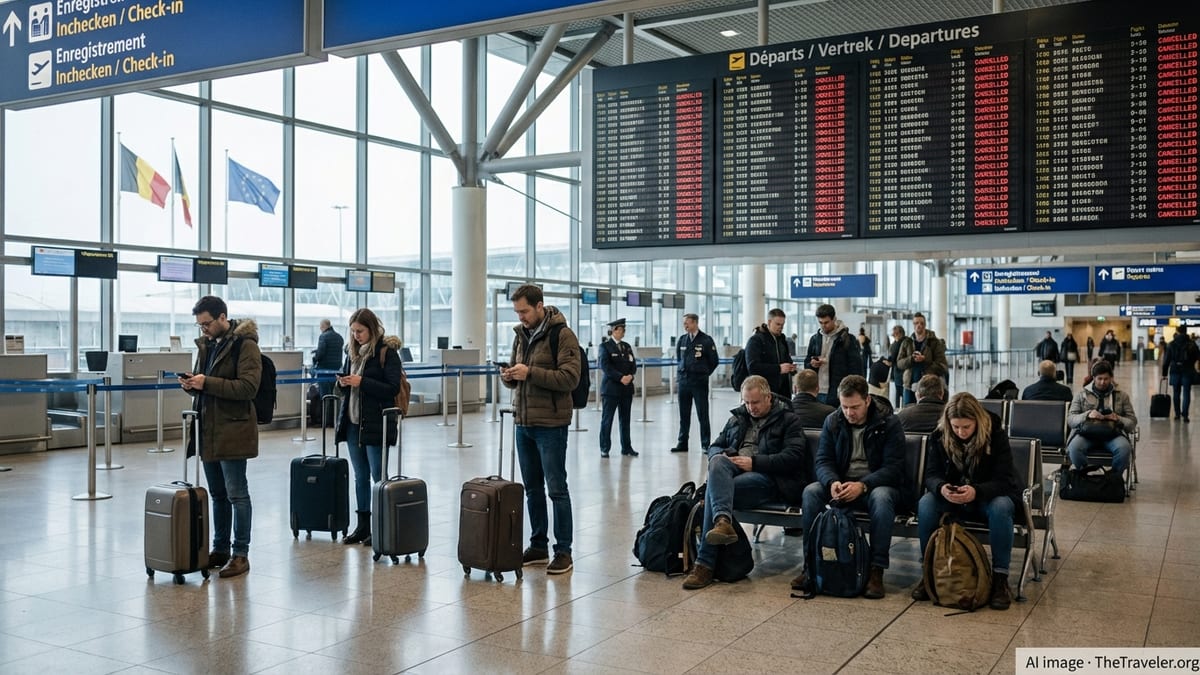
What Is Happening on March 12 at Brussels Airport
Brussels Airport in Zaventem is preparing for what executives are already calling a likely “day of zero departures” on 12 March, as Belgium’s three major trade union confederations press ahead with a 24-hour general strike. The industrial action covers a wide range of sectors, but transport and aviation services are at the heart of the unions’ strategy, putting the country’s primary international gateway under acute pressure.
Airport management has publicly acknowledged that cancelling most, if not all, passenger departures is now considered the most realistic scenario. Between 165 and 250 flights normally take off from Brussels Airport on a typical weekday, carrying tens of thousands of passengers to destinations across Europe, North America, Africa and the Middle East. Ground operations, from check in to baggage loading, are heavily dependent on staff who are expected to participate in the walkout.
While a final, detailed flight schedule for 12 March is still to be confirmed, the tone from both airport officials and airlines has shifted from caution to open warnings. Carriers are already adjusting timetables, activating flexible rebooking policies and urging customers to avoid nonessential travel on the day of the strike.
Limited arrivals may still be possible if sufficient staff can be deployed for critical functions, but the airport stresses that any inbound operations will likely run on a significantly reduced and volatile schedule. Passengers arriving in Belgium could face long waits on the ground, disrupted connections and constrained ground transport options.
Why Belgium’s Unions Are Calling a General Strike
The 12 March action is part of a broader confrontation between Belgian trade unions and the federal government over a package of socio-economic reforms. The three major union confederations FGTB, CSC and CGSLB have coordinated the walkout to protest planned changes to pensions, public spending and wage indexation, which they argue erode living standards and weaken social protections.
Union leaders say the government’s proposals amount to a multi-front assault on workers’ rights, citing concerns over the statutory retirement age, adjustments to how salaries track inflation and targeted austerity measures in public services. By calling a general strike with a formal 24-hour notice, they have enabled participation across both public and private sectors, from schools and ministries to factories, transport companies and airport service providers.
A major demonstration is planned in Brussels on the same day, adding to the strain on the capital’s transport network. Organisers are explicit that airports are a strategic pressure point: when air travel halts, the economic and political impact is immediate and visible, both domestically and internationally. Brussels Airport, as the country’s flagship hub and a symbol of Belgium’s connectivity, is therefore at the centre of the dispute.
This strike also follows a series of national and sectoral walkouts over the past two years that have periodically paralysed transport. Previous episodes have shown how quickly even short disruptions cascade across airlines, rail operators and local transit systems, leaving passengers scrambling for alternatives.
How Bad Could the Disruption Get for Travelers
For travelers scheduled to fly on 12 March, the prospects are stark. If the airport does proceed with cancelling nearly all departures, tens of thousands of passengers will have their trips delayed or rerouted in a single day, with knock-on effects stretching well into the following week as airlines work to clear backlogs. Long-haul flights, which are more complex to rebook and often operate with limited frequency, are particularly vulnerable.
Security screening staff, baggage handlers, check in agents and other ground personnel are among those expected to walk off the job. Without sufficient staffing in these areas, even a small number of scheduled flights can become unmanageable. Previous strikes in Belgium have demonstrated that once minimum safety and security thresholds cannot be guaranteed, airport authorities have little choice but to halt operations and keep passengers away from the terminal.
Brussels South Charleroi Airport, the country’s second international gateway and a major base for low cost carriers, is also expected to suffer heavy disruption. Past national strikes have led to all departures being cancelled at Charleroi, with only a small number of inbound flights operating. Travellers who had planned to use one airport as a backup for the other may therefore find both options sharply curtailed.
The disruption is unlikely to stop at Belgium’s borders. When a major European hub sharply reduces operations, neighbouring airports often face a surge in diverted and rebooked passengers. Rail companies and long distance coach operators typically see a spike in demand, while major hubs such as Amsterdam, Paris and Frankfurt may absorb rerouted flights and connecting travelers.
What Airlines and Brussels Airport Are Advising
Brussels Airport is advising passengers not to travel to the terminal on 12 March unless their airline has explicitly confirmed that their flight will operate. Past experience suggests that even when terminals remain physically open, services may be extremely limited, with minimal staff on hand and few facilities operating at normal levels. The airport has indicated that airlines will be responsible for directly informing customers of cancellations or significant changes.
Some carriers have moved quickly to give travelers more flexibility. Air Canada, which operates routes between Brussels and North America, has already activated a special rebooking policy for flights touching Brussels on the strike date. Passengers are being offered the option to bring trips forward, postpone them or reroute via alternative hubs within a defined time window, often without change fees, although fare differences may still apply.
European network airlines and low cost carriers are expected to follow with their own advisories and waivers. These typically allow passengers to shift their travel to another date or, in some cases, to depart from or arrive at a different airport in the region. Some airlines may also provide travel credits or vouchers in lieu of immediate refunds, particularly where full cancellation of a route is unlikely and schedules are expected to resume swiftly after the strike.
Travel agents and corporate travel managers are already reallocating bookings to avoid the most affected period. For business travellers, particularly those heading to time sensitive events or meetings in Brussels and other European capitals, companies are weighing whether to move departures to earlier in the week or to encourage rail travel where feasible.
What to Do if You Have a Flight on March 12
Passengers holding tickets for Brussels Airport on 12 March are being urged to act now rather than waiting for last minute updates. Airlines generally process changes on a first come, first served basis, and available seats on surrounding dates can disappear quickly as more travelers adjust their plans. Those with flexible itineraries or nonessential trips have the best chance of avoiding disruption by moving their travel several days away from the strike date.
The first step is to check your booking directly with your airline or travel provider. Many carriers have updated their apps and customer portals with alerts about the Belgian strike, and some have added self service tools that allow passengers to request date changes without calling customer service. Where online options are not available, reaching out by phone or via official social channels may be necessary, although call centres often face heavy volumes during major disruptions.
Travelers should also review the fare conditions attached to their tickets. Even when special waivers are introduced, there may be restrictions on the validity period for new travel dates, or on changes to origin and destination airports. Those who booked through online travel agencies or used loyalty points may find that policies differ from direct airline purchases and should prepare for slightly longer processing times.
Anyone who still plans to travel on 12 March despite the warnings should monitor flight status closely in the 24 to 48 hours before departure and again on the day itself. However, the overarching guidance from both airport officials and unions is clear: unless a departure is explicitly confirmed, passengers should avoid going to the airport to prevent overcrowding and unnecessary queues in a context of sharply reduced staffing.
Your Rights if Your Flight Is Canceled or Delayed
Under European air passenger rights regulations, travelers departing from an EU airport have a range of protections in the event of cancellations and significant delays. When a flight is cancelled, airlines must generally offer passengers a choice between re-routing at the earliest opportunity, rebooking at a later date convenient to the passenger, or a refund of the unused portion of the ticket. These obligations apply regardless of the cause of the disruption.
Financial compensation, however, is more complex in the case of strikes. In many instances, airlines argue that large scale industrial action beyond their direct control falls under the category of extraordinary circumstances, which can exempt them from paying standard lump sum compensation. The specific applicability can vary depending on the nature of the strike, the role of the airline in the dispute and evolving legal interpretations.
Even when cash compensation is not due, carriers are still required to provide “care” in the form of food, refreshments and, where necessary, accommodation while passengers wait to be rerouted. Travelers should keep receipts for any expenses incurred as a result of disruption, in case airlines request documentation before reimbursing costs or offering goodwill credits.
Special rules may apply for package holidays booked through tour operators, where both flights and accommodation form part of a single contract. In those cases, package travel regulations can impose broader obligations on the organiser to provide alternatives or refunds if a core component of the trip becomes impossible due to events such as a nationwide strike.
Impact on Trains, Public Transport and Alternative Routes
The effects of the general strike are expected to extend well beyond the airport perimeter. Belgium’s public transport networks, including urban buses, trams and some regional rail services, are likely to be heavily reduced as staff join the walkout and demonstrations take place in central Brussels. Even on lines that remain open, frequencies may be cut and services could be crowded with travelers seeking alternatives to cancelled flights.
International rail links, especially high speed trains connecting Brussels with Paris, London, Amsterdam and Cologne, may see increased demand from passengers rebooking their journeys from air to rail. While these operators are not formally central to the strike action, they often adjust timetables and onboard staffing in coordination with unions and safety authorities, and seats may sell out on peak services around 12 March.
For travelers already in continental Europe, routing via neighbouring airports such as Amsterdam Schiphol, Paris Charles de Gaulle or Düsseldorf may provide an alternative, provided surface connections are reliably available. Long distance coach companies are also likely to introduce additional capacity where possible, but travel times will be longer and peak day tickets may become scarce.
Local authorities and tourism bodies are advising visitors to build in extra time for all ground movements in and around Brussels on the day of the strike and to keep itineraries as flexible as possible. Those attending conferences, EU meetings or events scheduled in the Belgian capital around mid March may wish to adjust arrival and departure dates to avoid the most acute period of disruption.
Lessons From Previous Belgian Strikes for Today’s Travelers
Recent history provides a clear warning of what 12 March could look like. Previous general strikes in Belgium have repeatedly led to cancellations of all departing flights at Brussels Airport, with only a narrow band of arrivals maintained in some cases. On those days, departure boards have been filled with cancellations, terminals have been eerily quiet and airlines have relied heavily on rebooking passengers through other European hubs.
In 2025, similar national actions brought both Brussels Airport and Brussels South Charleroi Airport to a near standstill, forcing thousands of travellers to change plans at short notice. Those who acted early to adjust dates and routes generally encountered fewer difficulties, while passengers who waited until the strike was fully under way often faced limited options, longer waiting times and crowded rebooking queues.
For travelers looking ahead to March 2026, the key takeaway is that early preparation is their best defence. Monitoring official communications from Brussels Airport, airlines and union confederations in the coming weeks will be essential, as will staying flexible about routes and modes of transport. With the prospect of a complete halt to departures now firmly on the table, anyone with a ticket to or from Brussels around 12 March would be wise to review their plans now, rather than later.