

More news on this day
Brussels Airport has kicked off 2026 with a robust increase in both passenger and cargo traffic, recording 5.5% year-on-year growth in passengers and a 3.5% rise in cargo volumes in January, even as winter storms, de-icing operations and regional transport disruption put pressure on airport operations across Belgium and wider Europe.
January 2026 Figures Signal Confident Start to the Year
According to operational data released in recent days, Brussels Airport handled around 1.6 million passengers in January 2026, an increase of 5.5% compared with the same month last year. The performance cements the positive trajectory established in 2025, when the airport welcomed 24.4 million passengers, and underlines its continuing recovery from the pandemic period and from a series of industrial actions that weighed on traffic late last year.
Cargo activity also maintained its upward trend. Total cargo volumes exceeded 61,000 tonnes in January, a rise of 3.5% year-on-year. While dedicated freighter movements were slightly lower, improved load factors and the growing use of belly capacity in passenger aircraft helped sustain volume growth, confirming Brussels Airport’s role as a dual hub for both travellers and freight.
Commercial flight movements at the airport remained broadly stable, with just over 14,000 take-offs and landings during the month. Passenger flights increased modestly thanks to higher demand on European and long-haul routes, while cargo-only flights declined in number as airlines continued to optimise capacity and consolidate loads.
The January results follow a solid full-year 2025 performance in which both passenger and cargo operations expanded despite strikes, cyber incidents at a supplier and a series of national union actions. The figures for the first month of 2026 suggest that the airport has entered the new year with renewed momentum and improved operational resilience.
Passenger Recovery Gains Pace After a Difficult 2025
The 5.5% growth in passenger numbers in January 2026 marks an acceleration compared with the 3.3% increase recorded across 2025 as a whole. Airport management and local tourism officials see this as evidence that underlying demand remains strong, particularly for leisure trips and visits to friends and relatives, which led the recovery last year.
In 2025, Brussels Airport’s passenger growth was tempered by seven national trade union actions that forced the cancellation of an estimated 2,400 flights and prevented roughly 275,000 passengers from travelling. Those disruptions weighed on the full-year figures and kept traffic below pre-pandemic records. By contrast, the first weeks of 2026 have so far been free of large-scale industrial action, allowing airlines to operate fuller schedules.
Within the January 2026 traffic mix, outbound leisure routes to Mediterranean destinations and winter sun hotspots performed well, reflecting the continued appetite of Belgian travellers for short breaks and holiday escapes. At the same time, city-break traffic to and from major European capitals, alongside long-haul connections to North America, the Middle East and Asia, contributed to the uplift in overall passenger volumes.
Business travel, which lagged leisure demand during the early post-pandemic years, is also showing signs of more stable recovery. Corporate itineraries, trade fair attendance and European institutional travel to Brussels helped lift weekday load factors, even if business volumes have not yet fully regained their pre-2019 levels.
Cargo Volumes Extend Brussels Airport’s Logistics Role
The 3.5% increase in cargo volumes in January 2026 builds on a particularly strong 2025, when Brussels Airport handled approximately 795,000 tonnes of freight, up 8.5% on the previous year. That performance reinforced the airport’s reputation as a key European cargo gateway, especially for pharmaceuticals, express consignments and high-value goods.
In January 2026, growth was driven primarily by higher load factors on existing services rather than a surge in aircraft movements. Airlines made greater use of bellyhold capacity in passenger aircraft, taking advantage of the increase in passenger flights and optimising the balance between passengers and freight. Express and e-commerce flows remained dynamic, reflecting resilient online retail activity and rapid-delivery expectations from consumers across Europe.
Full-freighter operations, which expanded strongly during and after the pandemic, stabilised at slightly lower movement levels as carriers consolidated routes and frequencies. Trucked cargo showed signs of normalisation after earlier volatility, suggesting that more freight is being flown directly to and from Brussels rather than being routed via road to other hubs.
Key trade lanes continued to link Brussels with Asia, North America and Africa. Imports of pharmaceuticals, electronics and fashion goods, together with exports of Belgian and European industrial products and perishables, underpinned the cargo performance. The airport’s specialist facilities for temperature-controlled freight and its network of integrator operations remained central to this activity.
Winter Weather Puts Operations to the Test
The growth figures for January are particularly noteworthy in light of the severe winter weather that affected Belgium and much of northwestern Europe at the start of the month. A prolonged cold snap brought snow and ice across the country, triggering warnings from meteorological authorities and disruptions to planes, trains and road traffic.
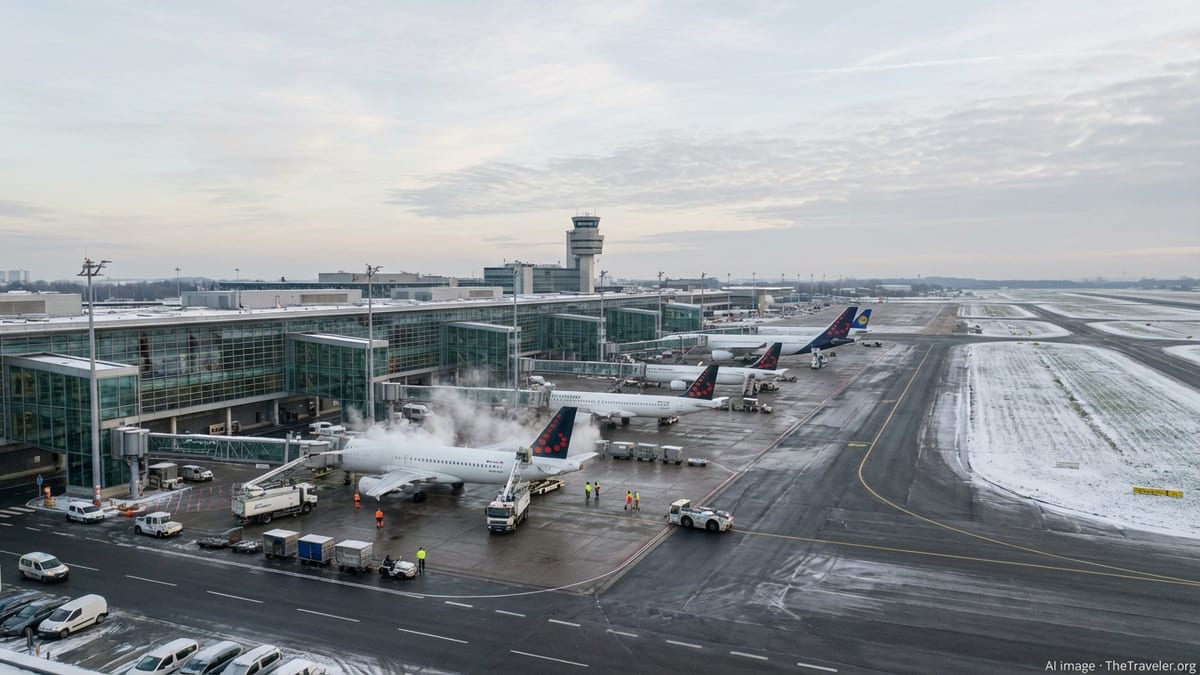
At Brussels Airport, de-icing operations became a daily feature as temperatures stayed below freezing and snow showers swept across the airfield. Ground handling teams had to allocate additional time to spray aircraft and clear runways and taxiways, resulting in delays typically ranging from 30 minutes to more than an hour on the worst-affected days.
On one of the heaviest snowfall days in early January, around 40 flights were cancelled as the airport responded to a code orange weather warning. These cancellations, affecting both arrivals and departures, were part of a broader pattern of disruption seen at major hubs across the region, including large-scale cancellations at Amsterdam’s Schiphol Airport and weather-related constraints at Paris airports.
Despite these challenges, Brussels Airport’s management described the impact on overall monthly traffic as limited. By adjusting schedules, prioritising safety-critical operations and maintaining close coordination with airlines, air traffic control and ground services, the airport was able to sustain a high proportion of planned movements and avoid more severe backlogs.
Operational Resilience and Preparedness Under Scrutiny
The harsh winter start to 2026 effectively served as a stress test for Brussels Airport’s resilience measures, particularly for its de-icing capacity, snow clearance capabilities and passenger communication systems. In recent years, European hubs have invested in winter operations infrastructure after several high-profile episodes of disruption exposed bottlenecks in de-icer supply, equipment and staffing.
At Zaventem, airport teams implemented contingency plans that included pre-positioning de-icing trucks, coordinating glycol supplies and staging additional staff during forecast snow events. While queues did form at peak times, stakeholders reported that most aircraft could be treated within acceptable windows, helping airlines to keep rotations running throughout the day.
Passenger information also came into sharper focus. Travellers were urged to monitor airline updates and airport channels before heading to the terminal, while carriers provided rebooking options and assistance for those caught up in cancellations or long delays. Given the region-wide nature of the weather front, many travellers had limited alternatives, underscoring how important clear and timely communication becomes in adverse conditions.
Industry observers noted that, although Brussels did face delays and a cluster of cancellations, the disruption was smaller than at some neighbouring hubs where shortages of de-icing fluid or more intense snowstorms forced more drastic capacity cuts. For airport managers, the experience is likely to feed into post-season reviews aimed at further strengthening winter preparedness ahead of the 2026 to 2027 season.
Economic and Tourism Impact for Belgium
Brussels Airport’s solid start to 2026 carries wider significance for Belgium’s economy and tourism sector. The airport is a major employer and economic engine, supporting thousands of direct and indirect jobs in aviation, logistics, hospitality and services. A sustained recovery in passenger traffic is closely tied to hotel occupancy, conference activity and spending in cities such as Brussels, Antwerp, Ghent and Bruges.
Tourism bodies have highlighted the importance of reliable air connectivity in attracting both short-break visitors from neighbouring countries and long-haul travellers from North America, the Middle East and Asia. The 5.5% passenger growth achieved in January comes as regional tourism promotion campaigns focus on cultural events, gastronomy, Christmas and winter markets and major exhibitions scheduled throughout 2026.
The cargo side of the airport’s business also feeds into the broader Belgian economy. Rising freight volumes support exporters and importers across sectors including pharmaceuticals, automotive components, high-tech equipment and food products. Efficient air cargo links are particularly critical for time-sensitive and high-value shipments, where delays can quickly erode margins or disrupt production schedules.
With 2025 already showing strong cargo expansion and a recovery in passenger numbers, policymakers and business groups will be watching closely to see whether the January 2026 trend continues into the spring and summer, traditionally busier seasons for both tourism and trade.
Comparisons with Other European Hubs
The performance of Brussels Airport in January 2026 stands out against a backdrop of more severe disruption and mixed traffic results at other major European hubs. Across the continent, airports from the Netherlands to France and Spain faced snowstorms, high winds and cold snaps that forced the cancellation of hundreds of flights and snarled ground operations.
At Amsterdam’s Schiphol Airport, for example, extensive snow and strong winds led to widespread cancellations and stranded passengers as airlines and ground handlers grappled with challenging conditions. In France, winter storms prompted cuts to flight schedules at major Paris airports, while ground transport was also hit, compounding the difficulties for travellers attempting to reroute.
In this context, Brussels’ ability to deliver positive year-on-year growth in both passengers and cargo demonstrates a relative operational strength. The Belgian hub benefited from slightly less extreme weather than some of its neighbours and from careful management of de-icing, runway clearance and slot coordination. However, aviation analysts caution that a single month is not enough to draw firm conclusions and that sustained performance over the remainder of the year will be the real test.
Nonetheless, the January figures help position Brussels Airport competitively within the European landscape. As airlines fine-tune their networks and look for reliable bases for both passenger and freight operations, consistent performance during periods of stress can be a differentiating factor when allocating capacity and investing in new routes.
Outlook for the Remainder of 2026
With the first month of 2026 in the books, Brussels Airport’s outlook for the year ahead appears cautiously optimistic. The combination of a 5.5% rise in passenger numbers and a 3.5% increase in cargo volumes against a backdrop of winter weather disruption suggests that underlying demand remains healthy and that the airport’s operations are robust.
Planned network developments are expected to support further growth. New routes introduced in 2025 are bedding in, while airlines are gradually adding capacity on selected European and intercontinental sectors. The continued expansion of long-haul services should bring additional belly cargo capacity, reinforcing the freight business and offering shippers more options.
At the same time, Brussels Airport is investing in infrastructure upgrades under its long-term development plan, including the phased implementation of projects to modernise terminals, improve passenger flows and expand cargo handling facilities. These initiatives are aimed at enhancing the travel experience and sustaining the airport’s competitiveness in a crowded regional market.
Risks remain, ranging from potential new waves of industrial action to geopolitical tensions, fuel price volatility and the possibility of further extreme weather events later in the year. For now, however, the airport’s strong January results provide a measure of reassurance to airlines, travellers, shippers and policymakers that Brussels Airport has entered 2026 on a firm footing, with resilient operations and growing traffic despite the challenges of a harsh European winter.