

More news on this day
Brussels Airport is set to become significantly more accessible from western Germany from September 2026, when a new high-speed ICE service will begin linking the airport directly with Cologne, marking the airport’s first true integration into the continental high-speed rail network.
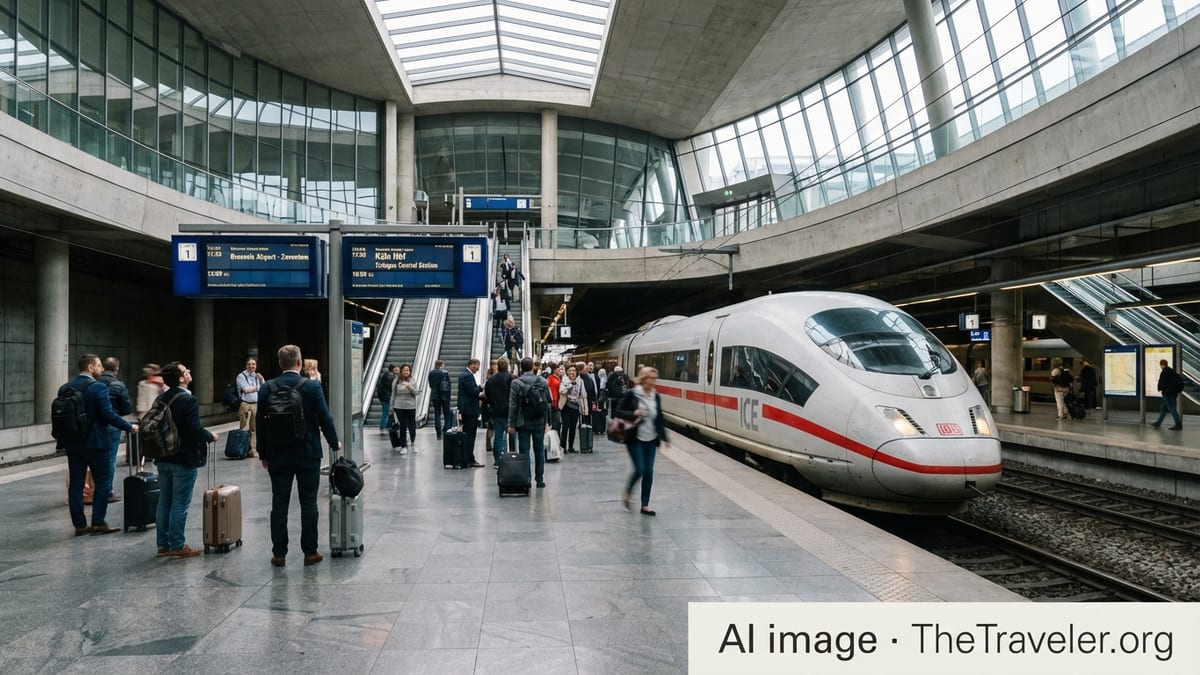
First Direct High-Speed Link Between Brussels Airport and Cologne
Germany’s national rail operator Deutsche Bahn has confirmed plans to launch a new Intercity Express connection between Cologne and Antwerp via Brussels Airport in early September 2026, with services currently scheduled to begin on 7 September. The route will provide a direct high-speed rail option between Cologne’s main station and Brussels Airport-Zaventem for the first time, reducing journey times to around two hours.
The trains will run as part of DB’s ICE network, using its latest high-speed rolling stock. From Cologne, services are expected to call at Aachen, Liège and Leuven before continuing to Brussels Airport and onward to Antwerp, creating a north–south corridor that links major population and business centers in Germany and Belgium. For travelers from North Rhine-Westphalia, the new line should offer a faster and more convenient alternative to current itineraries that require a change at Brussels-South station.
Initial plans set out two daily return trips between Cologne and Antwerp, giving four ICE services per day through Brussels Airport. The schedule is designed to provide early-morning arrivals at the airport suitable for long-haul departures, with return journeys later in the day to capture evening inbound flights. Industry observers note that the project has moved from regulatory application to confirmed implementation within less than two years, underlining strong political and commercial backing.
A New Intermodal Era for Brussels Airport
For Brussels Airport, the high-speed link represents a long-sought step toward becoming a fully fledged intermodal hub on a par with airports such as Amsterdam Schiphol or Paris Charles de Gaulle. Airport management has for years argued that direct high-speed services could materially reduce the need for short-haul feeder flights on routes of around 300 to 400 kilometers, freeing up runway capacity for more profitable long-haul operations.
The airport already sits on an upgraded rail junction that connects it to both the Brussels–Leuven and Brussels–Antwerp lines, with up to four conventional trains per hour running to Brussels-South for onward international services. However, the new ICE connection is the first to treat Brussels Airport itself as a primary high-speed stop rather than a branch off the main network. That shift is expected to strengthen the airport’s position as a gateway not only for Belgium but also for neighboring regions in Germany and the Netherlands.
The timing coincides with broader infrastructure upgrades around the airport station. Belgian infrastructure manager Infrabel has been investing in renewing tracks and junctions in the tunnels leading to Brussels Airport, aiming to increase reliability and capacity on the approaches. While some of this work has caused temporary disruption for domestic services, it lays the groundwork for sustained high-speed operations once the Cologne–Airport–Antwerp corridor opens.
Partnerships With Airlines to Simplify Door-to-Door Travel
The new rail connection is also paving the way for closer cooperation between rail and air operators. Brussels Airlines and Deutsche Bahn have announced plans to introduce combined rail–air tickets that would treat the ICE segment between Cologne and Brussels Airport as if it were a feeder flight, complete with a flight number and through-booking under an “Express Rail” style product.
Under this model, passengers would be able to purchase a single itinerary covering both the train journey and their flight from Brussels Airport, with coordinated schedules designed to protect connections in the event of delays. Travelers are expected to benefit from simplified check-in procedures, baggage handling options that mirror traditional air transfers, and eligibility to collect frequent flyer miles on the rail sector.
For Brussels Airlines, which maintains a strong long-haul network including a substantial African route map, the tie-up promises better access to customers from western Germany without adding short-haul flights that carry higher per-passenger emissions. For Deutsche Bahn, the partnership deepens its role as a feeder to major European hubs, reinforcing a trend in which high-speed rail increasingly replaces short regional flights on key corridors.
Boost to European Connectivity and Sustainable Transport Goals
Transport officials in both Belgium and Germany view the project as part of a wider shift toward more sustainable, interconnected mobility across Europe. High-speed rail is central to European climate and transport strategies, as it offers a lower-carbon alternative to short-haul flying on distances where journey times of two to four hours remain competitive.
The Cologne–Brussels Airport–Antwerp service will plug a notable gap in the continent’s network by putting an international airport directly on a high-speed axis that already links cities such as Frankfurt, Brussels and Amsterdam. Travelers from Cologne and Aachen will have faster one-seat rides not only to Brussels Airport but also to the wider Belgian rail system and, via Antwerp, to the Netherlands. In the opposite direction, Belgian passengers gain a more direct route into Germany’s dense ICE network.
The September 2026 launch is also seen as a test case for further intermodal developments. If passenger demand is strong, timetable planners have indicated that additional daily frequencies could be considered in subsequent years, potentially turning the current two daily train pairs into a more regular pattern. The link may also encourage other operators and airports to explore similar rail integrations as European governments push to limit short regional flights where rail offers a viable substitute.
Economic and Regional Impact Along the New Corridor
Beyond the headline route between Brussels Airport and Cologne, the intermediate stops at Aachen, Liège and Leuven are expected to benefit from improved connectivity. Business travelers, conference organizers and tourism operators in these cities anticipate easier access to long-haul air services without the need for transfers across Brussels, enhancing their appeal as destinations and investment locations.
Regional authorities have highlighted the potential for the new connection to support cross-border labor mobility and education links, especially between university hubs such as Leuven and Cologne. With a direct high-speed link to an international airport, students and professionals may find it more attractive to live and work along the corridor while maintaining international ties.
For Brussels Airport itself, the addition of ICE services is likely to reinforce commercial development plans around the terminal, including office space, hotels and logistics facilities that rely on fast passenger and staff access. Analysts note that as airports evolve into broader multimodal campuses, direct high-speed connections can become a deciding factor for companies choosing where to locate regional headquarters or service centers.