

More news on this day
Brussels Airport is set to join Europe’s growing club of fully fledged rail-air hubs, with a new high-speed ICE service to Cologne due to launch in September 2026, promising faster, smoother connections for travelers across Belgium and western Germany.
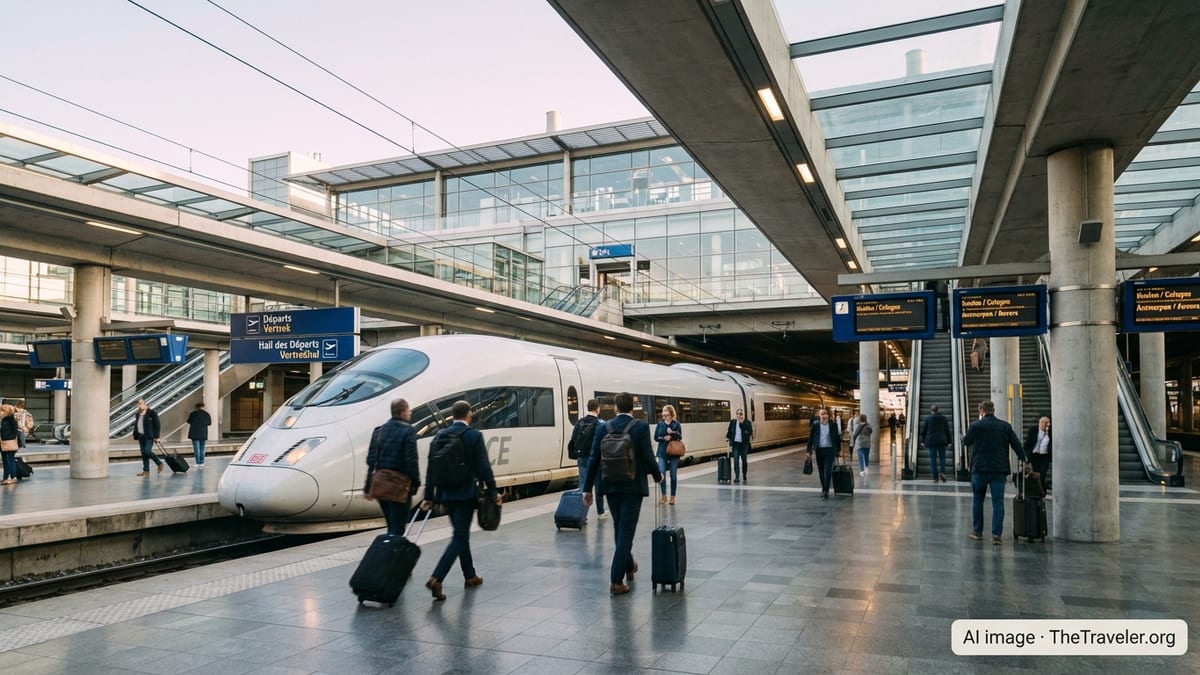
Direct ICE Link to Cologne Scheduled from September 2026
Germany’s national rail operator Deutsche Bahn will introduce a direct high-speed ICE connection linking Cologne and Brussels Airport in early September 2026, in what airport and rail officials describe as a major upgrade for cross-border mobility. The new route will give Cologne passengers a non-stop rail link into the terminal station beneath Brussels Airport, eliminating the need to change trains in Brussels city.
The service is expected to start on 7 September 2026, operating with modern ICE rolling stock and covering the Cologne–Brussels Airport stretch in around two hours. The train will run via Aachen, Liège and Leuven before reaching the airport and will then continue on to Antwerp, effectively creating a new north–south corridor that ties together key Belgian and German cities with a single high-speed spine.
Tickets for the new route have already gone on sale through Deutsche Bahn channels and partner platforms, reflecting strong confidence that the service will be fully integrated into the European timetable change in late summer 2026. Early schedules indicate two round trips per day between Cologne and Brussels Airport, timed to feed into the airport’s main departure and arrival waves.
Brussels Airlines–Deutsche Bahn Codeshare Targets Seamless Journeys
In parallel with the launch, Brussels Airlines is entering into a codeshare agreement with Deutsche Bahn on the new ICE service, allowing the train to carry a Brussels Airlines flight number and be sold as part of a single air-rail itinerary. The Belgian carrier will market the product under its “Express Rail” concept, mirroring the Lufthansa Group’s wider strategy of blending long-haul flights with fast rail feeders.
Passengers booking from Cologne and other cities in western Germany will be able to purchase a combined ticket that covers both the train leg to Brussels Airport and the onward flight, with guaranteed connections in case of delays. Airline-style benefits such as through check-in logic, aligned baggage rules for misconnection handling and eligibility for earning miles in the Miles & More program are expected to be part of the package.
For Brussels Airlines, the tie-up offers an opportunity to deepen its catchment area without adding short-haul feeder flights, particularly toward its extensive African network and other long-haul destinations. For Deutsche Bahn, the cooperation underscores its ambition to position high-speed rail as an environmentally friendlier alternative to regional flights, while still tapping into global aviation flows.
Strengthening Brussels Airport as an Intermodal European Hub
The new ICE stop builds on the existing rail infrastructure created under Belgium’s Diabolo project, which transformed Brussels Airport station from a terminus into a through-station connected to both the Brussels–Leuven and Brussels–Antwerp corridors. That upgrade was conceived precisely to accommodate future international and high-speed services, putting the airport on a similar footing to Amsterdam Schiphol and Paris Charles de Gaulle in terms of rail access.
Today, Brussels Airport is linked by frequent domestic trains to major Belgian cities and by international services via Brussels-Midi, but it has lacked a direct high-speed connection to Germany’s network. The Cologne ICE service will plug that gap, knitting the airport more tightly into the wider Paris–Brussels–Cologne high-speed axis and expanding options for travelers who prefer rail over short-haul flights.
Airport management has framed the development as a decisive step in enhancing Belgium’s international connectivity, arguing that easier rail access for German passengers can support growth in both business and leisure traffic. The route is expected to be particularly attractive for travelers from North Rhine-Westphalia, one of Europe’s largest economic regions, who will gain a straightforward rail link to more than 180 destinations served directly from Brussels Airport.
Timings, Rolling Stock and Passenger Experience
According to preliminary schedules released by Deutsche Bahn, two daily round trips will run between Cologne and Antwerp via Brussels Airport once the service starts. A morning ICE departure from Cologne Hauptbahnhof is planned to reach Brussels Airport shortly before the first long-haul wave, with an evening return allowing same-day trips and convenient connections for returning passengers.
The service will be operated by the latest generation of ICE trains, offering high-speed performance, reserved seating and onboard amenities familiar to regular German high-speed travelers. Journey times of about two hours between Cologne and the airport aim to compete directly with car travel, particularly when taking into account motorway congestion and airport parking costs.
Intermediate stops at Aachen, Liège and Leuven will give additional gateways into the network, allowing passengers from smaller cities and regions to tap into Brussels Airport’s long-haul connectivity without backtracking through Brussels’ central stations. The continuation to Antwerp extends the usefulness of the route within Belgium, turning the line into more than just an airport shuttle.
Implications for European Connectivity and Modal Shift
The Cologne–Brussels Airport high-speed link comes amid a broader European push to encourage travelers to switch from short-haul flights to rail when practical, while still preserving strong global connectivity via key hubs. By offering a timed, through-ticketed air-rail product, the partnership aims to make the train the default choice for passengers within a roughly 300-kilometer radius of Brussels.
Industry observers say the move could serve as a template for further integration of rail services into airport access across the continent, particularly along established high-speed corridors where infrastructure already exists. If passenger response is strong, additional frequencies or extended routes could be considered in the future, including deeper integration with existing high-speed services running toward Paris, Amsterdam and other major cities.
With bookings already open well ahead of the September 2026 launch, Brussels Airport, Brussels Airlines and Deutsche Bahn will be watching demand closely as they refine schedules and onboard services. For travelers, the new ICE connection promises a more integrated European journey, replacing one more short flight or long drive with a fast, rail-based approach directly into the heart of Belgium’s main international gateway.