

More news on this day
Northern Railway has extended the operation of the Budgam to Shri Mata Vaishno Devi Katra special train service until July 2, responding to sustained passenger demand and positioning the all-stops DEMU link as a key connector between the Kashmir Valley and one of India’s busiest pilgrimage hubs.
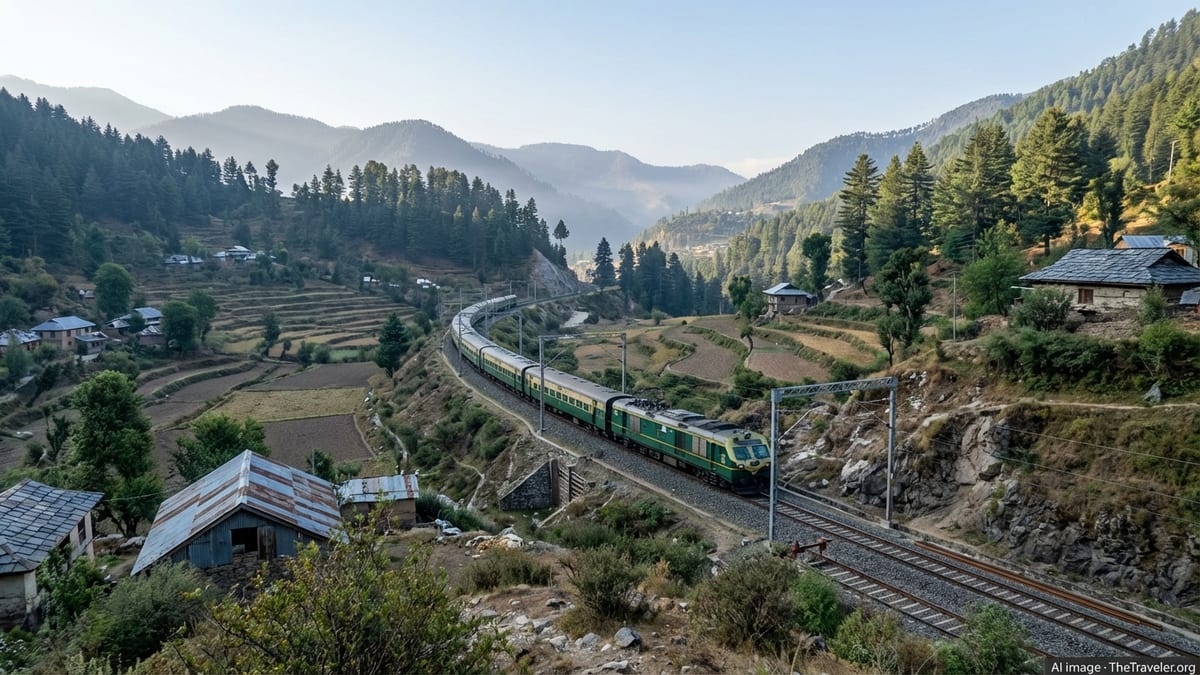
Extension Confirms Strong Demand on New Kashmir–Katra Rail Corridor
The Budgam to Katra special, operated as DEMU services 04688 (Budgam to SMVD Katra) and 04687 (SMVD Katra to Budgam), has now been scheduled to run daily from April 5 until July 2. The move formalizes what railway planners had anticipated since the opening of the full Udhampur–Srinagar–Baramulla Rail Link: that demand on this north–south corridor would stay high well into the summer travel season.
Timetable data for the current schedule shows the Budgam to Katra service departing Budgam at 07:20 and arriving at Shri Mata Vaishno Devi Katra at 13:00, covering roughly 200 kilometers in 5 hours and 40 minutes with 12 intermediate halts. In the return direction, the train leaves Katra at 13:45 and reaches Budgam at 20:00, with a journey time of about 6 hours and 15 minutes over the same distance.
Initially planned for a shorter operational window, the DEMU pair has consistently reported high occupancy, particularly on weekends and around religious events linked to the Vaishno Devi shrine. Railway officials have cited this sustained rush, along with feedback from passengers, as the primary rationale for maintaining the service through early July.
The extension overlaps with early portions of the Amarnath Yatra build-up period, when movement between Jammu, Katra and the Valley typically intensifies. Even before the core pilgrimage dates, advance travel by workers, service providers and families visiting relatives in the region tends to push demand for affordable, reliable rail options.
Daily All-Stops DEMU Service Anchors Regional Passenger Mobility
Unlike long-distance express or premium trains that often skip smaller stations, the Budgam–Katra special functions as an all-stops regional lifeline. Operating with Diesel Electric Multiple Units, the train is designed for frequent halts, rapid acceleration and de-acceleration, making it ideal for serving the string of towns and semi-urban settlements along the corridor.
The daily frequency provides a predictable schedule for commuters, traders, government employees and students who now rely on rail rather than road for inter-district travel. With departures and arrivals timed to connect broadly with morning activities at origin and evening return at destination, the service fills a critical gap in everyday mobility.
Railway planners have also highlighted that the DEMU configuration gives the operator greater flexibility to adjust formation length in line with seasonal or event-driven surges. While the present set is tailored to current demand patterns, officials can add or reduce coaches in response to future trends without altering the fundamental timetable structure.
By keeping fares in the lower regional segment and running on all seven days of the week, the Budgam–Katra special has emerged as a preferred mode for cost-conscious travelers who previously depended on buses and shared taxis across challenging mountain roads. For many, the shift to rail has meant shorter, safer and more predictable journeys.
Linking Budgam to SMVD Katra: A Strategic Spine for Pilgrim and Local Traffic
Budgam, situated near Srinagar and integrated into the Valley’s suburban rail network, has become an important origin point for both local commuters and longer-distance passengers heading towards Jammu and beyond. On the southern end, Shri Mata Vaishno Devi Katra station acts as a gateway for millions of pilgrims visiting one of India’s most significant Hindu shrines each year.
By running directly between Budgam and SMVD Katra, the special train creates a seamless spine for two major traffic streams: daily local movement inside Jammu and Kashmir, and continuous inflow and outflow of devotees to the Vaishno Devi shrine. For Kashmir-based pilgrims, the need for complex multimodal road transfers has been sharply reduced, replaced instead by a single through train journey.
The pairing of a Valley-originating service with a pilgrimage terminus is also expected to influence tourism patterns more broadly. Travel agents in Srinagar and other districts have started bundling rail tickets with hotel and darshan arrangements, marketing the train as a comfortable and weather-resilient option for families and elderly passengers.
For residents living along intermediate stations, the service does more than support pilgrimage travel. It offers a direct line for accessing jobs in Katra’s hospitality sector, for visiting relatives, and for transporting small cargo and agricultural produce between markets in the Valley and the Jammu region.
Part of a Wider Push to Strengthen Jammu–Kashmir Rail Integration
The extension of the Budgam–Katra special comes as Northern Railway accelerates efforts to knit together Jammu and the Kashmir Valley into a seamless rail network. Work on associated stretches, station upgrades and operational readiness has been underway as the region transitions from project construction to full-fledged passenger operations.
Recent inspections and reviews by senior railway officials across the Srinagar–Baramulla and Jammu–Katra legs have emphasized reliable, year-round connectivity as a core objective. Floods, landslides and harsh winter conditions have previously disrupted road links, highlighting the need for robust rail-based alternatives that can keep people and essential goods moving.
The Budgam–Katra DEMU is therefore seen not merely as a seasonal service but as a building block in a future network where trains from across India connect seamlessly through Katra into the Valley. Current operational strategies, which include transshipment at SMVD Katra for trains originating in other parts of the country, are designed to balance security requirements with the convenience of through-journey planning.
As additional infrastructure along the corridor is commissioned and stabilized, rail planners are expected to review the role of special services like the Budgam–Katra DEMU in the broader timetable. For now, its extension to July 2 is an early signal that the route is consolidating as a permanent element of the region’s transport landscape rather than a short-lived experiment.
Timings, Capacity and Operational Features of the Extended Train
The present timetable indicates a morning departure from Budgam at 07:20, allowing passengers from surrounding areas such as Srinagar and central Kashmir to connect via local services or short road transfers. Arrival at SMVD Katra at 13:00 gives pilgrims and travelers the rest of the afternoon to reach accommodations, complete formalities and, in many cases, begin the ascent towards the Vaishno Devi shrine.
On the return leg, the 13:45 departure from Katra provides a comfortable buffer for morning darshan or check-out from hotels, with an evening arrival in Budgam at 20:00 that still permits onward local transfers. The 12-halt pattern ensures that key intermediate stations receive service in both directions daily, stabilizing travel plans for residents along the line.
As a DEMU, the train is engineered for frequent stops with minimal time lost to acceleration and braking cycles. This is particularly important on a corridor that passes through varied terrain and serves a mix of small and medium-sized stations where boarding and alighting flows can fluctuate significantly from day to day.
Railway officials have advised passengers to factor in the all-stops nature of the service when planning connections to long-distance trains or flights from Jammu or beyond. While journey times are optimized for a regional passenger operation, the emphasis remains on comprehensive coverage rather than express-level speeds.
Economic and Social Ripple Effects Along the Corridor
Local businesses across both Jammu and Kashmir divisions are beginning to report tangible benefits from the Budgam–Katra special. Traders dealing in horticultural produce, handicrafts and everyday consumer goods have gained a new route for moving small consignments, often accompanying their merchandise in passenger coaches for sale at markets and seasonal fairs.
The tourism ecosystem around Katra is also seeing incremental changes. Hoteliers and guesthouse operators note that visitors from the Valley now arrive with more predictable timing, making it easier to manage check-in cycles, transport arrangements up to the shrine base and package itineraries that combine religious travel with sightseeing in Jammu city or Patnitop.
In towns along the line, small eateries, taxi stands and retail outlets near station approaches have seen increased footfall linked directly to the train’s daily operations. Regular movement of passengers has encouraged new micro-enterprises, from tea stalls to local tour guides offering last-mile assistance to visitors unfamiliar with the route.
Socially, the extended service strengthens people-to-people contact across regions that, until recently, were separated by time-consuming and sometimes uncertain road journeys. Student exchanges, medical referrals and inter-district family visits are all becoming more frequent as residents grow more confident in the reliability of the rail link.
Summer Travel Outlook and Prospects Beyond July 2
The current extension window up to July 2 aligns closely with early summer holidays in many parts of India, when families typically plan longer trips and pilgrimages. Rail industry observers suggest that maintaining the Budgam–Katra special through this period will be crucial in easing pressure on other trains that connect into Jammu and Katra from the plains.
With advance bookings for the Vaishno Devi corridor expected to rise steadily from late spring, the DEMU service gives passengers from the Valley and adjoining districts an assured and comparatively low-cost option. This, in turn, can help distribute flows more evenly across the day, reducing last-minute crowding at roads and bus stations.
While no official announcement has yet been made about operations beyond July 2, the strong ridership trends and the strategic importance of the Budgam–Katra link make further extensions or a transition to a regular, non-special schedule a distinct possibility. Any such decision will likely be based on detailed occupancy data and feedback from state authorities and local stakeholders.
For now, railway officials are focusing on ensuring punctuality, maintaining rolling stock and fine-tuning station-level arrangements such as signage, passenger information announcements and basic amenities. Their immediate goal is to demonstrate that the extended special can deliver a consistent, reliable experience throughout its current run.
What Passengers Should Know Before Boarding the Special
Passengers planning to travel on the Budgam–Katra special are being encouraged to familiarize themselves with the train numbers, departure times and halt pattern. Knowing that services 04688 and 04687 run daily, and that the journey involves multiple intermediate stops, helps travelers plan food, rest and onward connections more effectively.
Given the route’s popularity with pilgrims, families and elderly travelers, railway staff at key stations are expected to place additional emphasis on crowd management, clear public announcements and assistance for those carrying luggage or traveling with children. Travelers are advised to arrive at stations well ahead of departure, particularly during peak holiday and festival dates.
As the train is categorized as a special regional service rather than a premium express, passengers can expect basic, functional accommodation consistent with DEMU stock. Authorities highlight that cleanliness, safety and adherence to schedule remain priorities, even if the service does not feature the higher-end amenities found on long-distance or semi-high-speed trains.
For residents of Jammu and Kashmir, the message from the extension is clear: the rail bridge between Budgam and Katra is not a short-lived convenience but a growing part of daily life and regional integration. Each additional day of operation through to July 2 deepens the role of the corridor as a dependable connector between the Valley, the pilgrimage hub of Katra and the wider Indian rail network.