

More news on this day
Hundreds of travelers in Buenos Aires faced hours of uncertainty as Argentina’s two main gateways, Aeroparque Jorge Newbery and Ministro Pistarini International Airport, logged at least seven cancellations and more than 70 delayed flights, disrupting operations for Aerolíneas Argentinas, LATAM and several other carriers.
Get the latest news straight to your inbox!
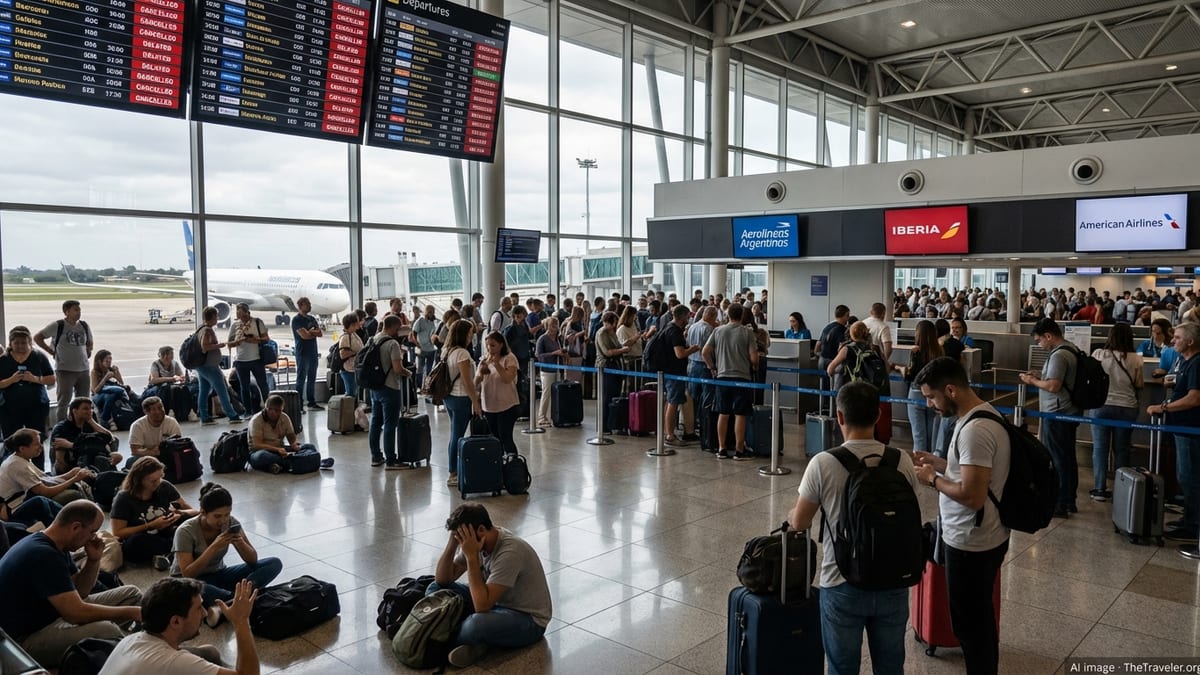
Major Disruptions at Buenos Aires’ Twin Airports
Publicly available flight-tracking data and local media coverage indicate that operations at Aeroparque Jorge Newbery, the city’s centrally located domestic and regional hub, and Ministro Pistarini International Airport in Ezeiza were heavily affected, with a combined tally of seven cancellations and 72 delayed departures and arrivals over the course of the day. The pattern created long lines at check in, security and customer service desks as passengers sought rebooking options and updated information.
The impact was most visible during the morning and late-evening peaks, when high-frequency domestic routes connect Buenos Aires with major Argentine cities such as Córdoba, Mendoza and Bariloche, and international services link the capital to regional hubs across South America. Even relatively short delays at these times quickly cascaded across the schedule, leaving aircraft and crews out of position and amplifying knock-on effects.
Reports suggest that the disruption affected both domestic and international operations. At Aeroparque, which concentrates a significant share of Argentina’s internal traffic, late-running departures caused aircraft to miss their next scheduled rotations. At Ezeiza, extended ground times for inbound flights contributed to late turnarounds on long-haul departures to destinations in North America and Europe.
Although the number of outright cancellations remained comparatively low relative to the day’s total traffic, the concentration of delays above 30 minutes was enough to unsettle connections for hundreds of travelers, particularly those holding separate tickets or transferring between the two airports by ground.
Aerolíneas Argentinas and LATAM Among Hardest Hit
National carrier Aerolíneas Argentinas, which dominates domestic traffic and operates a dense network from both Aeroparque and Ezeiza, experienced a significant share of the delays. The airline’s role as a primary connector between Buenos Aires and the provinces meant that even a handful of timetable disruptions spread quickly through its network, affecting itineraries involving multiple legs on the same day.
LATAM, one of the largest regional competitors on routes linking Argentina with neighboring countries, also saw schedule changes. Public timetables and day-of-travel trackers showed delays on flights serving key regional destinations, complicating onward connections at partner hubs and creating additional rebooking challenges for passengers with tight layovers.
Other carriers using Buenos Aires as a strategic gateway, including low cost operators and foreign airlines, were not immune. Even when individual flights were ready to depart on time, ground congestion, late-arriving passengers from delayed feeder services and the need to coordinate limited slots at peak hours contributed to schedule slippage across multiple operators.
Travel industry observers note that both Aerolíneas Argentinas and LATAM have expanded their presence in the Argentine market over recent years, boosting frequencies on high demand routes. On disruption-heavy days, that growth translates into more passengers funneling through the same constrained terminals, magnifying the visible impact when punctuality falters.
Passengers Face Missed Connections and Overnight Delays
For travelers, the statistics on cancellations and delays translated into missed connections, unplanned overnight stays and reworked itineraries. Passengers connecting from domestic services at Aeroparque to long haul departures at Ezeiza were particularly exposed, given the need to collect baggage, travel across the city and recheck for an international flight within a limited window.
Accounts shared on social platforms and travel forums described travelers racing between terminals, waiting in long queues to speak with airline staff and attempting to rebook online when call centers became congested. Some reported being automatically reprotected on later flights, while others with separate tickets encountered out of pocket costs for last minute changes.
The backlog also affected those starting or ending their journeys in Buenos Aires. Delayed evening departures from Aeroparque pushed arrivals at key tourist destinations into the early hours of the morning, complicating ground transport and accommodation check-in. Families and international visitors unfamiliar with the city’s layout faced additional stress when late changes forced them to adapt plans with limited advance notice.
Consumer advocates routinely advise travelers using Buenos Aires’ two-airport system to allow longer connection times than minimum standards suggest, precisely because of the risk that delays at either Aeroparque or Ezeiza can quickly undermine tightly timed itineraries. The latest wave of disruptions is likely to reinforce that guidance for upcoming peak travel periods.
Underlying Pressures on Argentina’s Air Travel System
The latest operational problems arrived against a backdrop of broader pressure on Argentina’s aviation infrastructure. Recent reports from aviation analysts and local outlets highlight recurring strains linked to air traffic control work actions, staffing levels and the challenge of managing growing demand within terminals and airspace that have seen only gradual upgrades.
Technical staff unions representing air navigation personnel have periodically announced staggered industrial actions in recent months, warning that more intense stoppages could affect departures at airports nationwide. Even when full work stoppages are not in effect, partial measures, minimum service operations or precautionary spacing between flights can reduce capacity and lead to slower throughput during busy spells.
Argentina’s volatile economic environment adds another layer of complexity. Currency swings and inflation have raised operating costs for airlines while also influencing passenger demand patterns, with many travelers booking closer to departure. That behavior can make it harder for carriers and airports to anticipate peak loads and allocate resources efficiently on the day of operation.
Aeroparque and Ezeiza have both undergone modernization and expansion in recent years, and official data show that passenger volumes have recovered strongly in the post pandemic period. Yet sector specialists frequently point to the need for continued investment in air traffic management systems, ground handling capacity and contingency planning to improve resilience when disruptions, whether operational or weather related, occur.
What Travelers Should Expect in the Coming Days
Given the scale of the latest disruption, travel industry commentary suggests that some residual delays are likely to persist as airlines reposition aircraft and crews and work through rebooked passengers. Even after schedules appear to normalize on departure boards, late arriving aircraft can continue to affect subsequent rotations for several cycles.
Airlines serving Buenos Aires generally encourage passengers to monitor flight status closely on the day of travel, arrive at the airport earlier than usual when conditions are unsettled and ensure that contact details within reservations are up to date for any schedule change notifications. Those connecting between Aeroparque and Ezeiza are often urged to allow generous buffers and consider potential traffic congestion on the ground when planning transfers.
Travel planners note that the pattern seen in Buenos Aires, with a relatively small number of outright cancellations but a large cluster of substantial delays, may recur during periods of industrial tension, infrastructure works or challenging weather. For international visitors, particularly those planning tight onward connections or time sensitive itineraries, building in extra flexibility can help absorb unexpected shocks.
For now, the seven cancellations and 72 delayed flights logged across Aeroparque Jorge Newbery and Ministro Pistarini International Airport serve as another reminder of both Buenos Aires’ central role in Argentina’s air transport network and the vulnerabilities that arise when its two key hubs come under simultaneous strain.