

More news on this day
Buenos Aires is recording a fresh upswing in visitor numbers as expanding air connectivity, rising passenger traffic and new investments at its two main airports channel more international and domestic tourists into Argentina’s capital.
Get the latest news straight to your inbox!
Airport Traffic Surges Ahead of National Tourism Trend
Publicly available aviation and tourism data indicate that Buenos Aires is outpacing Argentina’s broader tourism performance, with its airports acting as the main gateways for the country’s recent recovery in air travel. Ezeiza International Airport and Aeroparque Jorge Newbery together handled roughly 29.3 million passengers in 2024, according to a recent government investment report, underscoring the scale of traffic now concentrated in the metropolitan area.
While Argentina as a whole has experienced volatility in inbound tourism due to inflation and currency shifts, regional aviation statistics for 2025 show that the country is leading Latin America in air traffic growth, supported in large part by increased demand for flights into Buenos Aires. Industry coverage of the Latin American market notes that Argentina posted the highest percentage growth in regional air traffic in 2025, with international segments expanding faster than domestic services and a surge in inbound tourism cited as a key factor.
This divergence between national economic headwinds and local traffic growth suggests that Buenos Aires is consolidating its role as a hub for both international visitors and Argentine travelers connecting to the rest of the region. The city’s airports are increasingly functioning as the primary interface between Argentina and global tourism flows, even as other entry points, such as land borders and regional airports, grow at a slower pace.
Tourism-focused publications tracking Argentina’s recovery describe the capital’s air gateways as critical to sustaining visitor numbers, particularly from neighboring markets and North America. With most long-haul international flights still funneled through Ezeiza and a dense network of regional routes concentrated at Aeroparque, the Buenos Aires metropolitan area has become the focal point of the country’s tourism rebound by air.
Ezeiza Modernization and Technology Upgrades Support Growth
Recent infrastructure and technology investments at Ezeiza International Airport are reinforcing its role as Argentina’s main international gateway. Airport operator reports show that Ezeiza handled about 12 million passengers in 2024, representing more than a quarter of all passengers managed by the Aeropuertos Argentina system and confirming its position among the busiest airports in the country.
In early 2026, Ezeiza announced the deployment of an artificial intelligence ramp-visibility platform across all passenger gates, expanding a pilot program into full-airport coverage. Industry statements on the project emphasize that the system is intended to improve on-time performance and operational safety by giving ground teams real-time insight into aircraft turns, a factor that can indirectly enhance the passenger experience by reducing delays and congestion.
Alongside technology upgrades, Ezeiza has continued to refine its premium and transit offering. Corporate filings from the airport operator describe the completion of a new VIP lounge in 2025, designed with biometric access and expanded work and rest spaces for connecting passengers. The emphasis on higher-yield travelers reflects a strategy to attract long-haul traffic and position Buenos Aires as a competitive stopover option for routes linking North and South America with Europe.
Aviation trend bulletins tracking South Atlantic routes also highlight the importance of Ezeiza’s long-haul links to Madrid and other European hubs, which together move hundreds of thousands of passengers annually. Improvements to terminal capacity, passenger services and operational reliability are regarded as essential to maintaining and expanding these connections, particularly as other Latin American airports compete aggressively for the same flows.
Aeroparque’s Regional Network Draws Tourists Into the City Core
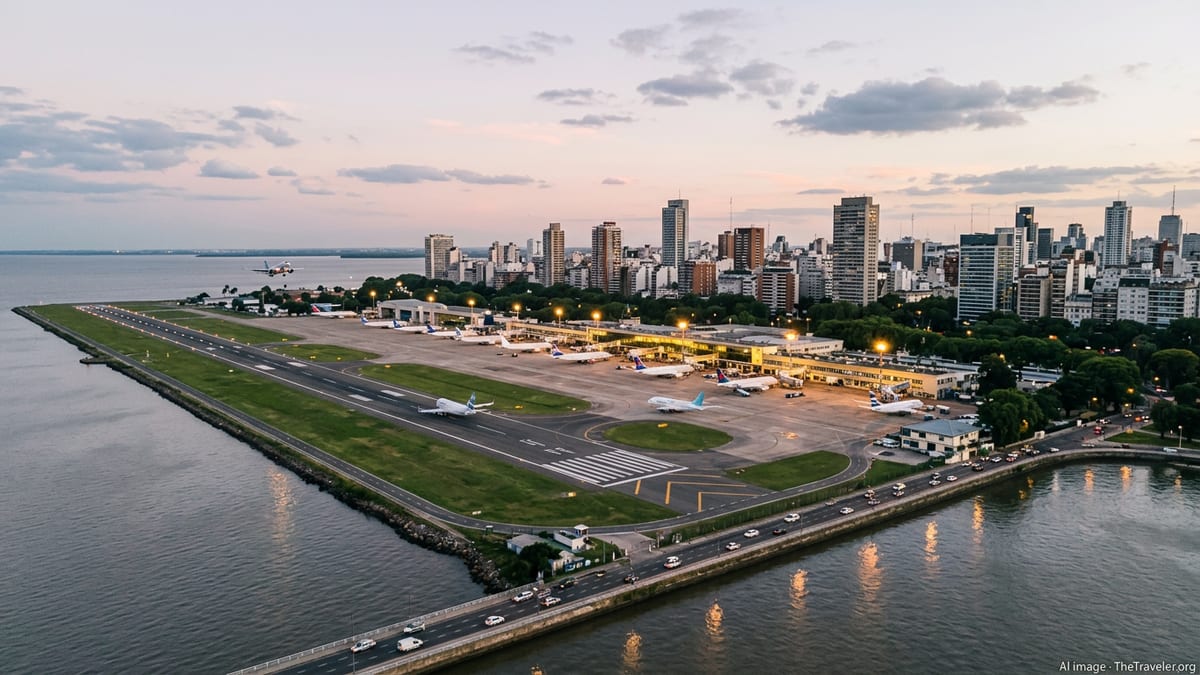
Complementing Ezeiza’s long-haul profile, Aeroparque Jorge Newbery has evolved into a dense hub for domestic and short-haul regional traffic, delivering tourists directly to the doorstep of Buenos Aires. Located along the Rio de la Plata and only a short drive from key neighborhoods such as Palermo and Recoleta, Aeroparque offers arriving visitors immediate access to the city’s hotels, cultural districts and business centers.
Municipal tourism reports for 2025 show that flights to and from Aeroparque, together with those at Ezeiza, represented the bulk of air operations involving the city, with more than 9,600 domestic flights recorded in November alone across the two airports. That volume reflects a substantial recovery in internal connectivity, making it easier for international arrivals to connect through Buenos Aires to destinations such as Bariloche, Salta or Ushuaia for multi-stop itineraries.
Regional aviation coverage points to a particularly strong upswing in routes linking Buenos Aires with major South American cities, especially in Brazil. On the high-demand Buenos Aires to Rio de Janeiro corridor, airlines are now offering more than 20 daily flights split between Aeroparque and Ezeiza, with total seat capacity on the route rising by nearly 20 percent year on year in early 2025. This intensification of service is expanding options for leisure travelers who combine stays in Buenos Aires with beach destinations across the region.
For inbound tourists, the growing web of short-haul connections also supports city-break travel, with travelers from neighboring countries using Buenos Aires for long weekends, events and shopping trips. Industry analyses of traffic flows note that a rising share of international arrivals to Argentina now come from within Latin America, and Aeroparque’s proximity to the city center helps convert that regional air growth directly into urban tourism activity.
Policy Shifts and Airline Strategies Boost Connectivity
The recent rise in tourism through Buenos Aires is closely linked to broader changes in Argentina’s aviation policy and airline strategies. Trade press coverage of the regional market emphasizes that an open-skies orientation and the entry of new competitors have stimulated capacity, particularly on regional routes where low-cost carriers have increased frequencies and introduced new city pairs.
According to analytical reports on Latin American aviation trends, Argentina recorded the strongest air traffic growth rate in the region in 2025, driven largely by international routes where both legacy and low-cost airlines expanded operations. Key markets such as Brazil, Colombia and the Dominican Republic registered double-digit growth in traffic to and from Argentina, with many of those passengers transiting through Buenos Aires.
National tourism promotion efforts are also being aligned with this aviation expansion. Press materials from Visit Argentina describe coordinated campaigns in Europe and the United States featuring discounted airfares on flag carrier Aerolíneas Argentinas, with Buenos Aires positioned as the primary entry point before travelers connect onward to other destinations. These promotions are intended to fill additional capacity created by new frequencies and improved aircraft utilization.
At the same time, airport development documents highlight ongoing investments in runway, apron and terminal capacity across the Buenos Aires system, aimed at accommodating forecast growth in passengers over the medium term. The combination of liberalized skies, aggressive airline marketing and infrastructure upgrades is setting the stage for continued gains in visitor numbers arriving by air.
Tourism Sector Adapts to Shifting Demand Patterns
The resurgence in airport traffic is prompting Buenos Aires’ tourism sector to adapt to changing visitor profiles and travel behaviors. Market research on Argentina’s tourism performance notes that, even as inbound arrivals have shown recent softness at the national level due to macroeconomic conditions, certain segments entering through Buenos Aires are expanding, including regional city-break travelers and higher-spending long-haul visitors.
City tourism authorities and local industry associations are using airport passenger figures as a leading indicator for accommodation demand, event planning and urban mobility needs. Monthly tourism reports prepared for the Buenos Aires government show close tracking of flight volumes at both Ezeiza and Aeroparque, reflecting the strong correlation between seat capacity and hotel occupancy in central districts.
Hospitality operators are responding by tailoring products to airport-driven demand, with more hotels emphasizing flexible check-in and check-out times, airport transfer services and packages that bundle domestic flights with stays in the city. Travel agencies and online platforms are promoting itineraries that take advantage of improved connectivity, encouraging visitors to use Buenos Aires as a base for exploring wine regions, Patagonia and the northwest before returning to the capital for urban experiences.
As airlines, airports and tourism businesses align strategies around the growing flow of passengers through Buenos Aires, the city appears poised to strengthen its position as one of South America’s primary gateways. If current trends in air connectivity, infrastructure investment and promotional activity continue, tourism growth driven by the capital’s airports is likely to remain a cornerstone of Argentina’s wider travel economy in the coming years.