

More news on this day
Exploding demand for corporate meetings, incentive trips and large-scale conferences in the United States, Germany, Singapore and France is powering a dramatic rebound in global travel, with business events helping to drive an estimated 1.64 trillion dollars in combined airline and hospitality revenue worldwide as carriers like Delta, Lufthansa, Singapore Airlines and Air France race to add premium seats, rebuild networks and court high-yield corporate clients.
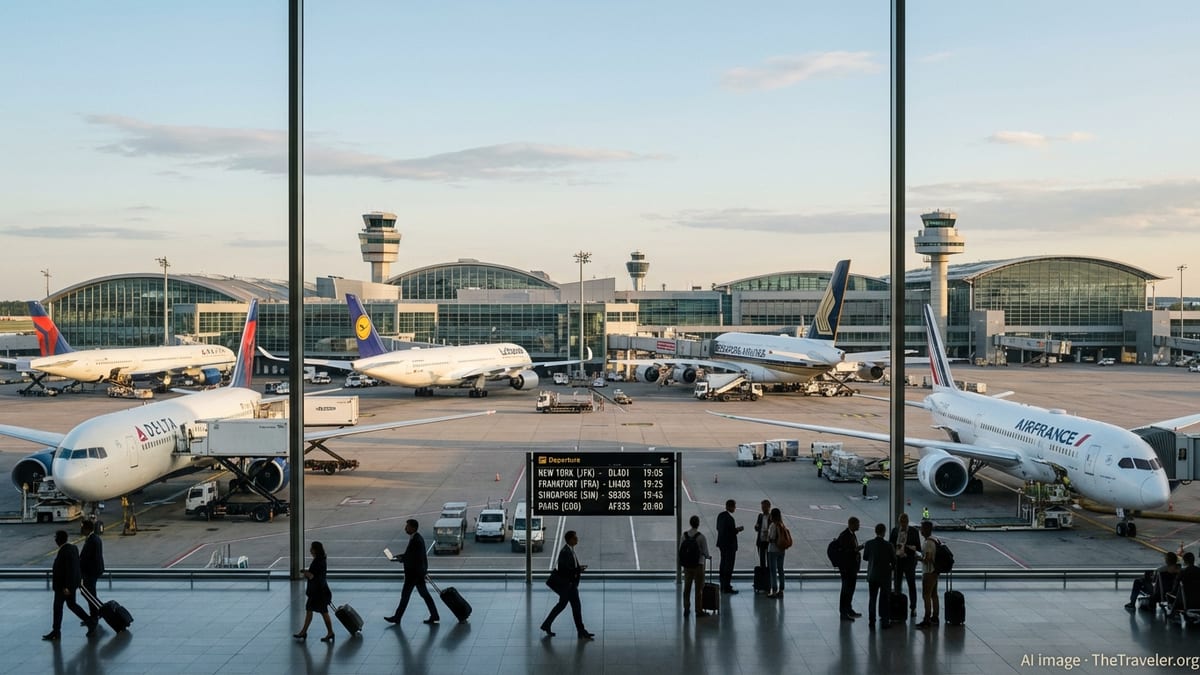
Business Events Roar Back as Corporate Travel Rewrites the Forecast
After several years of uncertainty, corporate travel and business events have re-emerged as one of the most powerful engines of global tourism spending. Airlines and hotel groups report that meetings, incentive trips, conferences and exhibitions are now accounting for a rising share of revenue, particularly on long-haul and premium routes. The rebound is strongest in markets with deep corporate bases and sophisticated event infrastructure, led by the United States, Germany, Singapore and France.
Carriers serving these four markets are seeing a decisive shift in mix toward higher-yield corporate passengers, even as broader leisure demand cools from its post-pandemic peak. Delta Air Lines in the U.S., Lufthansa Group in Germany, Singapore Airlines and Air France-KLM are all reporting sustained growth in premium and corporate segments, supported by a steady pipeline of global events and a renewed emphasis on in-person dealmaking.
Industry analysts say the surge in meetings and events is cascading across the wider travel economy. Airlines benefit not just from full premium cabins but also from higher load factors in the main cabin around major conferences, while hotel chains are reporting strong group bookings and record average daily rates in key business hubs. This combination is underpinning an estimated 1.64 trillion dollars in airline and hospitality activity linked directly or indirectly to business events.
Behind the headline figures is a strategic shift by leading carriers and destination countries. Rather than treating corporate travel as a niche that would permanently shrink after the widespread adoption of videoconferencing, major airlines are repositioning themselves as indispensable partners in their clients’ growth strategies. Dedicated business units, flexible contracts and data-driven loyalty programs are now central to how they compete for high-value travelers.
United States: Delta Leads a Sophisticated Corporate Travel Revival
In the United States, Delta Air Lines has emerged at the forefront of the corporate travel recovery. Recent earnings updates show full-year passenger revenue surpassing 50 billion dollars and total revenue above 63 billion dollars, with premium cabins and corporate demand outpacing the rest of the network. Executives describe a “steady” and improving corporate environment, with sales from business clients up year-on-year and particularly strong in banking, consumer services and media.
Delta has been explicit that premium and loyalty income now anchor its growth strategy. In a recent quarter, premium revenue grew faster than main-cabin income, while loyalty revenue, powered largely by its co-branded credit card partnership, climbed at a high single-digit pace. These diversified revenue streams allow the carrier to withstand softness in some segments of domestic leisure demand while leaning more aggressively into higher-margin corporate travel.
The airline has also invested in operational and product changes aimed squarely at business customers. Through its Delta Business arm, the carrier has rolled out new tools such as the Unused Ticket Transfer program, which lets corporate clients move value from unused tickets directly into their corporate spend accounts. Enhanced data and reporting capabilities give travel managers granular visibility into spending patterns, while a dedicated 24/7 Corporate Solutions team now provides on-demand support for complex or disrupted itineraries.
These initiatives are timed to coincide with a broader revival in the U.S. meetings and events sector. From tech summits in San Francisco and financial roadshows in New York to large trade expos in Las Vegas and Orlando, the volume of face-to-face engagements has risen steadily. For Delta, that means full premium cabins on trunk routes between major financial centers, strong yields on transcontinental flights and an opportunity to leverage its Atlanta, New York and Los Angeles hubs as gateways for global corporate traffic.
Germany: Lufthansa Bets on Premium and Network Depth
Germany remains one of the world’s most important business events markets, anchored by its powerful export industries and its role as a European hub for trade fairs. Cities such as Frankfurt, Munich, Berlin and Hamburg host a packed calendar of automotive, industrial technology and medical conferences that draw high-spending participants from across Europe, Asia and the Americas. Lufthansa Group, based in Frankfurt, sits at the center of this ecosystem.
While European airlines have faced higher operating costs and periodic labor disruptions, Lufthansa continues to prioritize its premium positioning and extensive network. The carrier has been investing in new-generation aircraft and upgraded onboard products, including redesigned business-class cabins and enhanced lounges at key German hubs. These investments are designed to capture a larger share of global corporate traffic that flows through Germany’s dense web of trade shows and congresses.
Corporate demand patterns into and out of Germany reflect the country’s industrial strengths. Routes connecting manufacturing regions in southern Germany with North America and East Asia have seen resilient business travel, particularly in sectors such as automotive, chemicals, engineering and logistics. Lufthansa’s joint ventures and partnerships on both the Atlantic and Pacific give it the connectivity to move these travelers efficiently between regional cities and global headquarters.
As with its peers, Lufthansa is also repositioning for a more sustainable future while serving this high-yield market. The carrier is accelerating fleet renewal and experimenting with sustainable aviation fuel supply arrangements tied to its largest corporate accounts. For companies under pressure to cut emissions from travel but still reliant on international meetings, such arrangements allow them to continue flying while demonstrating measurable progress toward climate goals.
Singapore: A Small City-State with Outsized MICE Influence
Singapore has long punched above its weight in the global meetings, incentives, conferences and exhibitions (MICE) industry, and that influence is only growing. With a strategic location at the crossroads of Asia, a reputation for safety and efficiency, and state-of-the-art venues clustered around Marina Bay and Changi Airport, the city-state has become a default choice for multinational companies organizing regional summits and global leadership gatherings.
Singapore Airlines, one of the world’s most respected carriers, is reaping the benefits. As long-haul and regional corporate flying has returned, the airline has focused on sustaining high load factors in its premium economy and business cabins, particularly on routes linking Singapore with key financial and technology centers such as London, New York, Frankfurt, San Francisco, Sydney and Tokyo. Its close integration with Changi’s hub operations means short transfer times and seamless connectivity for delegates traveling from secondary Asian cities to major congresses.
Policy moves in Singapore are also shaping the next phase of aviation growth. The government has announced a sustainable aviation fuel levy that will be applied to tickets for flights departing from Changi starting in 2026, with charges varying by distance and cabin class. The measure is designed to finance the gradual scaling up of sustainable aviation fuel use and to position Singapore as a leading regional hub for low-carbon aviation.
For business travelers and event planners, this intersection of sustainability and connectivity is increasingly important. Global companies under intense environmental scrutiny are keen to hold large meetings in destinations that align with their climate commitments. Singapore’s combination of advanced infrastructure, efficient border controls and credible green policies is expected to keep it high on the shortlist for flagship corporate events, ensuring robust premium demand for Singapore Airlines in the years ahead.
France: Air France Harnesses Premium Demand Amid a Complex Market
France, and particularly Paris, remains synonymous with flagship corporate gatherings, from global board retreats to mega-conventions held alongside international sporting events. Air France-KLM, headquartered in Paris and Amsterdam, has navigated a challenging operating backdrop but continues to highlight the strength of its premium and corporate franchise. Recent financial disclosures show group revenues rising, supported by robust demand in higher-yield cabins even as overall profitability has been squeezed by costs and one-off factors such as the disruption surrounding the Paris Olympics.
Executives at the group describe a clear upward trajectory in premium revenue. In recent years, premium income grew at double-digit rates year-on-year, and premium cabins now contribute more than a quarter of total group revenue. Corporate travel has been a key driver, with revenue from business clients climbing compared with pre-pandemic baselines, particularly on medium- and long-haul routes connecting Paris and Amsterdam with North America, Asia and Africa.
Air France-KLM is backing this demand with tangible product upgrades. The group has been aggressively renewing its fleet, replacing older aircraft with more fuel-efficient models configured with larger proportions of premium seats. New business-class suites, premium economy cabins and enhanced in-flight connectivity are intended not only to attract corporate travelers but also to encourage leisure passengers to trade up, further enriching the yield mix on busy business routes.
These efforts come amid shifting competitive dynamics. Air France-KLM is deepening its presence in northern Europe through its acquisition of a controlling stake in Scandinavian carrier SAS, giving it broader access to corporate clients across the Nordic markets. That, combined with its longstanding transatlantic joint ventures, is expected to funnel more high-yield traffic into Paris and Amsterdam, reinforcing France’s role as a gateway for global conferences and high-profile events across Europe.
How Business Events Translate Into a $1.64 Trillion Travel Engine
The estimated 1.64 trillion dollars in revenue linked to business events is not a single, discrete category, but the cumulative impact of multiple overlapping flows of spending. At its core are airline ticket sales associated with corporate trips, from individual client meetings to large conventions, and the hotel nights required to host participants in host cities. Around this core sit a range of ancillary services: airport transfers, restaurant and entertainment spending, venue rentals, technology support and destination management services.
For airlines, the real value is the structural lift in yields and load factors. Corporate travelers tend to book later, pay higher average fares and choose more flexible ticket types than leisure passengers. A full schedule of major conferences in hubs such as New York, Frankfurt, Singapore and Paris allows carriers to plan capacity with greater confidence and to maintain frequency on key routes, even when holiday demand softens. Premium cabins in particular benefit from executives willing to pay for flat beds and quiet workspaces on overnight flights.
Hotels and hospitality providers experience a similar effect. Host cities see spikes in occupancy and average daily rates around major events, often extending into shoulder nights as attendees arrive early for networking or stay on for leisure. Large convention centers in Germany, purpose-built MICE facilities in Singapore, and landmark venues in Paris and U.S. cities all rely on this recurring calendar of events to sustain investment and employment. The interplay between air connectivity and venue capacity becomes a virtuous cycle: strong air links attract bigger events, which in turn justify further investment in both aviation and hospitality infrastructure.
The economic reach of this ecosystem extends into local economies through jobs and tax revenues. Caterers, audiovisual technicians, translators, security providers and freelance event planners all derive income from the business events calendar. For governments in the United States, Germany, Singapore and France, attracting high-profile conferences is therefore not only a matter of prestige but also a tool for economic development, knowledge exchange and sectoral promotion, from biotechnology to green finance.
Airline Strategies: Premium Cabins, Loyalty and Sustainability
As the corporate travel rebound settles into a more stable pattern, leading carriers are refining strategies to lock in long-term value. Across Delta, Lufthansa, Singapore Airlines and Air France-KLM, three themes stand out: the elevation of premium cabins, the expansion of loyalty ecosystems and the integration of sustainability into corporate offerings. Together, these trends are reshaping how airlines think about their most valuable customers.
On the product side, premium cabins are no longer an afterthought. Delta has steadily increased the share of its revenue coming from premium seats and now sees premium sales approaching parity with main-cabin income. Air France and KLM are rolling out new business-class suites and premium economy products, while Lufthansa and Singapore Airlines continue to refine already highly regarded premium cabins. For corporate travelers, the result is more choice at the top end of the market, including intermediate options such as premium economy that satisfy cost-conscious travel managers while delivering an upgraded passenger experience.
Loyalty programs are the second pillar. Airlines are leveraging co-branded credit cards, expanded partnership networks and more sophisticated data analytics to deepen relationships with both individual travelers and corporate accounts. Delta’s loyalty revenue, for example, has been growing faster than overall ticket sales, reflecting increased card spending and new sign-ups. Similar dynamics are at play at Air France-KLM and Singapore Airlines, where tiered programs and corporate reward schemes encourage companies to channel more of their travel budgets through a single carrier or alliance.
The third theme is sustainability. With large corporations pledging aggressive emissions-reduction targets, airlines are racing to build credible green travel options. Singapore’s sustainable aviation fuel levy will provide a structured framework for funding lower-carbon flying, while European carriers such as Air France-KLM and Lufthansa are signing long-term sustainable fuel agreements and promoting “green fares” that bundle carbon reductions into the ticket. For business events planners, these offerings increasingly influence destination and airline choices.
Outlook: High-Stakes Competition for the Next Wave of Corporate Travel
The resurgence of business events and corporate travel has set the stage for an intense competitive cycle among airlines and host destinations. The United States, Germany, Singapore and France are well positioned, given their deep corporate bases, robust conference infrastructure and powerful home carriers. Yet they face challenges from rival hubs in the Middle East and Asia, where airports and airlines are investing heavily to capture long-haul premium traffic.
For Delta, Lufthansa, Singapore Airlines and Air France, the central question is how to sustain growth in a world where economic cycles, geopolitical tensions and environmental regulations can rapidly reshape demand. Investments in flexible fleets, technology and data-driven revenue management are essential to navigate these uncertainties. At the same time, each carrier is betting that companies will continue to place a premium on in-person connections for closing deals, aligning global teams and showcasing innovation.
What seems clear is that business events will remain a cornerstone of the travel economy. The 1.64 trillion dollar wave of spending rippling through airlines and hospitality is not simply a post-pandemic catch-up, but part of a broader revaluation of face-to-face interaction in an increasingly digital world. As major carriers and destination countries refine their strategies, the competition to host the next big conference, product launch or global summit is likely to intensify, reshaping routes, products and investment plans well into the next decade.