

More news on this day
Passengers traveling through Baltimore/Washington International Thurgood Marshall Airport on Friday evening faced a convergence of disruptions as a brief ground stop, residual flight delays and ongoing Transportation Security Administration staffing challenges combined to snarl departures at the height of the spring travel rush.
Get the latest news straight to your inbox!
Ground Stop Lifted, But Delays Ripple Through Evening Schedules
According to publicly available flight tracking data and local media coverage, a temporary ground stop affecting flights to and from BWI was issued on Friday, March 27, after an operational issue in the Washington-area airspace control system. The measure briefly halted departures and limited arrivals, forcing aircraft already on the ground to wait at gates or on taxiways while controllers resolved the problem.
Airport statements on social media indicated that the Federal Aviation Administration restriction was lifted later in the evening, allowing normal takeoffs and landings to resume. However, the pause left dozens of flights operating significantly behind schedule, with some departures pushed back by more than an hour as the system slowly unwound.
Airlines responded by juggling aircraft assignments and rebooking options for affected customers, but the timing of the disruption during one of the busiest travel periods of the year meant that many flights were already near capacity. Travelers with tight connections and late-night arrivals were particularly vulnerable to missed onward journeys and curtailed plans.
By late night, operations at BWI appeared to be stabilizing, but schedules for some early Saturday services still showed delays as carriers repositioned aircraft and crews that had been held in place during the ground stop.
TSA Staffing Shortages Add to Security Line Bottlenecks
The air traffic pause arrived on top of a separate pressure point on BWI operations: unusually long security checkpoint lines driven by TSA staffing shortages tied to the ongoing Department of Homeland Security funding impasse. National reporting in recent days has documented thousands of TSA officers across the United States working without pay, higher-than-normal sick calls and an uptick in resignations at some locations.
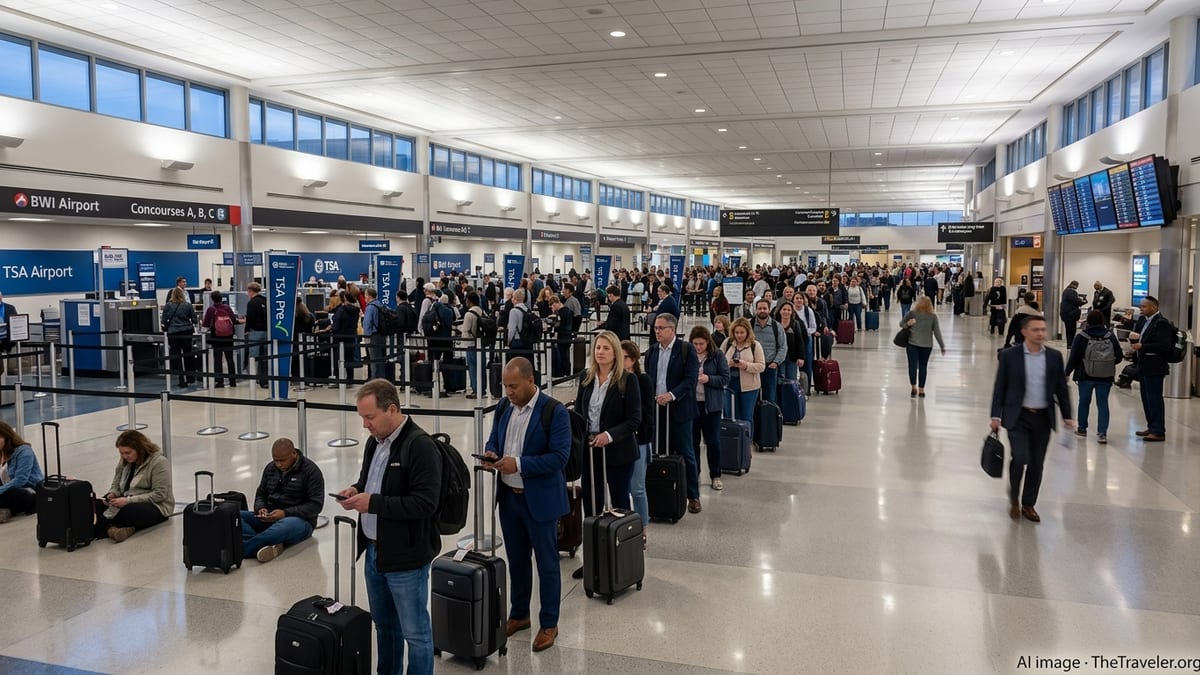
At BWI, social media posts and traveler accounts described early-morning and evening queues stretching far beyond the usual checkpoint entrances, with wait times in some cases exceeding two hours. While experiences varied considerably by time of day and checkpoint, many passengers reported arriving the commonly recommended three hours before departure and still coming close to missing their flights.
Publicly available information about the federal funding dispute indicates that TSA officers have faced weeks of uncertainty over pay, contributing to strain on staffing rosters at airports nationwide. Travel analysts note that when checkpoints cannot be fully staffed, lanes may open later than scheduled or close intermittently, creating bottlenecks that can quickly ripple into gate holds and departure delays.
Local discussions among travelers in the Baltimore region suggest that BWI, usually known for relatively smooth security processing, has seen a noticeable shift in recent days, particularly during the busiest early-morning bank of departures used by business travelers and spring-break vacationers.
Traveler Experiences Range From Routine to Highly Disrupted
Reports from passengers at BWI over the past week paint a picture of uneven conditions, with some travelers encountering near-normal waits and others facing severe slowdowns. Several accounts from midweek morning departures described clearing security in under 15 minutes, even on popular domestic routes, reinforcing the sense that not every time slot has been equally affected.
By contrast, multiple first-hand descriptions from Friday highlighted lines forming before dawn and snaking through the terminal as passengers waited for checkpoints to process a surge of departures. Some travelers described being rebooked onto later flights after it became clear they would not clear screening in time to board. Others expressed frustration that publicly posted wait-time estimates significantly understated the actual delays they encountered once inside the terminal.
Travel experts observing the situation note that such volatility is typical when staffing resources are strained. Relatively modest fluctuations in the number of officers on duty can swing conditions from “walk-through” to “standstill” in a short period, particularly at hub airports that rely on tightly banked departure waves. At BWI, where a major low-cost carrier operates an extensive schedule, those peaks can be especially pronounced in the early morning and late afternoon.
Despite the strain, many travelers have also reported positive interactions with front-line airport and security staff, describing officers and airline agents working to keep lines orderly, direct passengers to the correct queues and assist those at risk of missing flights with updated itineraries.
National Context: DHS Funding Standoff and Air Travel Reliability
The situation at BWI unfolds against a broader national backdrop of concern over the reliability of U.S. air travel during the ongoing Department of Homeland Security shutdown. Publicly accessible analyses of the impasse describe TSA officers and other DHS employees as being required to report to work without pay, a condition that unions and labor advocates warn is unsustainable.
Recent national coverage has noted that more than 50,000 TSA employees have been affected across the country, with some airports reporting extended security lines, sporadic checkpoint closures and a measurable increase in missed flights for passengers who arrived with typical time buffers. Aviation experts have cautioned that even short-lived disruptions to security screening can cascade throughout the network, as planes depart late, miss their assigned air traffic control slots and arrive out of sequence at connecting hubs.
At the same time, federal leaders have moved to authorize temporary pay measures for TSA personnel during the funding dispute. While that development is expected to ease some immediate pressures on the workforce once implemented, analysts suggest that rebuilding staffing levels and restoring confidence among both employees and travelers could take significantly longer than a single pay cycle.
For BWI, which serves as a critical gateway for the Baltimore region and a major alternative to Washington’s National and Dulles airports, the current disruptions are being closely watched as a test of how resilient the airport can be in the face of sustained national policy turbulence and localized operational shocks such as Friday’s ground stop.
What Travelers Can Expect in the Coming Days
Looking ahead to the rest of the weekend and the early-April travel period, publicly available forecasts suggest that BWI’s flight schedule will remain busy, particularly with spring-break and Easter holiday demand. Industry observers expect airlines and the airport operator to continue adjusting operations in real time as they monitor checkpoint throughput, staffing levels and any residual air traffic control constraints.
Travel commentators are widely advising passengers across the region to build in additional time for check-in and security screening at BWI, especially for early-morning departures and during the late-afternoon peak. Many are also recommending that travelers monitor their flights frequently through airline channels, as departure times may shift with relatively short notice in response to ongoing staffing or airspace flow challenges.
Some consumer advocates suggest that travelers consider strategies such as traveling with carry-on luggage only, using mobile boarding passes and arriving at the terminal earlier than usual when possible, as these steps can help minimize the risk of being caught in slower-moving check-in queues before even reaching security. However, they also caution that individual experiences will continue to vary, given the day-by-day changes in staffing rosters and passenger volumes.
For now, BWI remains fully open, with flights operating and security checkpoints processing passengers. Yet Friday’s combination of a temporary ground stop and heightened TSA staffing strain has underscored how swiftly minor disruptions can compound in the current environment, turning what might otherwise have been a routine travel day into a prolonged test of patience for many passengers.