

More news on this day
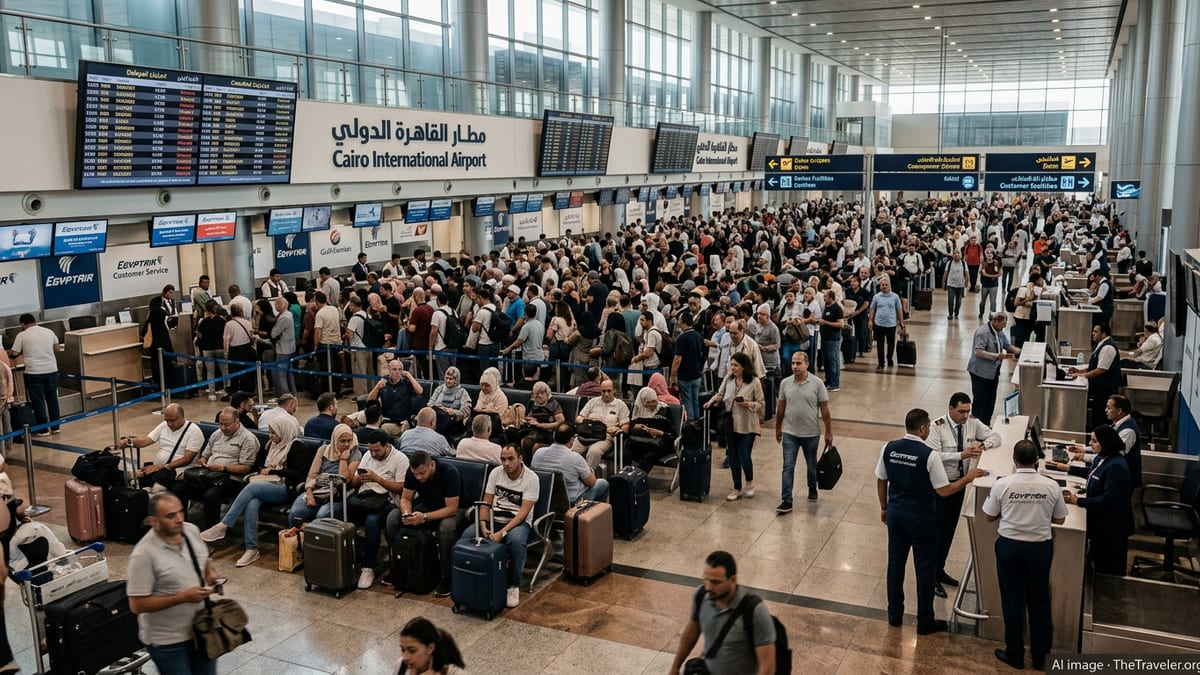
Hundreds of passengers were left stranded or facing marathon waits at Cairo International Airport on Sunday as EgyptAir, Qatar Airways, Emirates, Flynas and other carriers cancelled 52 flights and delayed a further 104 services amid ongoing turbulence in Middle East airspace.
Ripple Effects of Regional Airspace Turmoil Hit Cairo
The fresh wave of disruption at Cairo International Airport on 8 March comes after more than a week of airspace closures and reroutings linked to heightened geopolitical tensions across the region. While Cairo has remained technically open and fully operational, the knock-on impact from closures affecting key Gulf and Levant corridors has now spilled decisively into Egypt’s busiest gateway, which serves as the primary hub for EgyptAir and a major transit point between Africa, the Middle East and Europe.
According to airport operations data viewed by TheTraveler.org, the 52 cancellations span a mix of regional and medium-haul services, largely concentrated on routes linking Cairo with Gulf hubs, Levant capitals and select European cities. The additional 104 delays range from 45 minutes to several hours, as airlines juggle aircraft rotations, diverted crews and evolving flight permissions over still-sensitive airspace.
While the majority of long-haul flights to North America and Western Europe continue to operate, many are departing off-schedule, with carriers building in extra flying time to skirt affected areas. Travelers connecting through Cairo from sub-Saharan Africa have been particularly exposed, with missed onward flights and forced overnights becoming increasingly common.
Airport officials stressed that safety considerations and external airspace restrictions, rather than local infrastructure problems, are driving the disruption. However, for passengers confronted with packed terminals, overburdened customer service desks and limited real-time information, the distinction is largely academic.
EgyptAir Scrambles as Hub Operations Come Under Strain
EgyptAir, the flag carrier and dominant operator at Cairo International Airport, has been at the center of the unfolding chaos. The airline had already suspended and then partially restored a series of regional routes over the past week, including services to Dubai, Sharjah and Dammam, as authorities monitored fast-changing conditions across Middle East skies.
On Sunday, EgyptAir was responsible for a significant share of the cancellations and delays, as aircraft and crews remained out of position following days of diversions and truncated schedules. Short-haul links to Gulf cities, Iraq, Jordan and Lebanon were among the most affected, with multiple round trips scrubbed entirely and others amalgamated into single, heavily booked services.
Passengers with confirmed tickets reported being turned away at check-in or informed at the airport that their flights had been cancelled or retimed. Many complained of long waits to secure rebookings, with options limited by already congested alternative services and the reluctance of some carriers to commit additional capacity until the regional picture stabilizes.
EgyptAir has urged travelers to verify their flight status using official digital channels before heading to the airport and has been offering free date changes on affected routes. However, with hotel availability tight near the airport and call centers overwhelmed, many stranded passengers have had little choice but to spend the night in crowded waiting areas or pay out of pocket for last-minute accommodation.
Gulf Carriers and Flynas Adjust Networks Around Egypt
Major Gulf carriers that normally channel large volumes of traffic between Egypt, the wider Middle East and Europe have also been forced into sweeping schedule changes that are now being felt in Cairo. Qatar Airways has been operating a limited schedule to and from Doha, prioritizing repatriation flights and essential connections while trimming frequencies on some regional legs.
Emirates, one of the largest foreign operators into Egypt, has signaled that it aims to restore full capacity “in the coming days” following the partial reopening of some regional airspace. In the meantime, Cairo-bound passengers originating in Europe and Asia are facing a patchwork of rerouted or consolidated flights, significantly longer journey times and, in some cases, enforced stopovers at alternative hubs.
Saudi low-cost carrier Flynas has likewise cut and reshuffled parts of its network, including services linking secondary Saudi cities with Egypt. For travelers using Cairo as a jump-off point to perform religious pilgrimages or visit family across the Gulf, the shifting Flynas schedule has created additional uncertainty, particularly where separate tickets are involved and through-protection is limited.
Industry analysts note that carriers are walking a tightrope between maintaining essential connectivity and avoiding uneconomical operations on routes that may be subject to last-minute closure orders or lengthy detours. This, they warn, could mean sporadic disruption for Egypt-bound passengers persists even as headline airspace restrictions are gradually eased.
Impact on European Connections and Tourism Flows
The disruption has not been confined to regional travel. European-bound flights operated by EgyptAir, Emirates, Qatar Airways and codeshare partners have also felt the strain, with Cairo-origin services to cities such as London, Frankfurt, Milan and Madrid registering a spike in delays. Some departures have been held on the ground in Cairo to await inbound aircraft arriving late from the Gulf or South Asia.
Package holidaymakers and independent travelers heading from Europe to Egyptian resorts via Cairo have borne the brunt, as misaligned connections lead to missed domestic hops to Red Sea destinations. Tour operators reported scrambling to secure alternative routings via less affected hubs or moving clients to direct charter services where possible.
Tourism officials in Egypt are watching the situation closely, concerned that repeated travel headaches could dent a sector that has been steadily recovering in recent years. While the current wave of disruption is rooted in external geopolitical events rather than domestic instability, perceptions of unpredictability in regional air travel can be slow to shift once cemented in travelers’ minds.
Some European carriers that rely on codeshare partnerships with Gulf airlines for onward connectivity to Egypt and the wider region are also reviewing their schedules and selling policies. Several have implemented more generous rebooking rules for itineraries touching affected hubs, anticipating that further cascading delays remain likely in the short term.
Confused Passengers Seek Clarity Amid Uncertain Outlook
Inside Cairo International Airport’s terminals on Sunday, the human toll of the operational turmoil was evident. Families slept on luggage carts, business travelers hunched over laptops near power outlets, and long queues stretched from airline counters as frustrated passengers sought answers on when and how they might reach their destinations.
Information screens cycled through rolling lists of delayed and cancelled flights, but many travelers reported difficulty in understanding the underlying reasons or the likely duration of the disruption. Language barriers, limited staffing at peak times and inconsistent use of public address announcements added to the sense of confusion.
Airport and airline staff repeatedly urged passengers to rely on official mobile apps and websites for the latest updates, cautioning against unverified social media rumors that occasionally proclaimed routes reopened or flights restored ahead of formal confirmation. Seasoned travelers with flexible itineraries were among the first to reroute via relatively less affected hubs, though those options narrowed as the day went on.
With the regional security situation and associated airspace restrictions evolving by the hour, neither EgyptAir nor foreign carriers were willing to offer firm guarantees that the current disruption had peaked. For travelers with imminent plans involving Cairo or onward connections across the Middle East and Europe, the message from aviation experts was clear: build in extra time, stay informed through official channels and be prepared for schedules to change rapidly.