

More news on this day
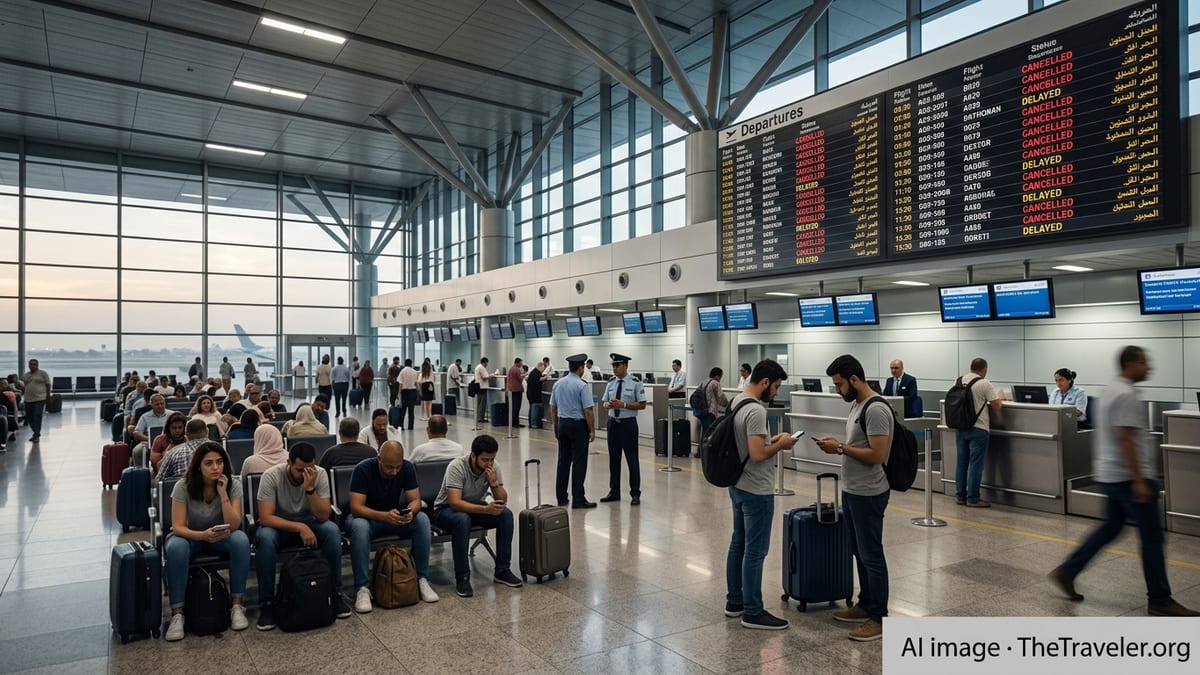
Travelers passing through Cairo International Airport faced extensive disruptions today as publicly available data indicated around 20 flight cancellations and more than 100 delays affecting services operated by EgyptAir, Qatar Airways, Gulf Air, Air Cairo and Emirates on key routes linking Cairo with Doha, Kuwait City, Riyadh, Dubai, Abu Dhabi and other major destinations.
Get the latest news straight to your inbox!
Regional Airspace Turmoil Ripples Into Cairo
The latest disruption at Cairo International Airport is unfolding against a backdrop of continuing airspace restrictions and instability across several Gulf states. Recent advisories and published coverage describe a patchwork of closures and partial reopenings in the skies over the United Arab Emirates, Qatar, Kuwait and neighboring countries, forcing airlines to adapt schedules, reroute aircraft and in some cases temporarily suspend services altogether.
These regional constraints have contributed to operational bottlenecks in Cairo, one of North Africa’s principal aviation hubs and a key gateway between Europe, Africa and the Middle East. Aircraft arriving from or destined for Doha, Dubai, Abu Dhabi, Kuwait City and Riyadh have been particularly vulnerable to cascading delays as carriers navigate longer routings, limited flight corridors and tightened slot availability at already congested airports.
Publicly available flight monitoring boards on Thursday showed EgyptAir, Qatar Airways, Gulf Air, Air Cairo and Emirates among the airlines most affected in Cairo, with cancellations concentrated on high-frequency regional services. Delays stretched from just over an hour to more than five hours on some departures, reflecting the difficulty of restoring regular rotations while airspace and airport capacity in the Gulf remain constrained.
Major Gulf Connections Among Hardest Hit
Routes linking Cairo to the Gulf’s largest hubs, including Doha’s Hamad International Airport and Dubai International Airport, have borne the brunt of the current disruption. Doha in particular has faced continuing operational challenges since Qatari airspace was restricted, with reports indicating that standard commercial traffic only partially resumed under limited safe corridors and priority given to repatriation and essential flights.
Dubai and Abu Dhabi, traditionally among the busiest connecting points for passengers traveling between Africa, Europe and Asia, are also operating with reduced capacity. Recent coverage has described phased resumptions of flights from the United Arab Emirates following earlier near-total suspensions, with carriers like Emirates and Etihad gradually rebuilding networks from a significantly curtailed baseline. The knock-on effects are visible in Cairo in the form of late inbound aircraft, missed connections and day-of-departure schedule changes.
Services to Kuwait City and Riyadh showed similar strain, with some departures from Cairo cancelled outright and others departing hours behind schedule. These city pairs typically handle substantial flows of labor, family and religious travel, meaning any interruption quickly leaves large numbers of passengers in limbo and complicates travel planning across the wider region.
Passengers Confront Long Waits and Last-Minute Changes
For passengers inside Cairo International Airport, the operational picture has translated into crowded departure halls, rolling gate changes and extended waits at check-in and transfer desks. Publicly accessible flight-tracking and airport information screens indicated clusters of delays on regional departures, while some aircraft remained on the ground awaiting updated routing clearances or inbound crews delayed from other disrupted hubs.
Travelers connecting through Cairo from Europe and Africa to Gulf destinations have been particularly exposed, as missed connections often require complex rebooking at a time when spare seats across the network are limited. With airlines trimming frequencies and consolidating flights, same-day alternatives are not always available, leading to overnight stays and, in some instances, multi-day re-accommodations.
Published guidance from travel management companies and industry advisories in recent days has urged passengers with imminent journeys through the Middle East to monitor flight status closely and build additional buffer time into connections. The situation at Cairo illustrates how quickly localized airspace decisions can reverberate across an interconnected schedule, leaving even passengers not originally traveling to or from the most affected airports caught up in the wider disruption.
Operational Strain on EgyptAir, Qatar Airways, Gulf Air and Emirates
The current wave of cancellations and delays is adding further operational strain to airlines that were already working to stabilize their schedules after earlier regional shocks. EgyptAir, which uses Cairo as its primary hub, has had to make day-by-day adjustments to departures serving Gulf capitals, while also managing aircraft and crew rotations for its broader African and European networks.
Qatar Airways continues to operate within the constraints of limited airspace reopening around Doha, focusing on a combination of repatriation services and curtailed commercial operations. Industry trackers and passenger reports indicate that the carrier has repeatedly revised its timetable as regulatory and security conditions evolve, contributing to late-notice changes on Cairo services.
Gulf Air and Emirates have faced similar challenges. Gulf Air’s operations have been heavily affected by restrictions linked to Bahrain’s airspace, while Emirates has been rebuilding its Dubai hub schedule step by step from an earlier period of extensive suspension. Both airlines figure prominently on Cairo’s departure and arrival boards to the Gulf, making their gradual return to fuller operations a key factor in how quickly connectivity from Cairo to regional hubs can normalize.
Outlook: Uncertain Timelines and Advice for Travelers
The outlook for travelers using Cairo International Airport remains uncertain, with the scale and duration of disruptions largely tied to evolving airspace and security conditions across the Middle East. While some carriers have begun adding back limited frequencies and operating special relief or repatriation flights, publicly available information suggests that a full return to pre-disruption schedules on Cairo’s Gulf routes is unlikely in the immediate term.
Travel industry guidance currently emphasizes flexibility and preparedness. Passengers are being encouraged to check their flight status repeatedly in the 24 hours before departure, register for airline notifications and consider alternative routings that avoid the most constrained hubs where possible. For those already in transit, local airport information desks and official airline communication channels remain the primary sources for updated departure times and rebooking options.
As Cairo International Airport works through the backlog created by approximately 20 cancellations and more than 100 delays in this latest episode, the situation underscores the vulnerability of regional air travel to rapid shifts in geopolitical and security conditions. For now, travelers planning to move between Cairo and Gulf cities such as Doha, Kuwait City, Riyadh, Dubai and Abu Dhabi face a travel environment defined by fluid timetables, limited spare capacity and the need for contingency planning.